


Review
doi: 10.1128/JVI.78.19.10213-10220.2004.
Pathogenesis of intestinal and systemic rotavirus infection
Affiliations
- PMID: 15367586
- PMCID: PMC516399
- DOI: 10.1128/JVI.78.19.10213-10220.2004
Item in Clipboard
Review
Pathogenesis of intestinal and systemic rotavirus infection
J Virol.
2004 Oct.
No abstract available
Figures
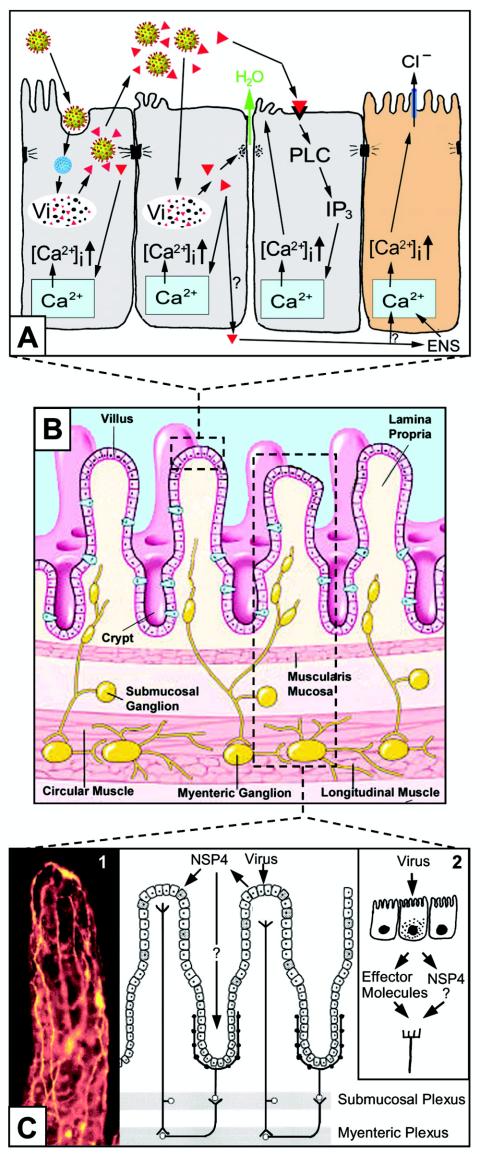
Model of rotavirus-induced diarrhea. Panel A depicts events in the infected epithelium. For clarity, not all events are shown in each cell. The following processes are shown in order from left to right across the four cells. (i) The initial cell is infected by luminal virus, with virus entry and uncoating, formation of a viroplasm (Vi), and the release of virus and viral proteins. NSP4 (red triangles) may be released via a nonclassical secretory pathway. Intracellular NSP4 also induces release of Ca2+ from the internal stores, primarily the endo-plasmic reticulum (blue), increasing [Ca2+]i. (ii) A cell is secondarily infected after virus release from the initial cell. NSP4 produced by the infection disrupts the tight junctions, allowing paracellular flow of water and electrolytes (green arrow). (iii) NSP4 binds to a specific receptor on a cell and triggers a signaling cascade through PLC and IP3 that results in release of Ca2+ and an increase in [Ca2+]i. Intracellular expression of NSP4 does not stimulate PLC. The increase in [Ca2+]i acts to disrupt the microvillar cytoskeleton. (iv) The brown cell represents a crypt cell. It can be acted on directly by NSP4, or NSP4 can stimulate the ENS, which in turn signals an increase in [Ca2+]i that induces Cl− secretion. Panel B shows the normal architecture of the small intestine, with the circulatory system removed for clarity. This panel emphasizes the ENS and its ganglia in the different submucosal levels. (Panel B is adapted from reference , with the permission of M. D. Gershon and the publisher.) Panel C shows a reflex arc in the ENS that can receive signals from the villus epithelium and activate the crypt epithelium. (Adapted from reference , with the permission of L. Svensson and the publisher.) Inset 1 shows a whole mount of an adult mouse small intestinal villus, stained with antibody to protein gene product 9.5 to reveal the rich innervation (yellow stain). (Inset 1 is used by courtesy of R. O. Heuckeroth and with permission.) Inset 2 shows that infected villus enterocytes may stimulate the ENS by the basolateral release of NSP4 or other effector molecules. (Inset 2 is adapted from reference with permission of L. Svensson and the publisher.)
References
-
- Adams, W. R., and L. M. Kraft. 1963. Epizootic diarrheas of infant mice: identification of the etiologic agent. Science 141:359-360. - PubMed
-
- Angel, J., B. Tang, N. Feng, H. B. Greenberg, and D. Bass. 1998. Studies of the role for NSP4 in the pathogenesis of homologous murine rotavirus diarrhea. J. Infect. Dis. 177:455-458. - PubMed
-
- Ball, J. M., P. Tian, C. Q-Y. Zeng, A. P. Morris, and M. K. Estes. 1996. Age-dependent diarrhea induced by a rotavirus nonstructural glycoprotein. Science 272:101-104. - PubMed
-
- Blutt, S. E., C. D. Kirkwood, V. Parreno, K. L. Warfield, M. Ciarlet, M. K. Estes, K. Bok, R. F. Bishop, and M. E. Conner. 2003. Rotavirus antigenaemia and viraemia: a common event? Lancet 362:1445-1449. - PubMed
Publication types
MeSH terms
Grants and funding
LinkOut - more resources
Full Text Sources
Medical
