


Human T-cell leukemia virus type 1 (HTLV-1) and HTLV-2 tax oncoproteins modulate cell cycle progression and apoptosis
- PMID: 15367606
- PMCID: PMC516438
- DOI: 10.1128/JVI.78.19.10399-10409.2004
Human T-cell leukemia virus type 1 (HTLV-1) and HTLV-2 tax oncoproteins modulate cell cycle progression and apoptosis
Abstract
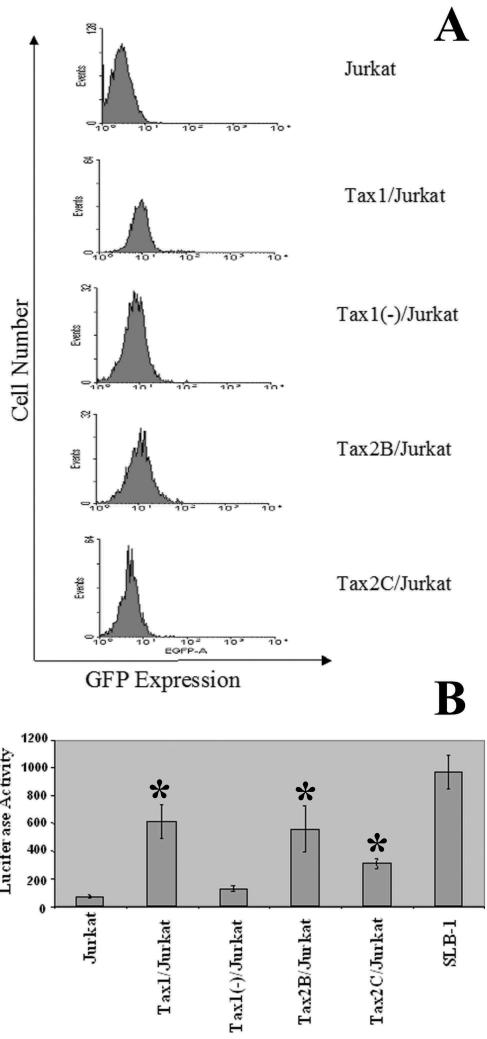
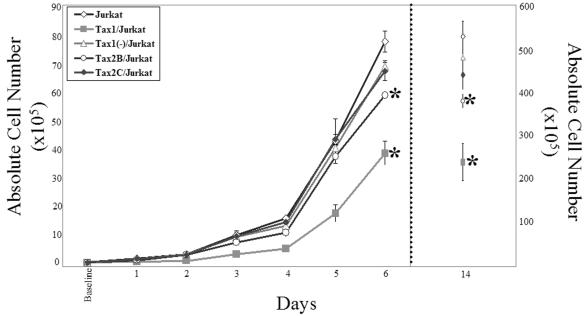
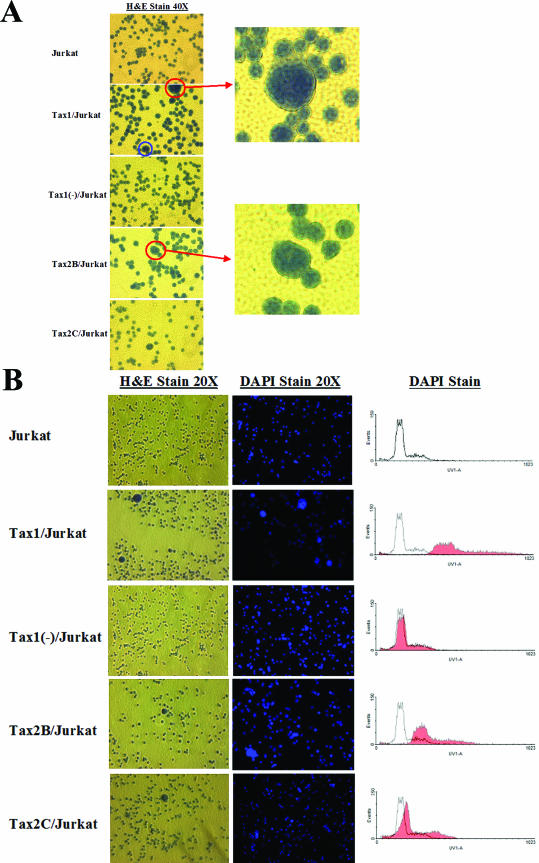
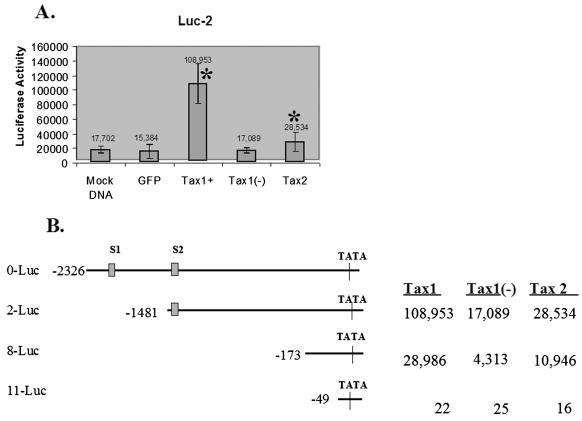
Human T-cell leukemia virus type 1 (HTLV-1) is the etiologic agent of adult T-cell leukemia and lymphoma, an aggressive clonal malignancy of human CD4-bearing T lymphocytes. HTLV-2, although highly related to HTLV-1 at the molecular level, has not been conclusively linked to development of lymphoproliferative disorders. Differences between the biological activities of the respective tax gene products (Tax1 and Tax2) may be one factor which accounts for the differential pathogenicities associated with infection. To develop an in vitro model to investigate and compare the effects of constitutive expression of Tax1 and Tax2, Jurkat T-cell lines were infected with lentivirus vectors encoding Tax1 and Tax2 in conjunction with green fluorescent protein, and stably transduced clonal cell lines were generated by serial dilution in the absence of drug selection. Jurkat cells that constitutively express Tax1 and Tax2 (Tax1/Jurkat and Tax2/Jurkat, respectively) showed notably reduced kinetics of cellular replication, and Tax1 inhibited cellular replication to a higher degree in comparison to Tax2. Tax1 markedly activated transcription from the cdk inhibitor p21(cip1/waf1) promoter in comparison to Tax2, suggesting that upregulation of p21(cip1/waf1) may account for the differential inhibition of cellular replication kinetics displayed by Tax1/Jurkat and Tax2/Jurkat cells. The presence of binucleated and multinucleated cells, reminiscent of large lymphocytes with cleaved or cerebriform nuclei often seen in HTLV-1- and -2-seropositive patients, was noted in cultures expressing Tax1 and Tax2. Although Tax1 and Tax2 expression mediated elevated resistance to apoptosis in Jurkat cells after serum deprivation, Tax1 was unique in protection from apoptosis after exposure to camptothecin and etoposide, inhibitors of topoisomerase I and II, respectively. Characterization of the unique phenotypes displayed by Tax1 and Tax2 in vitro will provide information as to the relative roles of these oncoproteins and their contribution to HTLV-1 and -2 pathogenesis in vivo.
Figures
References
-
- Akagi, T., H. Ono, and K. Shimotohno. 1996. Expression of cell-cycle regulatory genes in HTLV-1-infected T-cell lines: possible involvement of Tax1 in the altered expression of cyclin D2, p18Ink4, and p21Waf1/Cip1/Sdi1. Oncogene 12:1645-1652. - PubMed
-
- Ariumi, Y., A. Kaida, J. Y. Lin, M. Hirota, O. Masui, S. Yamaoka, Y. Taya, and K. Shimotohno. 2000. HTLV-1 tax oncoprotein represses the p53-mediated trans-activation function through coactivator CBP sequestration. Oncogene 19:1491-1499. - PubMed
-
- Buchschacher, G. L., Jr., and F. Wong-Staal. 2000. Development of lentiviral vectors for gene therapy for human diseases. Blood 95:2499-2504. - PubMed
-
- Burns, J. C., T. Friedmann, W. Driever, M. Burrascano, and J. K. Yee. 1993. Vesicular stomatitis virus G glycoprotein pseudotyped retroviral vectors: concentration to very high titer and efficient gene transfer into mammalian and nonmammalian cells. Proc. Natl. Acad. Sci. USA 90:8033-8037. - PMC - PubMed
Publication types
MeSH terms
Substances
Grants and funding
LinkOut - more resources
Full Text Sources
Other Literature Sources
Research Materials
