


Phosphorylation of C/EBPbeta at a consensus extracellular signal-regulated kinase/glycogen synthase kinase 3 site is required for the induction of adiponectin gene expression during the differentiation of mouse fibroblasts into adipocytes
- PMID: 15367685
- PMCID: PMC516726
- DOI: 10.1128/MCB.24.19.8671-8680.2004
Phosphorylation of C/EBPbeta at a consensus extracellular signal-regulated kinase/glycogen synthase kinase 3 site is required for the induction of adiponectin gene expression during the differentiation of mouse fibroblasts into adipocytes
Abstract
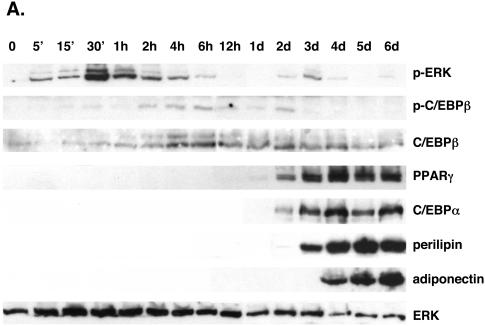
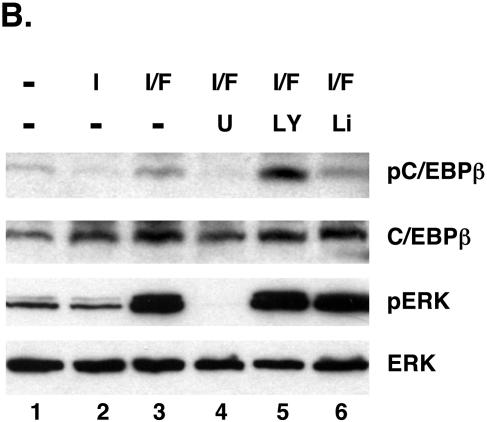
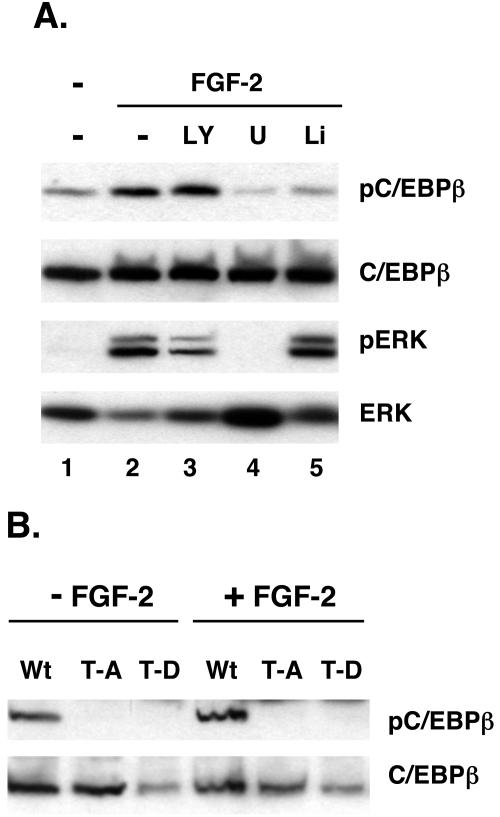
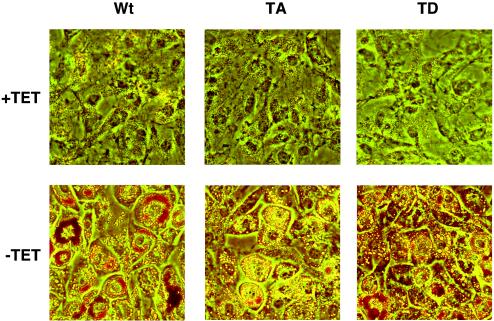
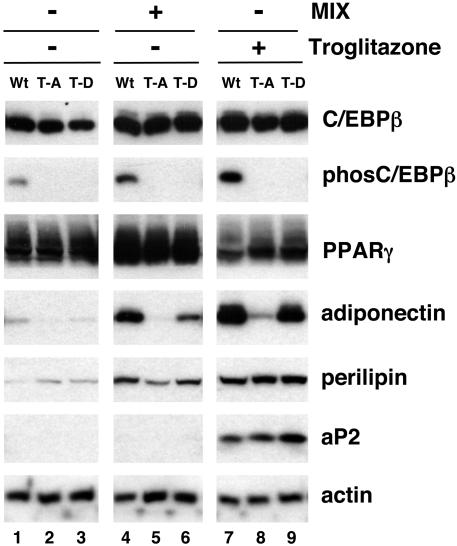
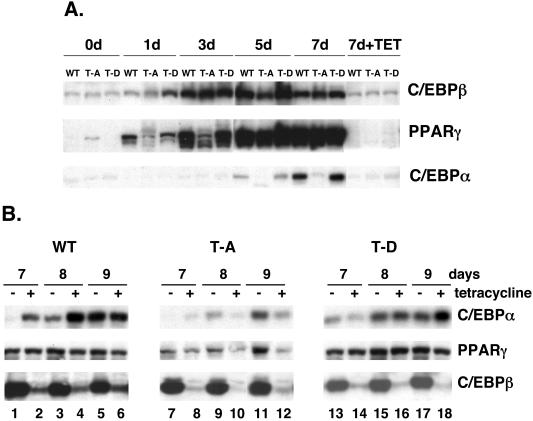
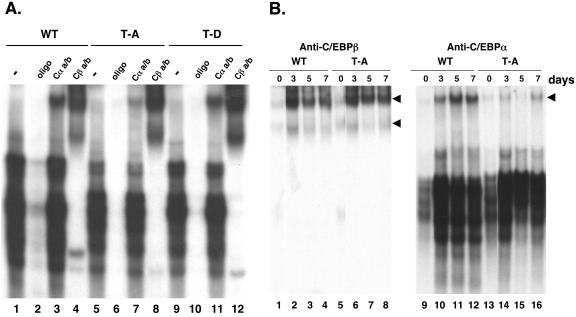
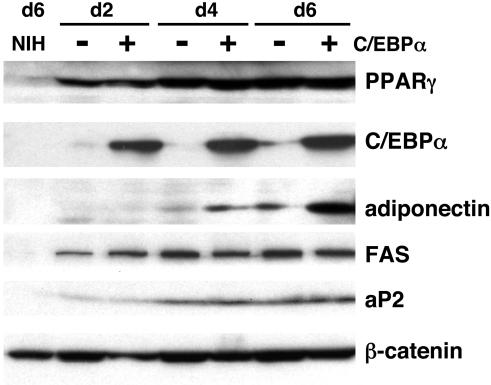
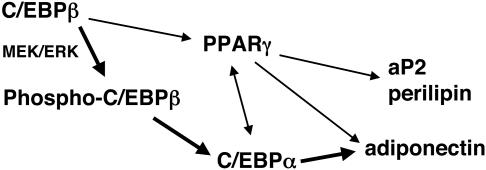
Stimulation of adipogenesis in mouse preadipocytes requires C/EBPbeta as well as activation of the MEK/extracellular signal-regulated kinase (ERK) signaling pathway. In this study, we demonstrate that phosphorylation of C/EBPbeta at a consensus ERK/glycogen synthase kinase 3 (GSK3) site regulates adiponectin gene expression during the C/EBPbeta-facilitated differentiation of mouse fibroblasts into adipocytes. First, we show that exposure of 3T3-L1 preadipocytes to insulin, dexamethasone (DEX), and isobutylmethylxanthine (MIX) leads to the phosphorylation of C/EBPbeta at threonine 188. Pretreating the cells with a MEK1-specific inhibitor (U0126) significantly attenuates this activity. Similarly, these effectors activate the phosphorylation of T188 within an ectopic C/EBPbeta overexpressed in Swiss mouse fibroblasts, and this event involves both MEK1 and GSK3 activity. We further show that expression of C/EBPbeta (p34kD LAP isoform) in Swiss mouse fibroblasts exposed to DEX, MIX, and insulin induces expression of peroxisome proliferator-activated receptor gamma (PPARgamma) and some adiponectin but that it does not activate expression of FABP4/aP2. In fact, complete conversion of these fibroblasts into lipid-laden adipocytes, which includes activation of FABP4 and adiponectin expression, requires their exposure to a potent PPARgamma ligand such as troglitazone. Expression of a mutant C/EBPbeta in which threonine 188 has been modified to alanine (C/EBPbeta T188A) can induce PPARgamma production in the mouse fibroblasts, but it is incapable of stimulating adiponectin expression in the absence or presence of troglitazone. Interestingly, replacement of T188 with aspartic acid creates a C/EBPbeta molecule (C/EBPbeta T188D) that possesses adipogenic activity similar to that of the wild-type molecule. The absence of adiponectin expression correlates with a reduced amount of C/EBPalpha in the adipocytes expressing the T188A mutant suggesting that C/EBPalpha is required for expression of adiponectin. In fact, ectopic expression of PPARgamma in C/EBPalpha-deficient fibroblasts (NIH 3T3 cells) produces a modest amount of adiponectin, whereas expression of both PPARgamma and C/EBPalpha in NIH 3T3 cells facilitates production of abundant quantities of adiponectin. These data demonstrate that phosphorylation of C/EBPbeta at a consensus ERK/GSK3 site is required for both C/EBPalpha and adiponectin gene expression during the differentiation of mouse fibroblasts into adipocytes.
Figures
References
-
- An, M. R., C. C. Hsieh, P. D. Reisner, J. P. Rabek, S. G. Scott, D. T. Kuninger, and J. Papaconstantinou. 1996. Evidence for posttranscriptional regulation of C/EBPα and C/EBPβ isoform expression during the lipopolysaccharide-mediated acute-phase response. Mol. Cell. Biol. 16:2295-2306. - PMC - PubMed
-
- Barak, Y., M. C. Nelson, E. S. Ong, Y. Z. Jones, P. Ruiz-Lozano, K. R. Chien, A. Koder, and R. M. Evans. 1999. PPARγ is required for placental, cardiac, and adipose tissue development. Mol. Cell 4:585-595. - PubMed
-
- Buck, M., V. Poli, T. Hunter, and M. Chojkier. 2001. C/EBPβ phosphorylation by RSK creates a functional XEXD caspase inhibitory box critical for cell survival. Mol. Cell 8:807-816. - PubMed
-
- Buck, M., V. Poli, P. van der Geer, M. Chojkier, and T. Hunter. 1999. Phosphorylation of rat serine 105 or mouse threonine 217 in C/EBP beta is required for hepatocyte proliferation induced by TGFα. Mol. Cell 4:1087-1092. - PubMed
Publication types
MeSH terms
Substances
Grants and funding
LinkOut - more resources
Full Text Sources
Molecular Biology Databases
Research Materials
Miscellaneous
