


Species-specific variation in the importance of the spectral quality gradient in canopies as a signal for photosynthetic resource partitioning
- PMID: 15374835
- PMCID: PMC4242218
- DOI: 10.1093/aob/mch197
Species-specific variation in the importance of the spectral quality gradient in canopies as a signal for photosynthetic resource partitioning
Abstract
Background and aims: Plants adjust the distribution of photosynthetic capacity and chlorophyll to canopy density. The importance of the gradient in the red : far-red ratio (R : FR) relative to the irradiance gradient was studied for its perception with respect to this partitioning of photosynthetic resources. Whether the relative importance of these two signals varied between six species of different growth habit (Phaseolus vulgaris, Lysimachia vulgaris, Hedera helix, Ficus benjamina, Carex acutiformis and Brachypodium pinnatum) was investigated further.
Methods: Single leaves of plants were shaded in daylight by a spectrally neutral filter or a leaf. In another experiment, leaves were treated with supplemental FR. In most cases, treatment effects were evaluated after 2 weeks.
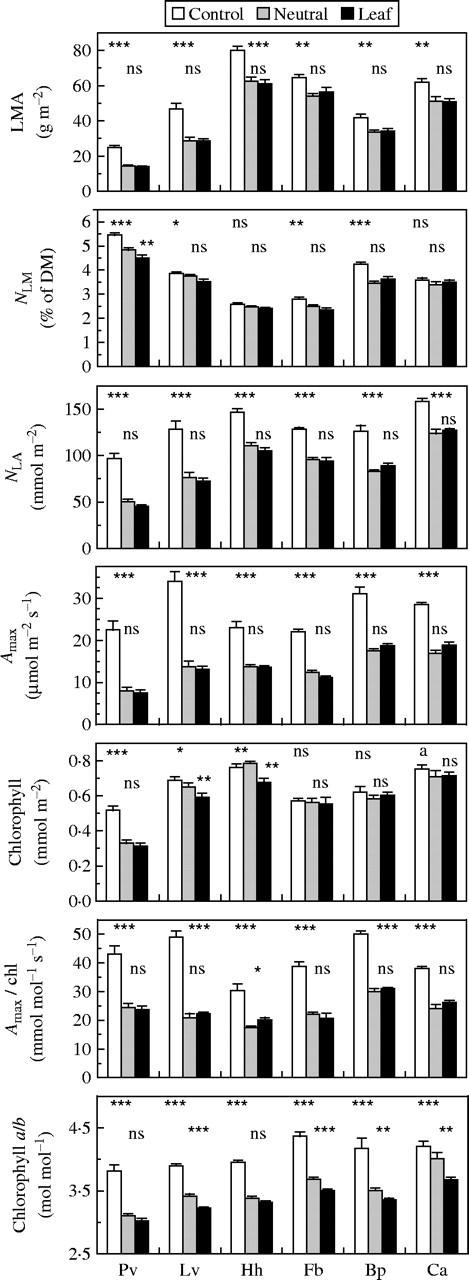
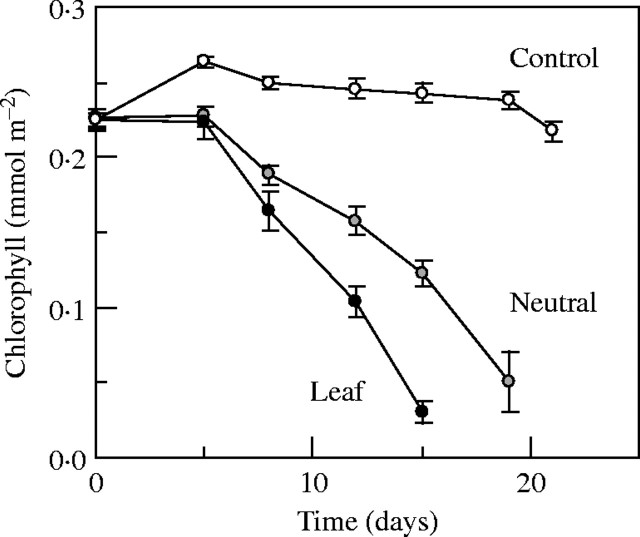
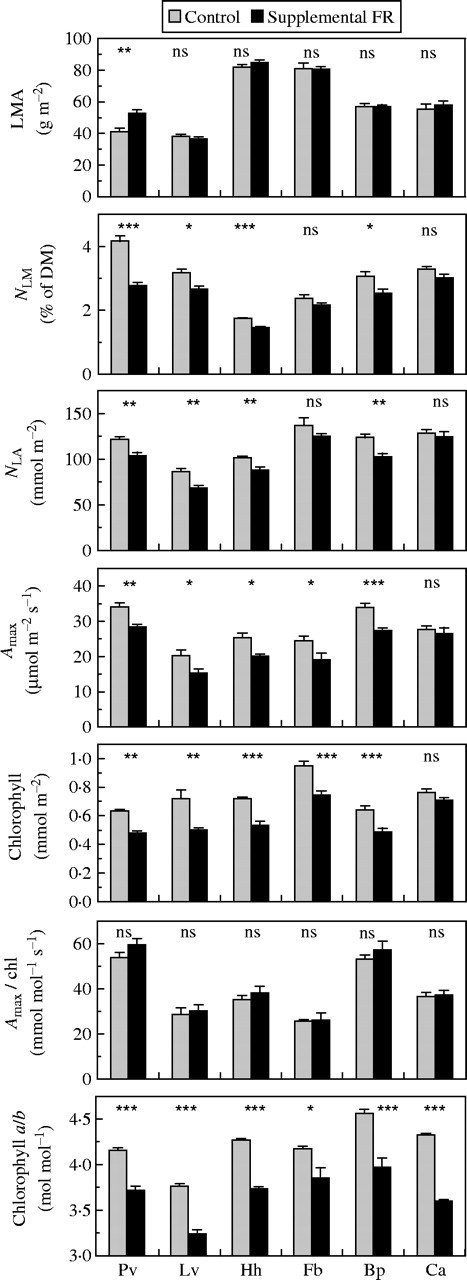
Key results: Nitrogen and photosynthetic capacity (Amax) per leaf area, parameters pertaining to between-leaf resource partitioning, were strongly reduced in neutral shade but not additionally by spectral leaf shade. Supplemental FR reduced these parameters also, except in Carex. Acceleration of induction of senescence was observed in spectral leaf shade in primary bean leaves. Amax per unit chlorophyll, a parameter pertaining to within-leaf resource partitioning, was reduced in neutral shade, but not in spectral leaf shade or supplemental FR.
Conclusions: Signalling mechanisms associated with perception of the R : FR gradient in canopies were less important than those associated with the irradiance gradient for between-leaf and within-leaf partitioning of photosynthetic resources. The relative importance of the signals differed between species because Carex was the only species for which no indications were found for an involvement of the spectral gradient in perception of canopy density.
Figures
References
-
- Anderson JM, Chow WS, Park YI. 1995. The grand design of photosynthesis: acclimation of the photosynthetic apparatus to environmental cues. Photosynthesis Research 46: 129–139. - PubMed
-
- Anten NPR, Miyazawa K, Hikosaka K, Nagashima H, Hirose T. 1998. Leaf nitrogen distribution in relation to leaf age and photon flux density in dominant and subordinate plants in dense stands of a dicotyledonous herb. Oecologia 113: 314–324. - PubMed
-
- Anten NPR, Hikosaka K, Hirose T. 2000. Nitrogen utilisation and the photosynthetic system. In: Marshall B, Roberts JA, eds. Leaf development and canopy growth. Sheffield: Sheffield Academic Press, 171–203.
-
- Ballaré CL. 1999. Keeping up with neighbours: phytochrome sensing and other signalling mechanisms. Trends in Plant Science 4: 97–102. - PubMed
-
- Ballaré CL, Scopel AL, Sánchez RA. 1990. Far-red radiation reflected from adjacent leaves – an ealy signal of competition in plant canopies. Science 247: 329–332. - PubMed
