


doi: 10.1128/JB.186.19.6651-6655.2004.
Importance of Rhodospirillum rubrum H(+)-pyrophosphatase under low-energy conditions
Affiliations
- PMID: 15375148
- PMCID: PMC516592
- DOI: 10.1128/JB.186.19.6651-6655.2004
Item in Clipboard
Importance of Rhodospirillum rubrum H(+)-pyrophosphatase under low-energy conditions
J Bacteriol.
2004 Oct.
Abstract
The physiological role of the membrane-bound pyrophosphatase of Rhodospirillum rubrum was investigated by the characterization of a mutant strain. Comparisons of growth levels between the wild type and the mutant under different low-potential conditions and during transitions between different metabolisms indicate that this enzyme provides R. rubrum with an alternative energy source that is important for growth in low-energy states.
Figures
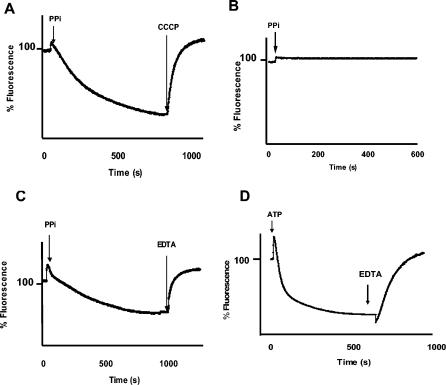
ΔpH in chromatophores of the different strains. Assay conditions were a solution containing 2 mM Tris-HCl (pH 7.4), 0.25 M trehalose, 0.2 M choline chloride, 5 mM MgCl2, 3 μM acridine orange, and 0.5 mg of protein/ml of chromatophores and a temperature of 25°C. The reaction was initiated by the addition of 1 mM PPi (A to C) or 2 mM ATP (D). Gradients were collapsed by the addition of 2.5 μM carbonyl cyanide m-chlorophenylhydrazone (CCCP) (A) or 5 mM EDTA (C and D). Excitation and emission wavelengths were set at 495 and 540 nm, respectively. (A to C) PPi-dependent ΔpH in the wild type (A), the RG1 mutant (B), and RG1-P1 (complemented mutant) (C); (D) ATP-dependent ΔpH in RG1.
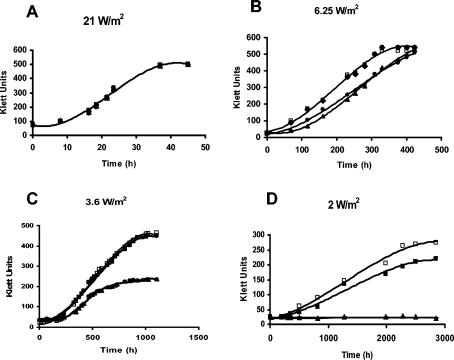
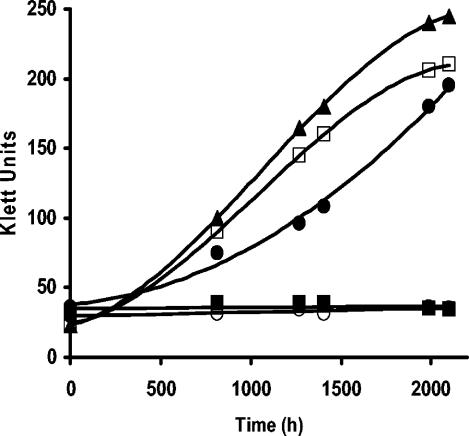
Effect of decreasing light intensity on photosynthetic growth of R. rubrum strains. Bacteria were grown in high light intensity before being subcultured and transferred to different light intensities. Light intensity was measured with a YSI-Kettering model 65A radiometer (Yellow Springs Instrument Co., Yellow Springs, Ohio) and was adjusted by rheostat control of two tungsten 40-W lamps at a 30-cm distance. □, wild type; •, RG1 mutant; ▪, RG1-P1 (complemented mutant); ▴, RG1-P (mutant with empty vector). Growth curves are representative of the results of one of at least four identical experiments.
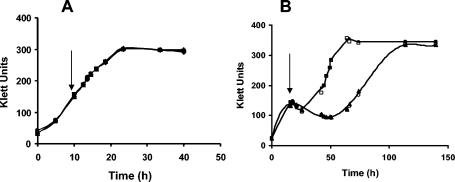
Effect of metabolic shifts in the growth of R. rubrum strains. (A) Photosynthetic to respiratory metabolic shift; (B) respiratory to photosynthetic metabolic shift. To adapt bacteria to the first metabolism, they were subcultivated in it three times before the experiment. The experiment started when the bacteria were transferred to a fresh medium under the same metabolic condition. When the culture reached the early exponential phase, the metabolic shift was imposed (arrow), and it continued until the stationary phase was achieved. Light intensity was 21 W/m2. □, wild type; ○, RG1 mutant; ▪, RG1-P1 (complemented mutant); ▴, RG1-P (mutant with an empty vector).
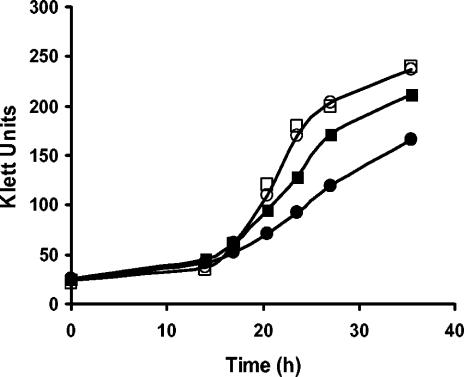
Effect of oxygen tension in aerobic growth of R. rubrum strains. Bacteria were grown in the dark with continuous shaking in a TS Autoflow CO2/O2 incubator (NuAire, Inc). Oxygen levels were controlled by injecting air and N2. Open symbols, 21% O2; filled symbols, 10% O2; ▪, wild type; •, RG1 mutant.
Photosynthetic growth of different species of purple nonsulfur bacteria at a light intensity of 2 W/m2. The species for this experiment were selected based on the presence (□, R. rubrum; •, Rhodopseudomonas palustris; and ▴, Rhodomicrobium vannielii) or absence (○, Rhodobacter sphaeroides, and ▪, Rhodobacter capsulatus) of H+PPase in them.
References
-
- Baltscheffsky, H., L. V. von Stedingk, H. W. Heldt, and M. Klingenberg. 1966. Inorganic pyrophosphate: formation in bacterial photophosphorylation. Science 153:1120-1122. - PubMed
-
- Baykov, A. A., N. V. Sergina, O. A. Evtushenko, and E. B. Dubnova. 1996. Kinetic characterization of the hydrolytic activity of the H+ pyrophosphatase of Rhodospirillum rubrum in membrane-bound and isolated states. Eur. J. Biochem. 236:121-127. - PubMed
-
- Celis, H., and I. Romero. 1987. The phosphate-pyrophosphate exchange and hydrolytic reactions of the membrane-bound pyrophosphatase of Rhodospirillum rubrum: effects of pH and divalent cations. J. Bioenerg. Biomembr. 19:255-272. - PubMed
-
- Celis, H., B. Franco, S. Escobedo, and I. Romero. 2003. Rhodobacter sphaeroides has a family II pyrophosphatase. Comparison with other species of photosynthetic bacteria. Arch. Microbiol. 179:368-376. - PubMed
Publication types
MeSH terms
Substances
LinkOut - more resources
Full Text Sources
Molecular Biology Databases
