


Chronometric readout from a memory trace: gamma-frequency field stimulation recruits timed recurrent activity in the rat CA3 network
- PMID: 15375190
- PMCID: PMC1665348
- DOI: 10.1113/jphysiol.2004.066639
Chronometric readout from a memory trace: gamma-frequency field stimulation recruits timed recurrent activity in the rat CA3 network
Abstract
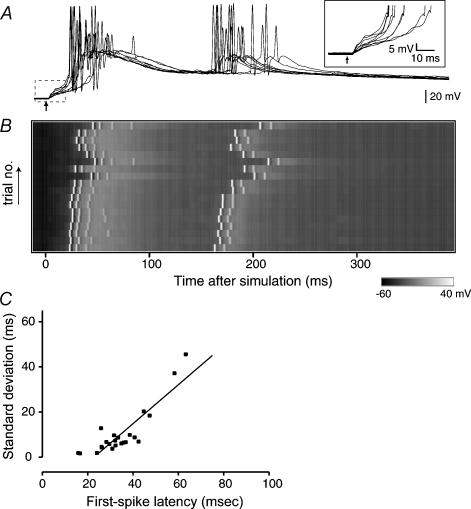
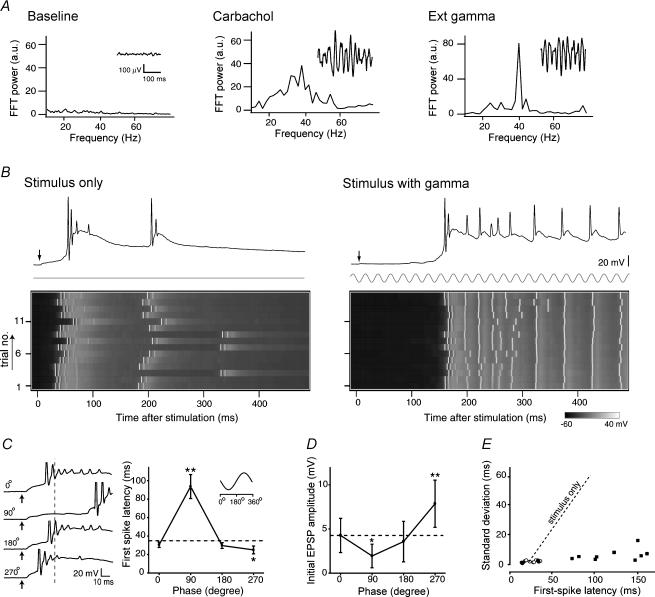
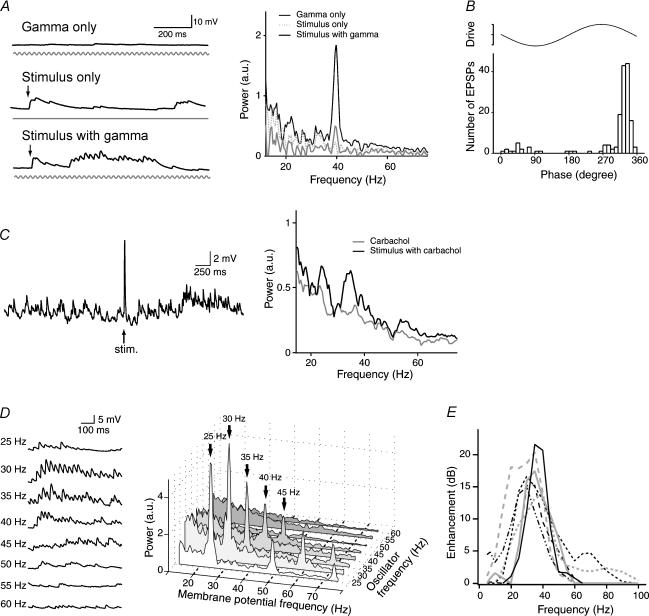
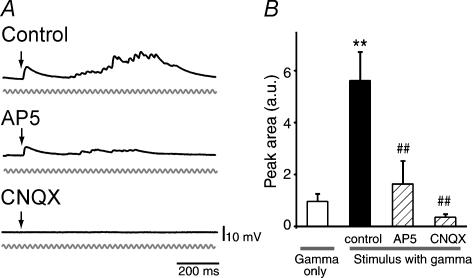
Synchronous population activity is prevalent in neurones of the central nervous system and experimentally captured as oscillatory electric fields, the frequency of which can represent the state of the neural circuit, e.g. theta (approximately 5 Hz) and gamma (approximately 40 Hz). Such field oscillations, however, are not merely a result of coherent neuronal activity. They may also play active roles in information processing in the brain. In this study, we observed that, in cultured hippocampal slices, CA3 pyramidal cells responded to single-pulse stimuli with monosynaptic and polysynaptic potentials and firing spikes which occurred after variable latencies. The variability of the spike latencies was greatly reduced in the presence of weak electric field oscillations, especially the oscillation in the gamma-band frequency range, that per se induced only small fluctuations in the subthreshold membrane potential, and this effect was inhibited by blockade of NMDA receptor activity. Furthermore, the latency of the firing spikes changed if the stimulus was applied at a different phase of the imposed gamma oscillations. These results may suggest that the background field oscillations serve as an extracellular time reference and assure accurate and stable decoding of a memory trace present in cortical feedback networks.
Figures
References
-
- Amaral DG, Witter MP. The 3-dimensional organization of the hippocampal-formation – a review of anatomical data. Neuroscience. 1989;31:571–591. - PubMed
-
- Amit DJ, Brunel N. Dynamics of a recurrent network of spiking neurons before and following learning. Network. 1997;8:373–404.
-
- Brody CD, Hopfield JJ. Simple networks for spike-timing-based computation, with application to olfactory processing. Neuron. 2003;37:843–852. - PubMed
MeSH terms
Substances
LinkOut - more resources
Full Text Sources
Miscellaneous
