


Review
doi: 10.1104/pp.104.048579.
Weeds, worms, and more. Papain's long-lost cousin, phytochelatin synthase
Affiliations
- PMID: 15375203
- PMCID: PMC523314
- DOI: 10.1104/pp.104.048579
Item in Clipboard
Review
Weeds, worms, and more. Papain's long-lost cousin, phytochelatin synthase
Plant Physiol.
2004 Sep.
No abstract available
Figures
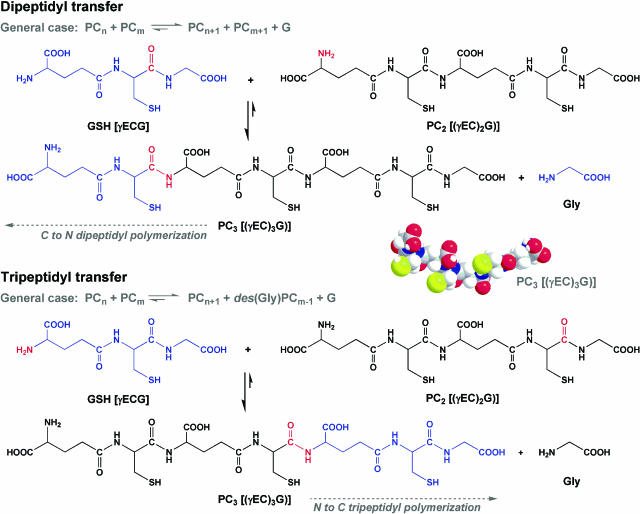
PC synthase-catalyzed synthesis of PC3 from GSH and PC2 by dipeptidyl transfer or tripeptidyl transfer. In dipeptidyl transfer, PC chain extension proceeds in the C to N direction and is not associated with the production of des(Gly)PCs, according to the general equation PCn + PCm → PCn+1 + PCm−1, where PC1 = GSH. In tripeptidyl transfer, PC chain extension proceeds in the N to C direction and is associated with the production of des(Gly)PCs according to the general equation PCn + PCm → PCn+1 + des(Gly)PCm−1 + G, where des(Gly)PC1 = γ-Glu-Cys. Also shown is a space-filling model of PC3—gray, white, red, blue, and yellow spheres denote C, H, O, N, and S atoms, respectively.
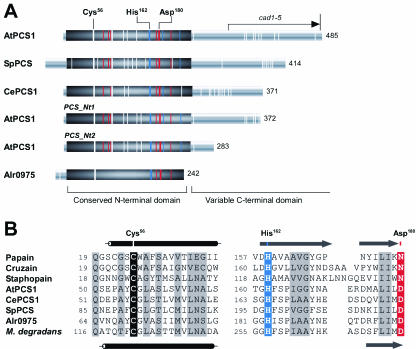
A, Comparison of PC synthase polypeptides and their derivatives from different organisms. The examples shown are the full-length PC synthase polypeptides from Arabidopsis (AtPCS1), S. pombe (SpPCS), C. elegans (CePCS1), and Nostoc sp. PCC 7120 (Alr0975) and the two truncated derivatives of V8 protease-digested native AtPCS1 (PCS_Nt1 and PCS_Nt2). The approximate positions of all Cys residues are indicated by white vertical bars, and of the conserved His and Asp residues in the N-terminal domain by blue and red bars, respectively. AtPCS1 residues Cys-56, His-162, and Asp-180 are the three residues that are conserved in all known PC synthases and align with the catalytic triad residues of members of the papain family of Cys proteases. Also shown is the position of the Arabidopsis cad1-5 nonsense mutation. Numbers on the right denote total number of residues in each polypeptide. This figure is essentially an update of Figure 2 from Cobbett (2000). B, Alignment of papain superfamily polypeptides of known structure (papain, PDB code 1PE6; cruzain, 1AIM; staphopain, 1CV8) with AtPCS1, CePCS1, SpPCS, Alr0975, and the Microbulbifer degradans PC synthase homolog (GenBank ID 48861977) in the vicinity of the catalytic triad residues shown in A. Other residues that are also reasonably conserved among all of the sequences are shaded in gray. Shown above the alignment is the actual secondary structure of staphopain A. Shown below the alignment is the predicted secondary structure for AtPCS1. Cylinders, α-helix; arrows, β-sheet.
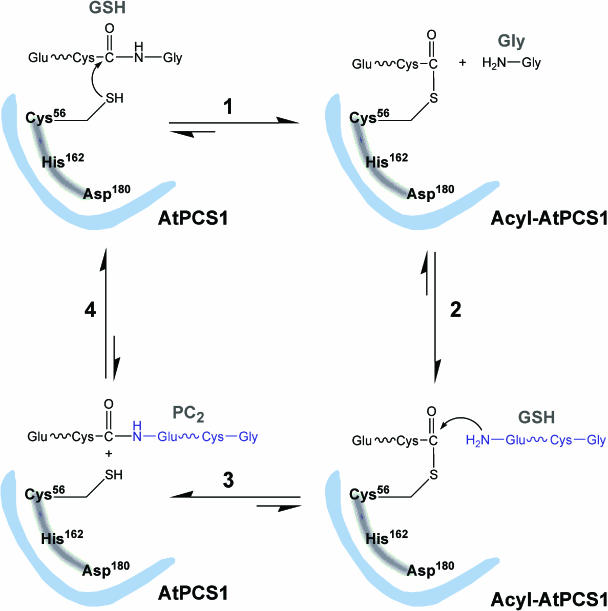
Tentative catalytic mechanism of PC synthase based on the results of kinetic analyses, measurements of acylation of the enzyme, site-directed mutagenesis, and the mechanism of distantly homologous Cys proteases of the papain superfamily. Refer to the main body of the text for detailed description. ∼∼, γ-peptidyl bond between Glu and Cys residues in GSH substrate.
References
-
- Al-Lahman A, Rohde V, Heim P, Leughter R, Veeck J, Wunderlich C, Wolf K, Zimmermann M (1999) Biosynthesis of phytochelatin in the fission yeast. Phytochelatin synthesis: a second role for the glutathione synthetase gene of Schizosaccharomyces pombe. Yeast 15: 385–396 - PubMed
-
- Barrett AJ, Rawlings ND (2001) Evolutionary lines of cysteine proteases. Biol Chem 382: 727–733 - PubMed
-
- Beck A, Lendzian K, Oven M, Christmann A, Grill E (2003) Phytochelatin synthase catalyzes key step in turnover of glutathione conjugates. Phytochemistry 62: 423–431 - PubMed
-
- Brennan RJ, Schiestl RH (1996) Cadmium is an inducer of oxidative stress in yeast. Mutat Res 356: 171–178 - PubMed
-
- Cheah E, Austin C, Ashley GW, Ollis D (1993) Substrate-induced activation of dienelactone hydrolase: an enzyme with a naturally occurring Cys-His-Asp triad. Protein Eng 6: 575–583 - PubMed
Publication types
MeSH terms
Substances
LinkOut - more resources
Full Text Sources
Other Literature Sources
