. 2004 Oct;16(10):2683-92.
doi: 10.1105/tpc.104.024398. Epub 2004 Sep 17.

The plant-specific cyclin-dependent kinase CDKB1;1 and transcription factor E2Fa-DPa control the balance of mitotically dividing and endoreduplicating cells in Arabidopsis

Affiliations

The plant-specific cyclin-dependent kinase CDKB1;1 and transcription factor E2Fa-DPa control the balance of mitotically dividing and endoreduplicating cells in Arabidopsis

Véronique Boudolf et al. Plant Cell. 2004 Oct.

Abstract

Transgenic Arabidopsis thaliana plants overproducing the E2Fa-DPa transcription factor have two distinct cell-specific phenotypes: some cells divide ectopically and others are stimulated to endocycle. The decision of cells to undergo extra mitotic divisions has been postulated to depend on the presence of a mitosis-inducing factor (MIF). Plants possess a unique class of cyclin-dependent kinases (CDKs; B-type) for which no ortholog is found in other kingdoms. The peak of CDKB1;1 activity around the G2-M boundary suggested that it might be part of the MIF. Plants that overexpressed a dominant negative allele of CDKB1;1 underwent enhanced endoreduplication, demonstrating that CDKB1;1 activity was required to inhibit the endocycle. Moreover, when the mutant CDKB1;1 allele was overexpressed in an E2Fa-DPa-overproducing background, it enhanced the endoreduplication phenotype, whereas the extra mitotic cell divisions normally induced by E2Fa-DPa were repressed. Surprisingly, CDKB1;1 transcription was controlled by the E2F pathway, as shown by its upregulation in E2Fa-DPa-overproducing plants and mutational analysis of the E2F binding site in the CDKB1;1 promoter. These findings illustrate a cross talking mechanism between the G1-S and G2-M transition points.


Figures
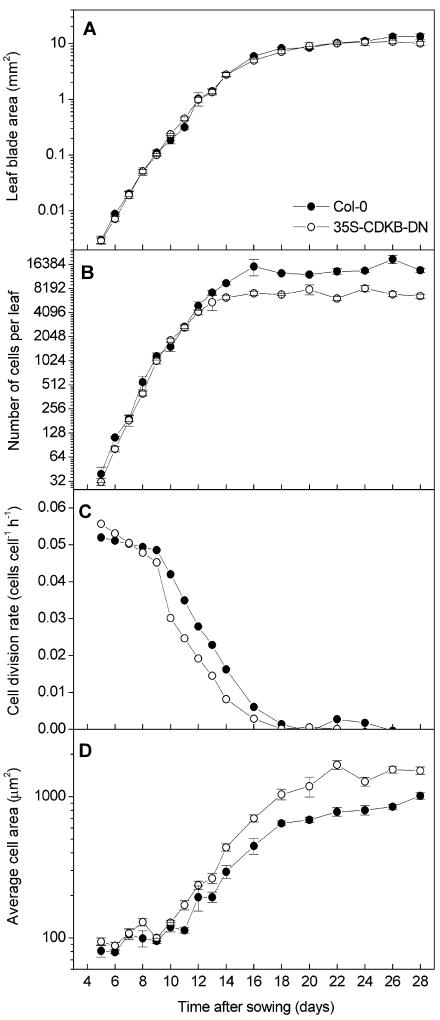
Figure 1.
Figure 1.
Kinematic Analysis of Leaf Growth of the First Leaf Pair of Wild-Type Columbia-0 and CDKB1;1.N161-Overproducing Plants. (A) Leaf blade area. Col-0, Columbia-0. (B) Epidermal cell number on the abaxial side of the leaf. (C) Average cell division rates of the epidermal cells on the abaxial side of the leaf. (D) Epidermal cell size on the abaxial side of the leaf. Error bars denote standard errors (n = 4 to 10). Symbols in (B), (C), and (D) as in (A).
Figure 2.
Figure 2.
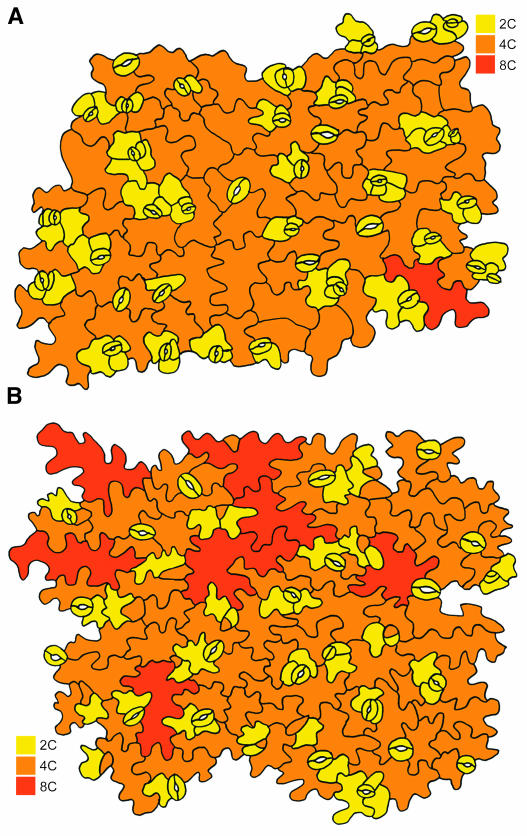
Abaxial Epidermal Peel of the First Leaves 14 d after Germination. (A) Wild-type plants. (B) Plants overexpressing CDKB1;1.N161. The ploidy level of the cells is indicated by color according to the legend.
Figure 3.
Figure 3.
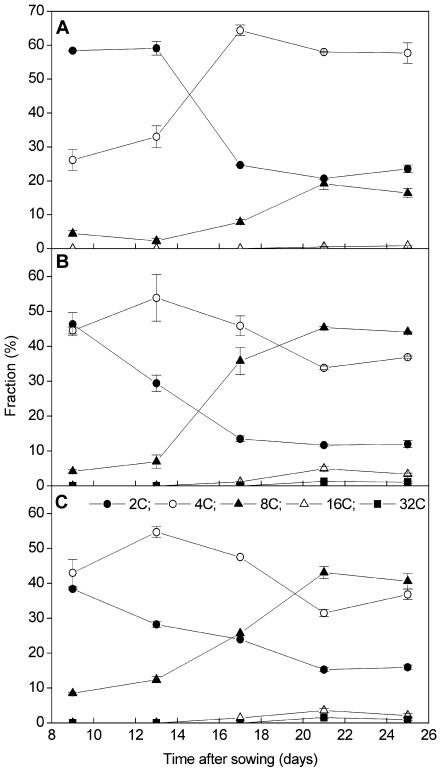
DNA Ploidy Level Distribution of the First Leaves of Wild-Type (Col-0) and CDKB1;1.N161-Overproducing Plants during Development. (A) Wild type (Col-0). (B) CaMV35S:CDKB1;1.N161 line 1.2. (C) CaMV35S:CDKB1;1.N161 line 9.2. Leaves were harvested at the indicated time points. Data represent average ± sd. Symbols in (A) and (B) as in (C).
Figure 4.
Figure 4.
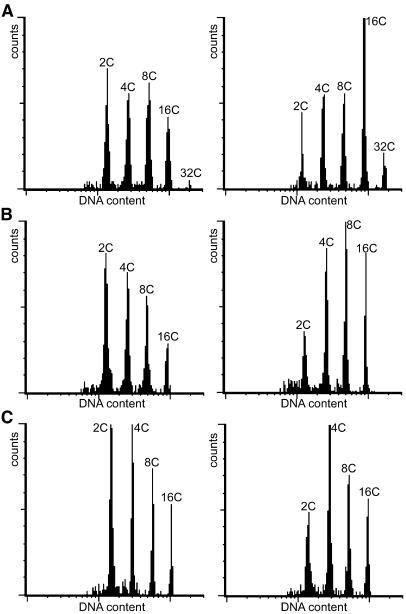
DNA Ploidy Level Distribution of Wild-Type Plants (Col-0; Left) and CDKB1;1.N161-Overproducing Plants (Right) in Different Tissues. (A) Cotyledons. (B) Hypocotyls. (C) Roots.
Figure 5.
Figure 5.
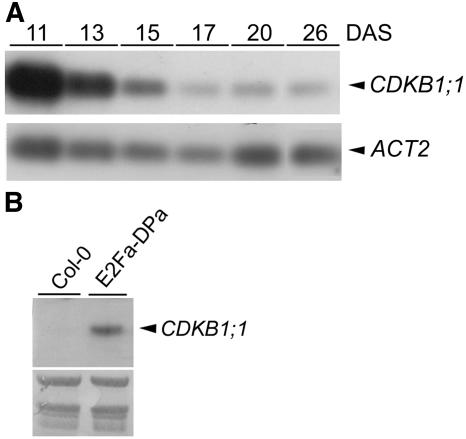
Expression Analysis of the CDKB1;1 Gene. (A) Transcript levels of CDKB1;1 during leaf development. cDNA prepared from the first leaf pair harvested at the indicated time points was subjected to semiquantitative RT-PCR analysis with gene-specific primers. The actin 2 (ACT2) gene was used as loading control. DAS, days after sowing. (B) RNA gel blot analysis of CDKB1;1. RNA was extracted from 12-d-old control (Col-0) and E2Fa-DPa seedlings. Equal loading of the gel was confirmed by methylene blue staining of the membrane (bottom panel).
Figure 6.
Figure 6.
Drawing-Tube Images of Wild-Type and Transgenic Plants. (A) Wild type (Col-0). (B) CaMV35S:CDKB1;1N161 × Col-0. (C) Col-0 × CaMV35S:E2Fa-DPa. (D) CaMV35S:CDKB1;1.N161 × CaMV35S:E2Fa-DPa.
Figure 7.
Figure 7.
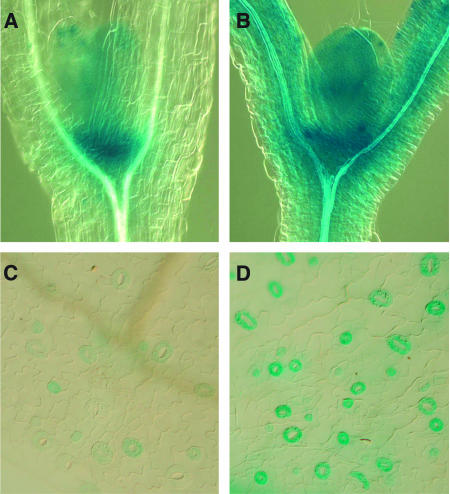
Activity of the CDKB1;1 Promoter Fused to the GUS Reporter (pCDKB;1:GUS) in Wild-Type (Col-0) and E2Fa-DPa–Overexpressing Plants Visualized by Histochemical Staining. (A) GUS activity in the shoot apex of untransformed plants. (B) GUS activity in the shoot apex of E2Fa-DPa transgenic plants. (C) GUS activity in stomata of untransformed plants. (D) GUS activity in stomata of E2Fa-DPa transgenic plants.
Figure 8.
Figure 8.
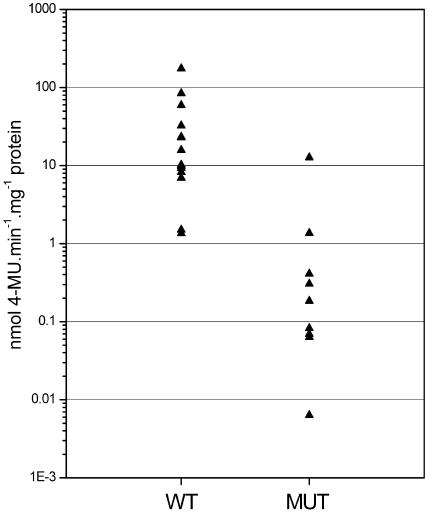
Quantification of Wild-Type and Mutant CDKB1;1 Promoter Activity. GUS activity was measured fluorometrically in protein extracts prepared from transgenic BY-2 cells transformed with the wild type (n = 14) or mutant (MUT; n = 14) CDKB1;1 promoter fused to the GUS reporter gene. 4-MU, 4-methylumbelliferone.
Figure 9.
Figure 9.
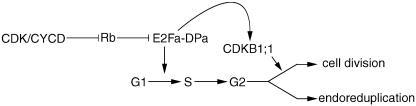
Model Illustrating the Interaction between E2Fa-DPa and CDKB1;1 Activity to Drive the Mitotic Cell Cycle. For details, see text. Rb, retinoblastoma.

References

    1. Boudolf, V., Barrôco, R., de Almeida Engler, J., Verkest, A., Beeckman, T., Naudt, M., Inzé, D., and De Veylder, L. (2004). B1-type cyclin-dependent kinases are essential for the formation of stomatal complexes in Arabidopsis thaliana. Plant Cell 16, 945–955. - PMC - PubMed
    1. Breyne, P., Dreesen, R., Vandepoele, K., De Veylder, L., Van Breusegem, F., Callewaert, L., Rombauts, S., Raes, J., Cannoot, B., Engler, G., Inzé, D., and Zabeau, M. (2002). Transcriptome analysis during cell division in plants. Proc. Natl. Acad. Sci. USA 99, 14825–14830. - PMC - PubMed
    1. Brodsky, V.Y., and Uryvaeva, I.V. (1977). Cell polyploidy: Its relation to tissue growth and function. Int. Rev. Cytol. 50, 275–332. - PubMed
    1. Cebolla, A., Vinardell, J.M., Kiss, E., Oláh, B., Roudier, F., Kondorosi, A., and Kondorosi, E. (1999). The mitotic inhibitor ccs52 is required for endoreduplication and ploidy-dependent cell enlargement in plants. EMBO J. 18, 4476–4484. - PMC - PubMed
    1. D'Amato, F. (1964). Endopolyploidy as a factor in plant tissue development. Caryologia 17, 41–52.

Publication types

MeSH terms

LinkOut - more resources