. 2004 Oct;16(10):2734-48.
doi: 10.1105/tpc.104.026070. Epub 2004 Sep 17.

Biosynthesis of very-long-chain polyunsaturated fatty acids in transgenic oilseeds: constraints on their accumulation

Affiliations

Biosynthesis of very-long-chain polyunsaturated fatty acids in transgenic oilseeds: constraints on their accumulation

Amine Abbadi et al. Plant Cell. 2004 Oct.

Abstract

Omega6- and omega3-polyunsaturated C20 fatty acids represent important components of the human diet. A more regular consumption and an accordingly sustainable source of these compounds are highly desirable. In contrast with the very high levels to which industrial fatty acids have to be enriched in plant oils for competitive use as chemical feedstocks, much lower percentages of very-long-chain polyunsaturated fatty acids (VLCPUFA) in edible plant oils would satisfy nutritional requirements. Seed-specific expression in transgenic tobacco (Nicotiana tabacum) and linseed (Linum usitatissimum) of cDNAs encoding fatty acyl-desaturases and elongases, absent from all agronomically important plants, resulted in the very high accumulation of Delta6-desaturated C18 fatty acids and up to 5% of C20 polyunsaturated fatty acids, including arachidonic and eicosapentaenoic acid. Detailed lipid analyses of developing seeds from transgenic plants were interpretated as indicating that, after desaturation on phosphatidylcholine, Delta6-desaturated products are immediately channeled to the triacylglycerols and effectively bypass the acyl-CoA pool. Thus, the lack of available Delta6-desaturated acyl-CoA substrates in the acyl-CoA pool limits the synthesis of elongated C20 fatty acids and disrupts the alternating sequence of lipid-linked desaturations and acyl-CoA dependent elongations. As well as the successful production of VLCPUFA in transgenic oilseeds and the identification of constraints on their accumulation, our results indicate alternative strategies to circumvent this bottleneck.


Figures
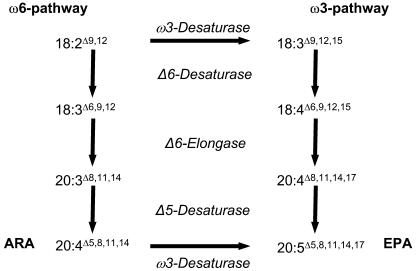
Figure 1.
Figure 1.
Simplified ω6- and ω3-Pathways for the Biosynthesis of VLCPUFA from Linoleic (18:2) and α-Linolenic (18:3) Acid, Respectively.
Figure 2.
Figure 2.
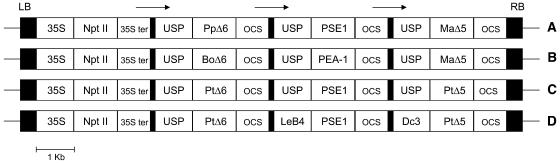
T-DNA of the Binary Vectors Used for Plant Transformation. LB and RB, left and right T-DNA borders, respectively; USP, promoter region of the unknown seed protein of Vicia faba; LeB4, promoter of the legumin gene of V. faba; Dc3, promoter of the helianthinin gene of Daucus carota; OCS, terminator region of octopin synthase gene of A. tumefaciens; 35S, 35S promoter of Cauliflower mosaic virus (CaMV); 35S ter, CaMV 35S terminator; Npt II, neomycin phosphotransferase gene; PpΔ6, BoΔ6, and PtΔ6, Δ6-desaturases from P. patens (AJ222980), B. officinalis (U79010), and P. tricornutum (AY082393), respectively; MaΔ5 and PtΔ5, Δ5-desaturases from M. alpina (AF054824) and P. tricornutum (AY082392), respectively; PSE1 and PEA-1, Δ6-elongase from P. patens (AF428243) and C. elegans (F56H11.4), respectively.
Figure 3.
Figure 3.
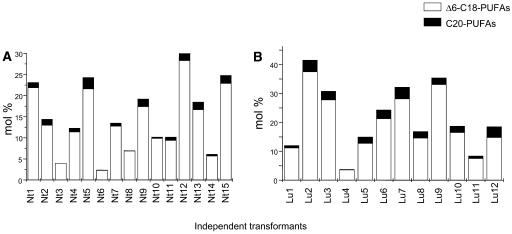
Δ6-C18- and C20-Polyunsaturated Fatty Acid Proportions in a Selection of Seeds from Primary Transformants of Tobacco and Linseed Transformed with Construct C. Seeds were collected at 40 d after flowering (DAF) from transgenic tobacco (A) and linseed (B). FAMEs were prepared from whole seeds and analyzed by gas chromatography (GC) as indicated in Methods. Open bars, Δ6-C18-polyunsaturated fatty acid proportions; closed bars, C20-polyunsaturated fatty acid proportions.
Figure 4.
Figure 4.
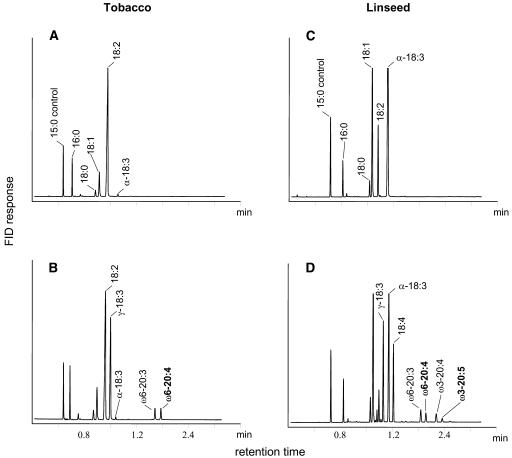
Fatty Acid Profiles of Seeds from Wild-Type and Single-Copy Tobacco and Linseed Transformants. Seeds were collected at 40 DAF from wild-type ([A] and [C]) and transgenic ([B] and [D]) tobacco and linseed transformed with construct C (Figure 1). FAMEs were prepared from whole seeds and analyzed by GC as indicated in Methods. In this particular linseed plant, C20-polyunsaturated fatty acids accounted for 5% of the total fatty acids. It should be pointed out that none of the major peaks shown go off scale.
Figure 5.
Figure 5.
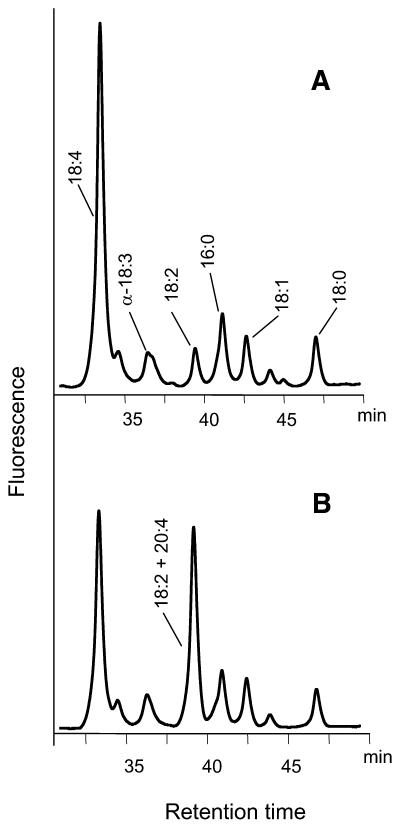
In Vitro Assay of Elongase Activity. Microsomes from developing embryos were incubated with 18:4-CoA in the absence (A) and presence (B) of malonyl-CoA, NADH, and NADPH. After purification of the acyl-CoAs, they were converted to their etheno-derivatives and analyzed by HPLC. In the assay in (B), ∼50% of 18:4-CoA is elongated to 20:4-CoA.
Figure 6.
Figure 6.
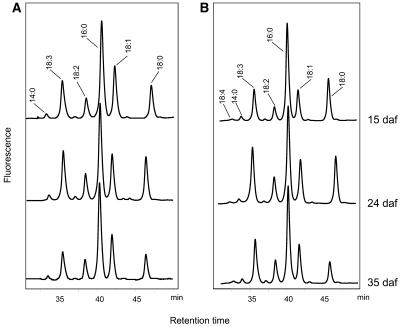
Profiles of Acyl-CoAs from Developing Wild-Type and Transgenic Linseed. Immature seeds were harvested at 14, 24, and 35 DAF from wild-type (A) and transgenic (B) linseed expressing construct C and subjected to acyl-CoA extraction. The acyl-CoAs were converted to their etheno-derivatives and analyzed by HPLC.
Figure 7.
Figure 7.
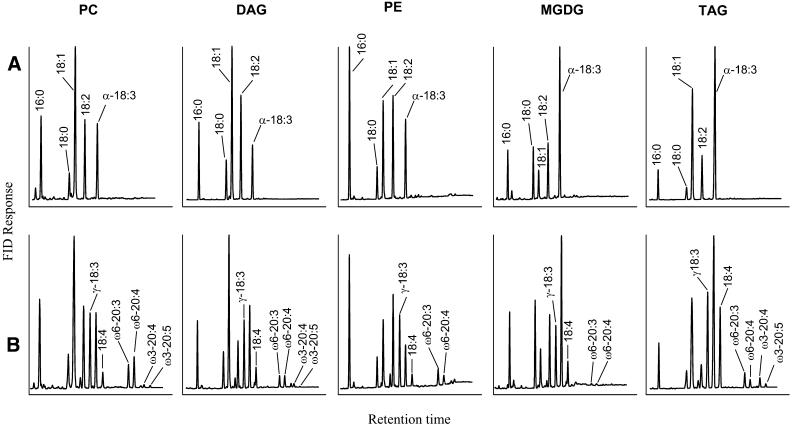
Fatty Acid Profiles of PC, DAG, PE, MGDG, and TAG from Developing Wild-Type and Transgenic Linseed Seeds (24 DAF). PC, DAG, PE, MGDG, and TAGs were purified by high-performance thin-layer chromatography (HPTLC) from the respective lipid fractions as indicated in Methods and directly subjected to transesterification for GC analysis. (A) Wild-type seeds. (B) Transgenic seeds.
Figure 8.
Figure 8.
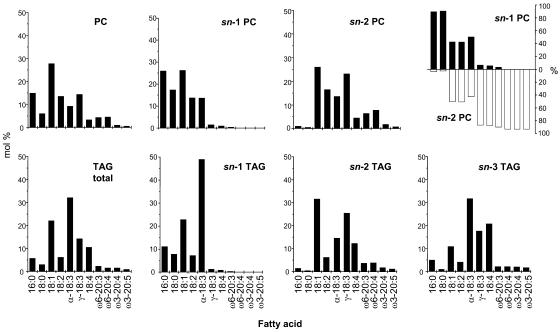
Regiospecific Distribution of Fatty Acids in PC and TAG from Developing Seeds of Transgenic Linseed (24 DAF). The positional analysis of fatty acids from PC and TAG were determined as indicated in Methods. In all plots, except for the right PC plot, mol % refers to the percentage of each acyl group in the lipid class or at a particular position in that lipid class. In the right PC plot, “%” refers to the percentage of each fatty acid found in the sn-1 or sn-2 position. Each value is the mean from three independent experiments.
Figure 9.
Figure 9.
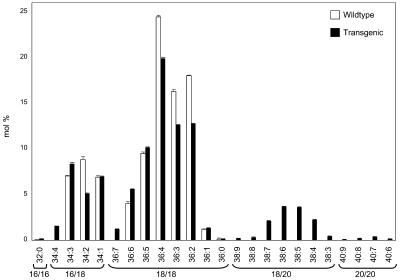
Molecular Species of PC from Developing Wild-Type and Transgenic Linseed (24 DAF).
Figure 10.
Figure 10.
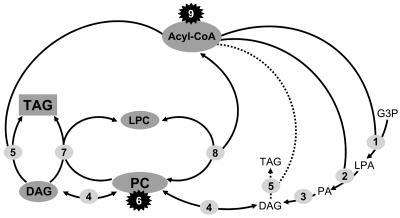
Accumulation of Linseed TAG by Channeling of Acyl Groups through PC. The stepwise acylation of glycerol-3-phosphate (G3P) by acyl-CoA:1-glycerol-3-phosphate acyltransferase (G3PAT; 1) and acyl-CoA:1-acyl-glycerol-3-phosphate acyltransferase (2) yields 1-acyl-glycerol-3-phosphate (LPA) and phosphatidic acid (PA), which is hydrolyzed by phosphatidic acid phosphatase (3) to give DAG. Its conversion to TAG by acyl-CoA:diacylglycerol acyltransferase (5) immediately after the primary formation of DAG by the Kennedy pathway represents a minor alternative for TAG synthesis in linseed (indicated by the dotted arrow). The major part of DAG is converted to PC in a reversible reaction catalyzed by CDP-choline:diacylglycerol cholinephosphotransferase (CPT; 4). PC is the substrate for acyl group desaturases (6). They may accept both the sn-1 and sn-2–localized acyl groups (the genuine enzymes), or their action may be confined to the sn-2–bound acyl chains (the heterologously expressed Δ6- and Δ5-desaturase). In a reversible reaction, the acyl-CoA:lyso-phosphatidylcholine acyltransferase (8) equilibrates the sn-2–bound acyl group with the acyl-CoA pool. The formation of C20-polyunsaturated fatty acids by the heterologously expressed acyl-CoA elongase (9) occurs by elongation of Δ6-C18–polyunsaturated acyl-CoA and thus depends on their release from PC into the acyl-CoA pool by the LPCAT (8). The activities of the desaturases (6) and elongase (9) together with the reversibility of LPCAT (8) and CPT (4) result in a continuous change of the acyl groups of the acyl-CoA pool, PC, and DAG, which all participate in this equilibration. Only after passage through PC, a highly desaturated DAG is finally converted into TAG. This channeling is catalyzed by two enzymes, the DAGAT (5) mentioned before and the phospholipid:diacylglycerol acyltransferase (PDAT; 7) that transfers the sn-2–bound acyl group from PC to the sn-3 position of TAG. These major routes, deduced by labeling studies with wild-type linseed (Slack et al., 1983; Stymne and Stobart, 1984), are supported by the acyl profiles of the various pools (acyl-CoA, PC, DAG, and TAG) studied in this investigation with transgenic linseed.
Figure 11.
Figure 11.
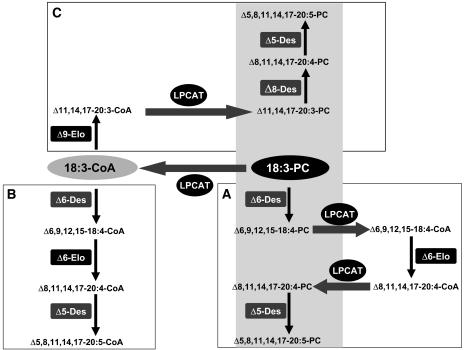
Differences in the Interplay between Desaturases, Elongases, and Acyltransferases in the Biosynthesis of VLCPUFA in Transgenic Plants. Three different strategies can be used to generate VLCPUFA. (A) The lipid-linked desaturation pathway was followed by our approach and requires both forward and reverse reactions of a Δ6-specific LPCAT, which is the limiting step in linseed. (B) The acyl-CoA pathway, where both the elongation and desaturation occur in the acyl-CoA pool, requires acyl-CoA front-end desaturases so far only known from mammals. PC, phosphatidylcholine; Elo, elongase; Des, desaturase; light gray shading represents the membrane environment. (C) An alternative pathway relying on the initiating Δ9-elongation step in the acyl-CoA pool followed by lipid-linked desaturations has been verified in leaves (Qi et al., 2004).

References

    1. Abbadi, A., Domergue, F., Meyer, A., Riedel, K., Sperling, P., Zank, T., and Heinz, E. (2001). Transgenic oilseeds as sustainable sources of nutritionally relevant C20 and C22 polyunsaturated fatty acids? Eur. J. Lipid Sci. Technol. 103, 106–113.
    1. Agius, F., Gonzalez-Lamothe, R., Caballero, J.L., Munoz-Blanco, J., Botella, M.A., and Valpuesta, V. (2003). Engineering increased vitamin C levels in plants by overexpression of a D-galacturonic acid reductase. Nat. Biotechnol 21, 177–181. - PubMed
    1. Bäumlein, H., Boerjan, W., Nagy, I., Bassuner, R., Van Montagu, M., Inze, D., and Wobus, U. (1991). A novel seed protein gene from Vicia faba is developmentally regulated in transgenic tobacco and Arabidopsis plants. Mol. Gen. Genet. 225, 459–467. - PubMed
    1. Beaudoin, F., Michaelson, L.V., Hey, S.J., Lewis, M.J., Shewry, P.R., Sayanova, O., and Napier, J.A. (2000). Heterologous reconstitution in yeast of the polyunsaturated fatty acid biosynthetic pathway. Proc. Natl. Acad. Sci. USA 97, 6421–6426. - PMC - PubMed
    1. Beaudoin, F., and Napier, J.A. (2004). Biosynthesis and compartmentation of triacylglycerol in higher plants. In Lipid Metabolism and Membrane Biogenesis, G. Daum, ed (Berlin: Springer), pp. 267–287.

Publication types

MeSH terms

Substances