


Corticosterone controls the developmental emergence of fear and amygdala function to predator odors in infant rat pups
- PMID: 15380840
- PMCID: PMC1880875
- DOI: 10.1016/j.ijdevneu.2004.05.011
Corticosterone controls the developmental emergence of fear and amygdala function to predator odors in infant rat pups
Abstract
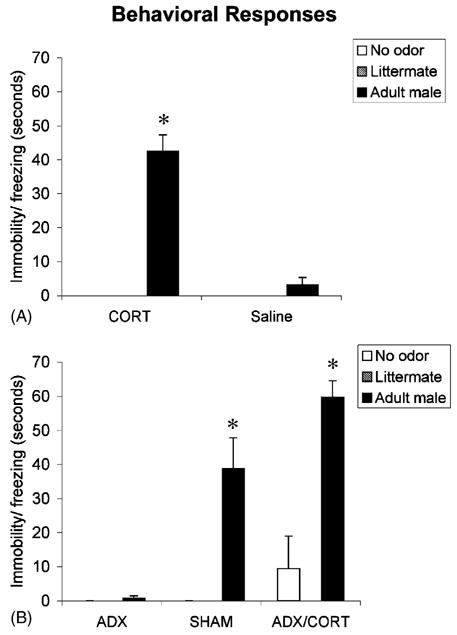
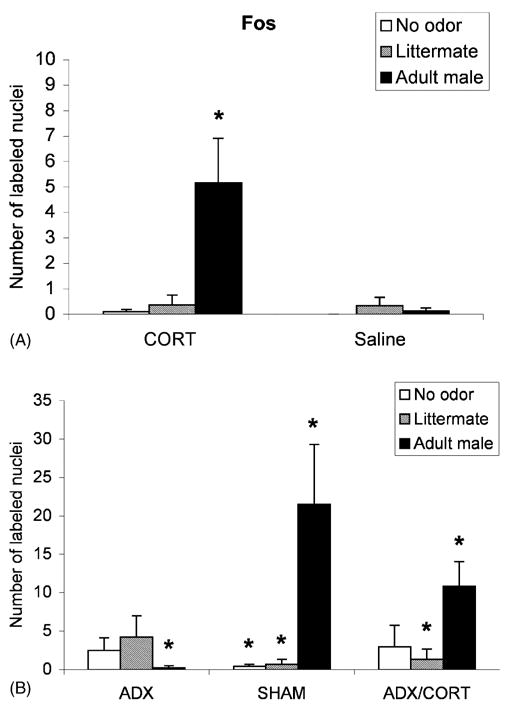
In many altricial species, fear responses such as freezing do not emerge until sometime later in development. In infant rats, fear to natural predator odors emerges around postnatal day (PN) 10 when infant rats begin walking. The behavioral emergence of fear is correlated with two physiological events: functional emergence of the amygdala and increasing corticosterone (CORT) levels. Here, we hypothesize that increasing corticosterone levels influence amygdala activity to permit the emergence of fear expression. We assessed the relationship between fear expression (immobility similar to freezing), amygdala function (c-fos) and the level of corticosterone in pups in response to presentation of novel male odor (predator), littermate odor and no odor. CORT levels were increased in PN8 pups (no fear, normally low CORT) by exogenous CORT (3 mg/kg) and decreased in PN12 pups (express fear, CORT levels higher) through adrenalectomy and CORT replacement. Results showed that PN8 expression of fear to a predator odor and basolateral/lateral amygdala activity could be prematurely evoked with exogenous CORT, while adrenalectomy in PN12 pups prevented both fear expression and amygdala activation. These results suggest that low neonatal CORT level serves to protect pups from responding to fear inducing stimuli and attenuate amygdala activation. This suggests that alteration of the neonatal CORT system by environmental insults such as alcohol, stress and illegal drugs, may also alter the neonatal fear system and its underlying neural control.
Figures
References
-
- Anand A, Shekhar A. Brain imaging studies in mood and anxiety disorders: special emphasis on the amygdala. Ann N Y Acad Sci. 2003;985:370–388. - PubMed
-
- Barr GA. Ontogeny of nociception and antinociception. NIDA Res Monogr. 1995;158:172–201. - PubMed
-
- Beane ML, Cole MA, Spencer RL, Rudy JW. Neonatal handling enhances contextual fear conditioning and alters corticosterone stress responses in young rats. Horm Behav. 2002;41:33–40. - PubMed
-
- Bolles RC, Woods PJ. The ontogeny of behaviour in the albino rat. Anim Behav. 1964;12:427–441.
Publication types
MeSH terms
Substances
Grants and funding
LinkOut - more resources
Full Text Sources
