Comparative Study
. 2004 Oct;240(4):667-74; discussion 675-6.
doi: 10.1097/01.sla.0000140755.97224.9a.

Systemic siRNA-mediated gene silencing: a new approach to targeted therapy of cancer

Affiliations
Comparative Study

Systemic siRNA-mediated gene silencing: a new approach to targeted therapy of cancer

Mark S Duxbury et al. Ann Surg. 2004 Oct.

Abstract

Objective: RNA interference (RNAi), mediated by small interfering RNA (siRNA), silences genes with a high degree of specificity and potentially represents a general approach for molecularly targeted anticancer therapy. The aim of this study was to evaluate the ability of systemically administered siRNA to silence gene expression in vivo and to assess the effect of this approach on tumor growth using a murine pancreatic adenocarcinoma xenograft model.

Summary background data: Carcinoembryonic antigen-related cell adhesion molecule 6 (CEACAM6) is widely overexpressed in human gastrointestinal cancer. Overexpression of CEACAM6 promotes cell survival under anchorage independent conditions, a characteristic associated with tumorigenesis and metastasis.

Methods: CEACAM6 expression was quantified by real-time polymerase chain reaction (PCR) and Western blot. Mice (n = 10/group) were subcutaneously xenografted with 2 x 10 BxPC3 cells (which inherently overexpress CEACAM6). Tumor growth, CEACAM6 expression, cellular proliferation (Ki-67 immunohistochemistry), apoptosis, angiogenesis (CD34 immunohistochemistry), and survival were compared for mice administered either systemic CEACAM6-specific or control single-base mismatch siRNA over 6 weeks, following orthotopic tumor implantation.

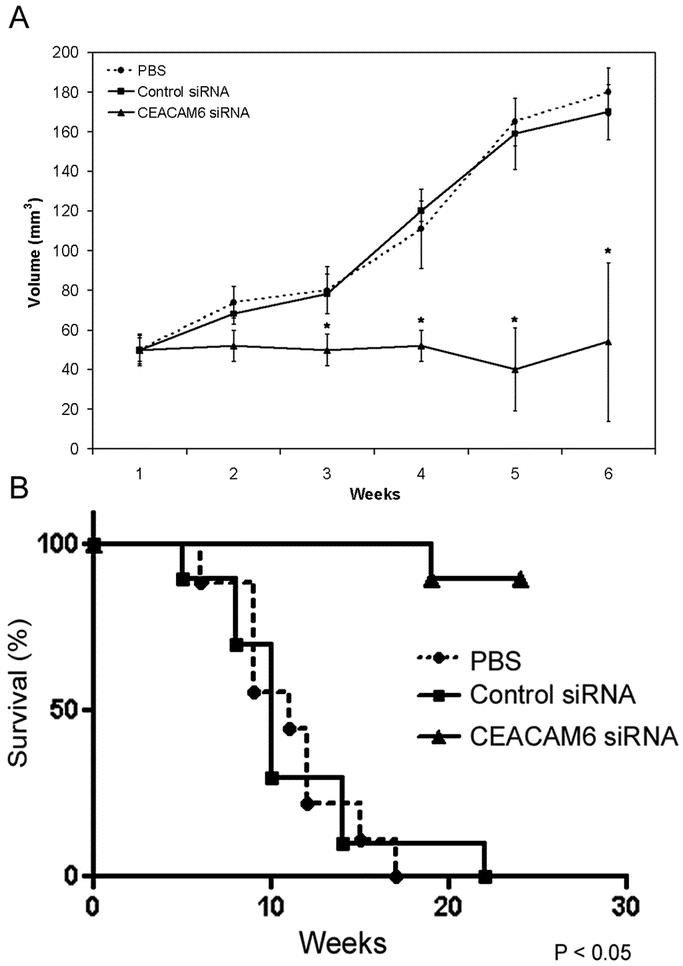
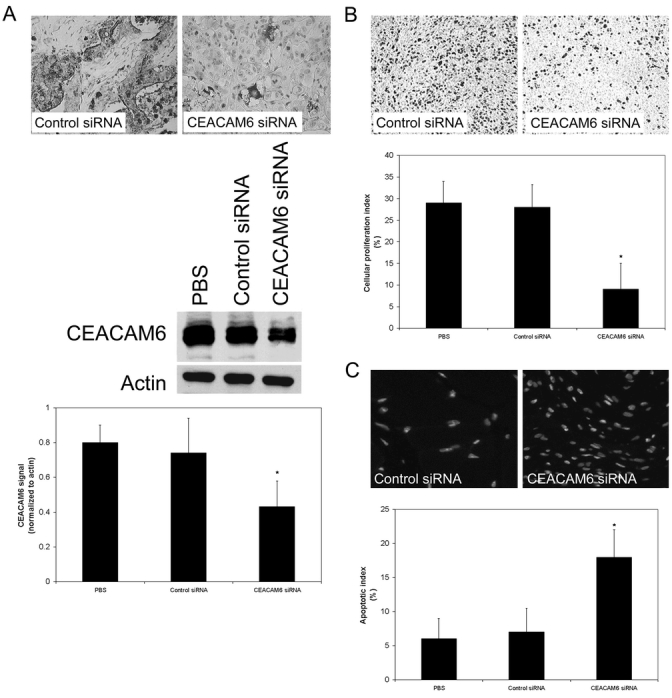
Results: Treatment with CEACAM6-specific siRNA suppressed primary tumor growth by 68% versus control siRNA (P < 0.05) and was associated with a decreased proliferating cell index, impaired angiogenesis and increased apoptosis in the xenografted tumors. CEACAM6-specific siRNA completely inhibited metastasis (0% of mice versus 60%, P < 0.05) and significantly improved survival, without apparent toxicity.

Conclusions: Our data demonstrate the efficacy of systemically administered siRNA as a therapeutic modality in experimental pancreatic cancer. This novel therapeutic strategy may be applicable to a broad range of cancers and warrants investigation in patients with refractory disease.


Figures
None
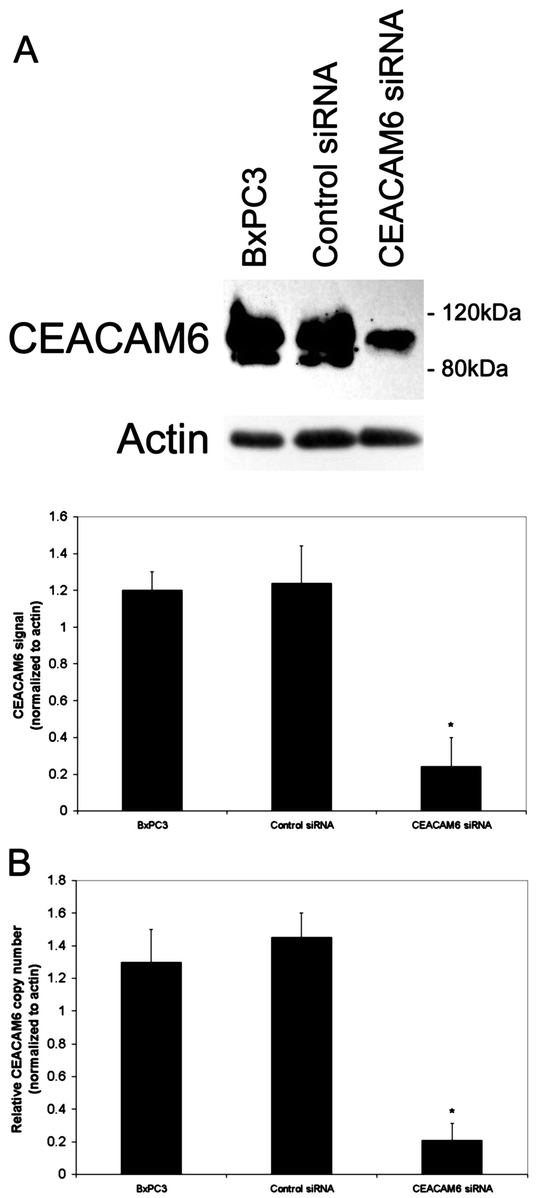
FIGURE 1. CEACAM6 gene silencing by siRNA. Suppression of CEACAM6 expression was confirmed at protein level by Western blot analysis (A) and at transcript level by real-time PCR (B). Analysis was performed 96 hours following siRNA transfection. CEACAM6 protein expression was suppressed by approximately 80% in CEACAM6-specific siRNA treated cells, relative to control siRNA and untransfected cells, which did not differ in their level of CEACAM6 expression. Representative blots are shown. Densitometric values are means (± SD) from triplicate blots, normalized to actin. * P < 0.05 versus control siRNA-treated cells.
None
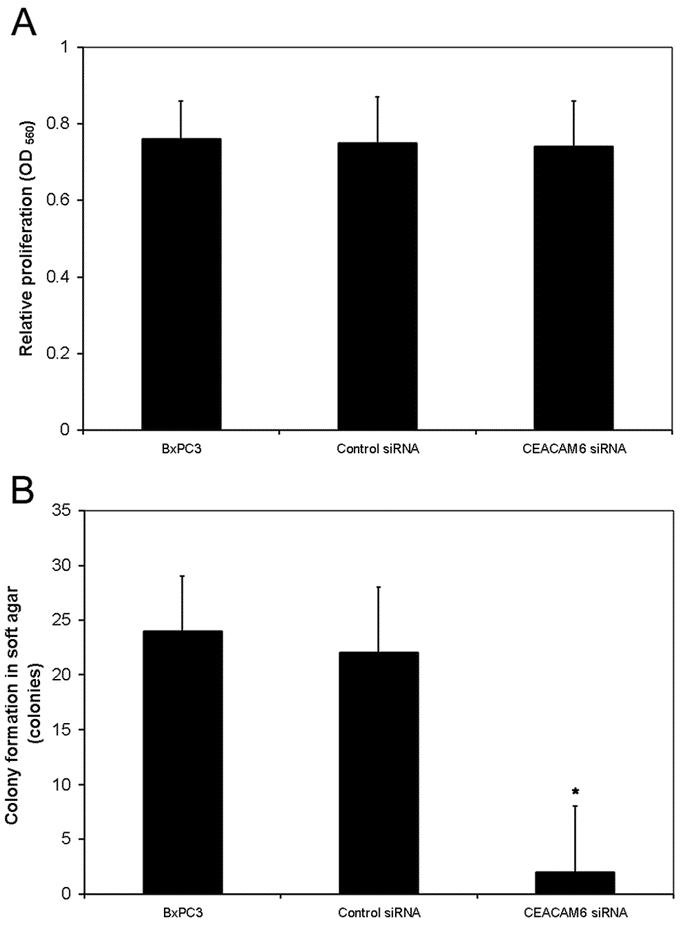
FIGURE 2. Effect of CEACAM6 gene silencing on cellular proliferation in monolayer culture and soft agar. A, Suppression of CEACAM6 expression had no significant effect on cellular proliferation in monolayer culture, as quantified by MTT assay. B, Colony formation in soft agar was significantly attenuated by CEACAM6 gene silencing. Values are means (± SD) from triplicate experiments. * P < 0.05 versus control siRNA.
None
FIGURE 3. Effect of systemic siRNA on xenograft tumor growth and mouse survival. A, Subcutaneous tumor xenograft-bearing nude mice were treated systemically with either CEACAM6-specific siRNA, control siRNA, or PBS for 6 weeks (n = 10 per group), during which time tumor volume was calculated weekly using the formula: [1/2] × a × b2, where a and b represent the larger and smaller tumor diameters, respectively. CEACAM6-specific siRNA suppressed mean tumor growth by 68% at 6 weeks. The volume of tumors from mice treated with control siRNA did not differ significantly from those from mice receiving PBS. Values are means (± SEM). B, In a separate experiment, mice received 2 × 10⁶ BxPC3 cells by surgical orthotopic implantation. Two weeks following implantation, mice were treated systemically with either CEACAM6-specific siRNA, control siRNA, or PBS for 6 weeks (n = 10 per group). Mouse survival was analyzed using the Kaplan-Meier method. The survival rate of mice treated with CEACAM6-specific siRNA was significantly greater than that of mice treated with either control siRNA or PBS (P < 0.05 by log-rank test).
None
FIGURE 4. A, Suppression of CEACAM6 expression by systemically administered CEACAM6-specific siRNA, but not control siRNA, was confirmed by performing CEACAM6 immunohistochemistry on 5-μm tumor sections and by Western blot analysis of tumor homogenates. CEACAM6 expression was suppressed by 42%, relative to control siRNA and PBS treated tumors. Representative blot shown with mean densitometric values (± SD) from triplicate blots. * P < 0.05 versus control siRNA-treated tumors. B, Tumor xenograft cellular proliferation was quantified by Ki-67 immunohistochemistry. The fraction of Ki-67-positive cells (proliferation index) was determined by counting 100 cells in 5 random fields from each tumor section. Tumors from mice treated with CEACAM6-specific siRNA exhibited significantly lower cellular proliferation indices than those from mice treated with control siRNA. Values are means (± SD). * P < 0.05 versus control siRNA-treated tumors. C, Tumor xenograft cellular apoptosis was quantified by TUNEL staining 5-μm tumor sections. The apoptotic fraction was derived by counting the TUNEL-positive fraction of 100 cells from 5 random fields in each tumor section. Tumors from mice treated with CEACAM6-specific siRNA exhibited significantly higher levels of apoptosis than those from mice treated with control siRNA. Values are means (± SD). * P < 0.05 versus control siRNA-treated tumors.
None
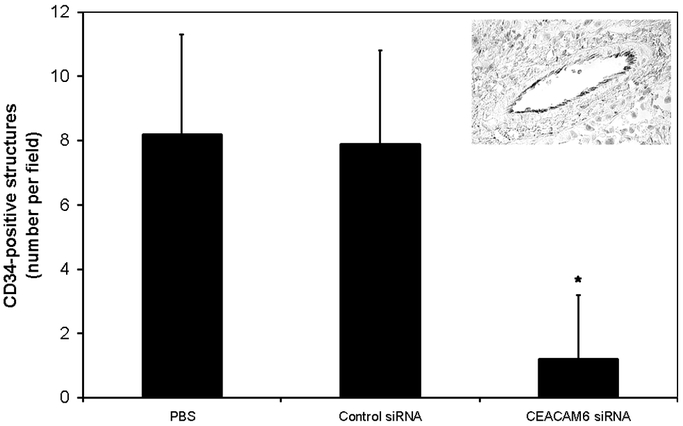
FIGURE 5. Tumor angiogenesis was quantified by immunohistochemical staining for CD34. The number of CD34-positive structures was quantified in 5 random fields in each tumor section. CEACAM6-specific siRNA substantially reduced the number of CD34-positive structures, suggesting reduced levels of tumor angiogenesis, relative to control siRNA-treated cells. Values are means (± SD). * P < 0.05 versus control siRNA-treated tumors. A typical CD34-positive structure containing erythrocytes is shown in the inset.

References

    1. Burris HA III, Moore MJ, Andersen J, et al. Improvements in survival and clinical benefit with gemcitabine as first-line therapy for patients with advanced pancreas cancer: a randomized trial. J Clin Oncol. 1997;15:2403–2413. - PubMed
    1. Fire A, Xu S, Montgomery MK, et al. Potent and specific genetic interference by double-stranded RNA in Caenorhabditis elegans. Nature. 1998;391:806–811. - PubMed
    1. Hannon GJ. RNA interference. Nature. 2002;418:244–251. - PubMed
    1. Thompson JA, Grunert F, Zimmermann W. Carcinoembryonic antigen gene family: molecular biology and clinical perspectives. J Clin Lab Anal. 1991;5:344–366. - PubMed
    1. Kuroki M, Abe H, Imakiirei T, et al. Identification and comparison of residues critical for cell-adhesion activities of two neutrophil CD66 antigens, CEACAM6 and CEACAM8. J Leukoc Biol. 2001;70:543–550. - PubMed

Publication types

MeSH terms