


The impact of chemotherapy on the survival of patients with high-grade primary extremity liposarcoma
- PMID: 15383796
- PMCID: PMC1356470
- DOI: 10.1097/01.sla.0000141710.74073.0d
The impact of chemotherapy on the survival of patients with high-grade primary extremity liposarcoma
Abstract
Objective: To determine if chemotherapy offers a survival benefit to patients with large, high-grade, primary extremity liposarcoma.
Summary background data: The impact of chemotherapy on the survival of patients with primary extremity soft tissue sarcoma is controversial and its effect on individual histologic subtypes is not defined.
Patient and methods: Two prospectively collected sarcoma databases were used to identify all patients with >5 cm, high-grade, primary extremity liposarcoma that underwent surgical treatment of cure from 1975 to 2003 (n = 245). Clinical, pathologic and treatment variables were analyzed for disease-specific survival (DSS), distant recurrence-free survival (DRFS) and local recurrence-free survival (LRFS).
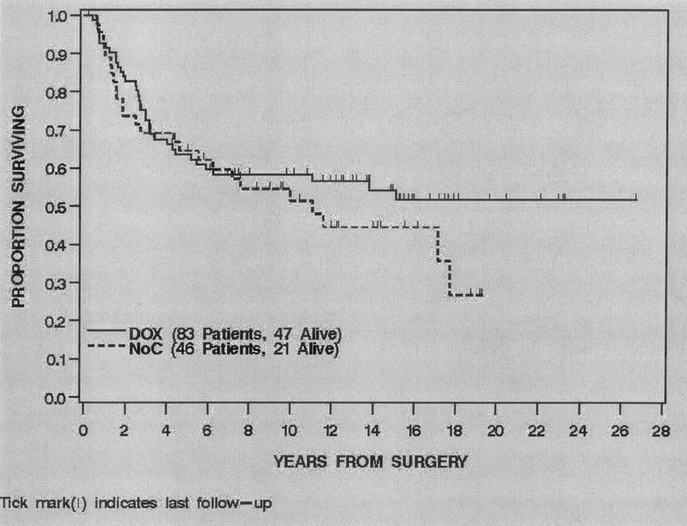
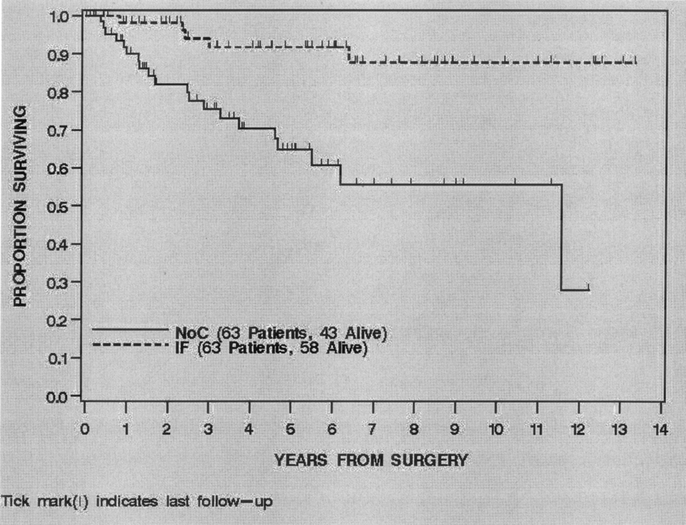
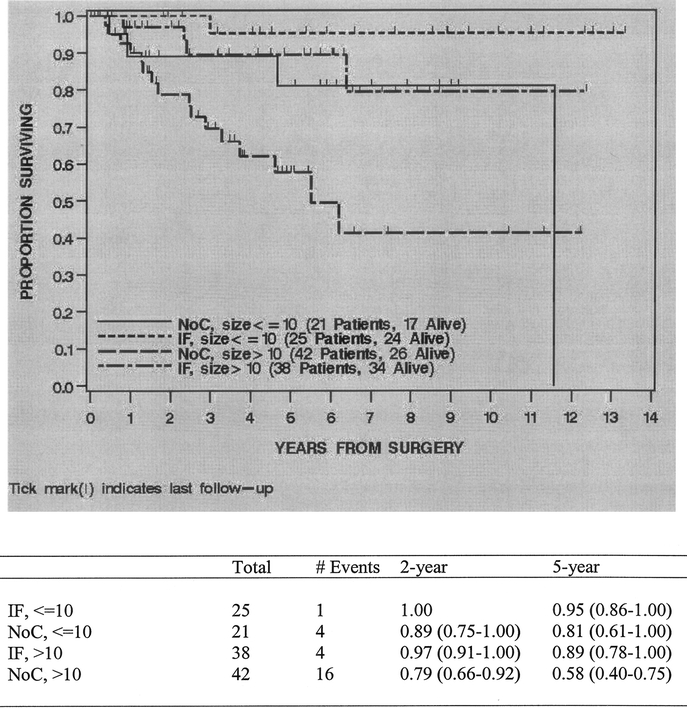
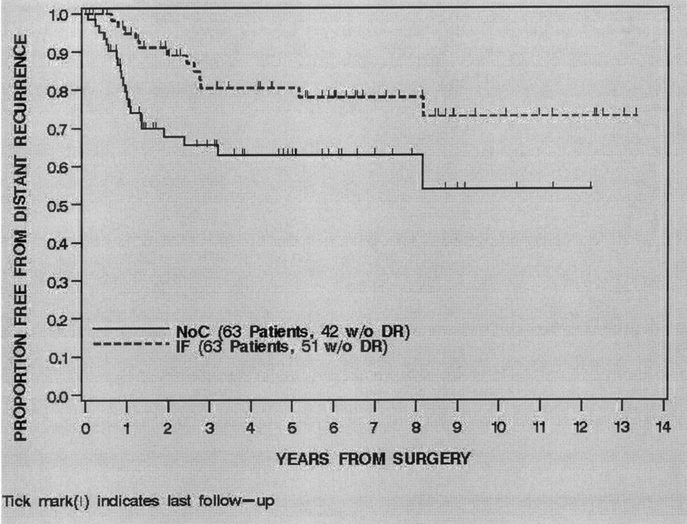
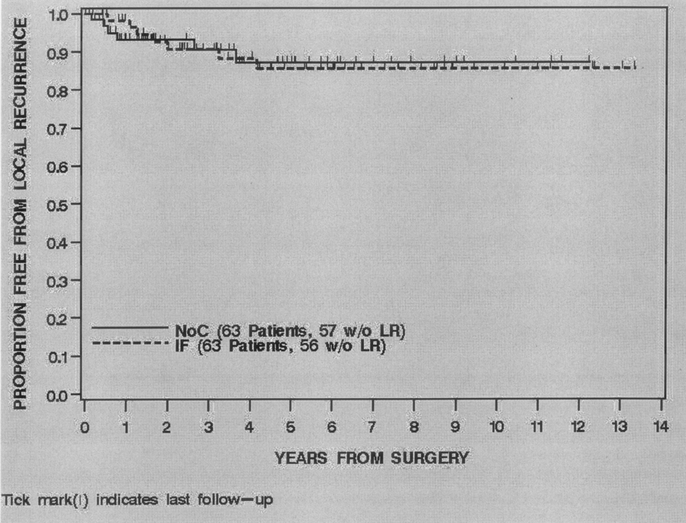
Results: Sixty-three (26%) patients were treated with ifosfamide based chemotherapy (IF), 83 (34%) with doxorubicin based chemotherapy (DOX) and 99 (40%) received no chemotherapy (NoC). To assess the impact of DOX, a contemporary cohort analysis of patients treated from 1975 to 1990 was performed. The 5 year DSS of the DOX treated patients was 64% (53%-74%) compared with 56% (51%-79%) for the NoC patients (log-rank P value = 0.28). To assess the impact of IF, a contemporary cohort analysis of patients treated from 1990 to 2003 was performed. The 5 year DSS of the IF treated patients was 92% (84%-100%) compared with 65% (51%-79%) for the NoC patients (log-rank P value = 0.0003). Independent prognostic factors for improved DSS were smaller size (HR = 0.7, P = 0.01), myxoid/round cell histologic subtype (HR = 0.3, P = 0.03) and treatment with IF (HR = 0.3, P = 0.01). The five-year DRFS of the IF treated patients was 81% (70%-92%) compared with 63% (50%-76%) for the NoC patients (log-rank P value = 0.02). The 5 year LRFS of the IF treated patients was 86% (76%-96%) compared with 87% (77%-97%) for the NoC patients (log-rank P value = 0.99).
Conclusions: In patients with large, high-grade, primary extremity liposarcoma; DOX is not associated with improved DSS and IF is associated with an improved DSS. Treatment with IF should be considered in patients with high-risk primary extremity liposarcoma.
Figures
References
-
- Lewis JJ, Brennan MF. Soft tissue sarcomas. Curr Probl Surg. 1996;33:817–872. - PubMed
-
- Eilber FC, Eilber FR. Soft tissue sarcoma. In: Cameron ed. Current Surgical Therapy. Seventh Edition. St. Louis, MS, Mosby 2001;1213–1218.
-
- Linehan DC, Lewis JJ, Leung D, et al. Influence of biologic factors and anatomic site in completely resected liposarcoma. J Clin Oncol. 2000;18:1637–1643. - PubMed
-
- Pisters PWT, Leung DHY, Woodruff J, et al. Analysis of prognostic factors in 1041 patients with localized soft tissue sarcomas of the extremities. J Clin Oncol. 1996;14:1679–1689. - PubMed
Publication types
MeSH terms
Substances
Grants and funding
LinkOut - more resources
Full Text Sources
Miscellaneous
