


Serum levels of the proinflammatory cytokines interleukin-1 beta (IL-1beta), IL-6, IL-8, IL-10, tumor necrosis factor alpha, and IL-12(p70) in Malian children with severe Plasmodium falciparum malaria and matched uncomplicated malaria or healthy controls
- PMID: 15385460
- PMCID: PMC517593
- DOI: 10.1128/IAI.72.10.5630-5637.2004
Serum levels of the proinflammatory cytokines interleukin-1 beta (IL-1beta), IL-6, IL-8, IL-10, tumor necrosis factor alpha, and IL-12(p70) in Malian children with severe Plasmodium falciparum malaria and matched uncomplicated malaria or healthy controls
Abstract
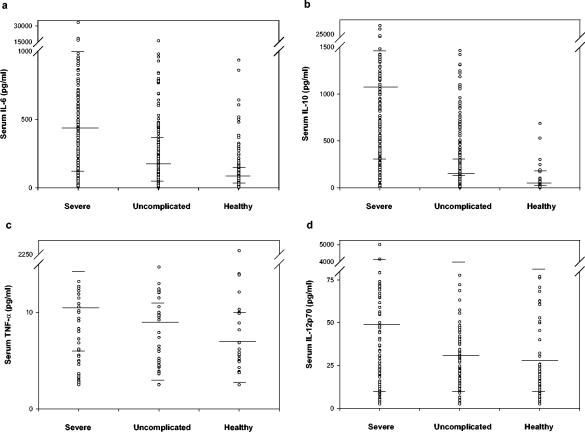
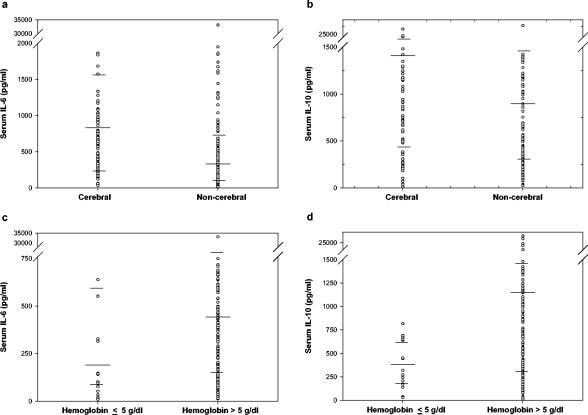
Inflammatory cytokines play an important role in human immune responses to malarial disease. However, the role of these mediators in disease pathogenesis, and the relationship between host protection and injury remains unclear. A total of 248 cases of severe Plasmodium falciparum malaria among children aged 3 months to 14 years residing in Bandiagara, Mali, were matched to cases of uncomplicated malaria and healthy controls. Using modified World Health Organization criteria for defining severe malaria, we identified 100 cases of cerebral malaria (coma, seizure, and obtundation), 17 cases of severe anemia (hemoglobin, <5 g/dl), 18 cases combined cerebral malaria with severe anemia, and 92 cases with hyperparasitemia (asexual trophozoites, >500,000/mm3). Significantly elevated levels (given as geometric mean concentrations in picograms/milliliter) of interleukin-6 (IL-6; 485.2 versus 54.1; P = <0.001), IL-10 (1,099.3 versus 14.1; P = <0.001), tumor necrosis factor alpha (10.1 versus 7.7; P = <0.001), and IL-12(p70) (48.9 versus 31.3; P = 0.004) in serum were found in severe cases versus healthy controls. Significantly elevated levels of IL-6 (485.2 versus 141.0; P = <0.001) and IL-10 (1,099.3 versus 133.9; P = <0.001) were seen in severe malaria cases versus uncomplicated malaria controls. Cerebral malaria was associated with significantly elevated levels of IL-6 (754.5 versus 311.4; P = <0.001) and IL-10 (1,405.6 versus 868.6; P = 0.006) compared to severe malaria cases without cerebral manifestations. Conversely, lower levels of IL-6 (199.2 versus 487.6; P = 0.03) and IL-10 (391.1 versus 1,160.9; P = 0.002) were noted in children with severe anemia compared to severe malaria cases with hemoglobin at >5 g/dl. Hyperparasitemia was associated with significantly lower levels of IL-6 (336.6 versus 602.1; P = 0.002). These results illustrate the complex relationships between inflammatory cytokines and disease in P. falciparum malaria.
Figures
References
-
- Abrams, E. T., H. Brown, S. W. Chensue, G. D. Turner, E. Tadesse, V. M. Lema, M. E. Molyneux, R. Rochford, S. R. Meshnick, and S. J. Rogerson. 2003. Host response to malaria during pregnancy: placental monocyte recruitment is associated with elevated beta chemokine expression. J. Immunol. 170:2759-2764. - PubMed
-
- Brown, H., G. Turner, S. Rogerson, M. Tembo, J. Mwenechanya, M. Molyneux, and T. Taylor. 1999. Cytokine expression in the brain in human cerebral malaria. J. Infect. Dis. 180:1742-1746. - PubMed
-
- Cai, G., R. A. Kastelein, and C. A. Hunter. 1999. IL-10 enhances NK cell proliferation, cytotoxicity and production of IFN-γ when combined with IL-18. Eur. J. Immunol. 29:2658-2665. - PubMed
-
- Clark, I. A., and G. Chaudhri. 1988. Tumour necrosis factor may contribute to the anaemia of malaria by causing dyserythropoiesis and erythrophagocytosis. Br. J. Hematol. 70:99-103. - PubMed
Publication types
MeSH terms
Substances
Grants and funding
LinkOut - more resources
Full Text Sources
Other Literature Sources
