


Review
doi: 10.1128/AAC.48.10.3645-3654.2004.
Antimicrobial peptides from marine invertebrates
Affiliations
- PMID: 15388415
- PMCID: PMC521913
- DOI: 10.1128/AAC.48.10.3645-3654.2004
Item in Clipboard
Review
Antimicrobial peptides from marine invertebrates
Antimicrob Agents Chemother.
2004 Oct.
No abstract available
Figures
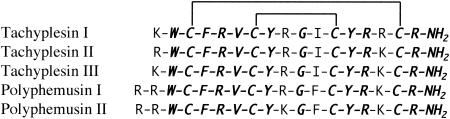
Amino acid sequences of tachyplesins and polyphemusins isolated from horseshoe crabs. Identical amino acids are shown in bold and italics. The disulfide linkages between Cys-3 and Cys-16 and between Cys-7 and Cys-12 are shown by the heavy solid lines connecting the respective cysteine residues. (Adapted with permission from Muta et al. [66].)
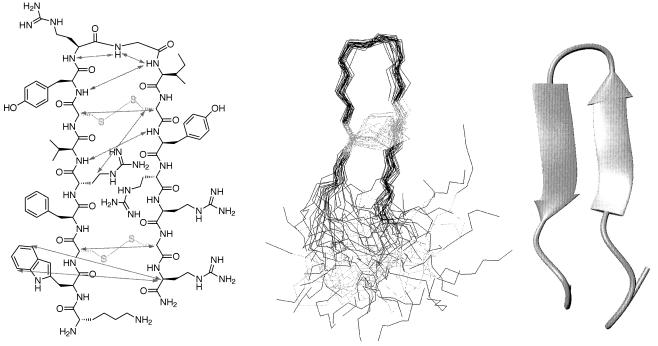
Solution structure of tachyplesin I. (Left panel) Schematic representation showing selected nonsequential NOEs as gray arrows. Disulfide bonds and cysteine residues are shown in yellow. (Center panel) Composite of 30 solution structures. (Right panel) Minimized average structure in an aqueous environment. (Reprinted from reference with the permission of the publisher.)
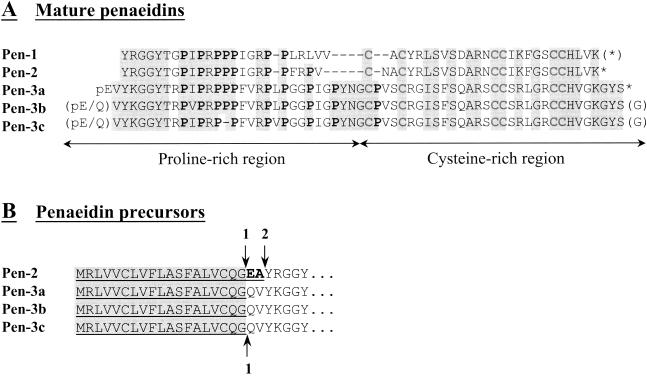
Sequence comparisons of penaeidins. (A) Mature penaeidin primary sequences. Proline and cysteine residues are in boldface, and identical amino acids are shaded gray. pE stands for pyroglutamic acid, and asterisks indicate C-terminal amidation. Assumed posttranslational modifications are in parentheses. Gaps were introduced to optimize the alignment. (B) N-terminal sequences of penaeidin precursors. Underlined amino acids indicate sequences absent from the mature molecules. Arrows indicate predicted cleavage sites. The “1” and “2” indicate preferential and secondary cleavage sites, respectively. Identical residues are shaded gray, and the dipeptide Glu-Ala found only in Pen-2 is in boldface. (Reprinted from reference with the permission of the publisher.)
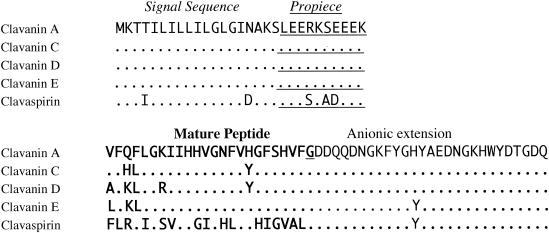
Amino acid sequences of clavanins A, C, D, and E and clavaspirin. The full sequence of preproclavanin A is shown, and residues identical to clavanin A are indicated by a dot. Differing residues are shown. The mature peptides are in boldface type, and the anionic propieces are underlined. The C-terminal glycine (underlined) is converted to an amide in mature clavanins. (Reprinted from reference with the permission of the publisher.)
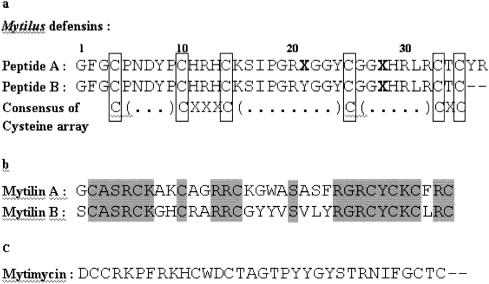
Amino acid sequences of antimicrobial peptides isolated from Mytilus edulis. (a) Mytilus defensins A and B. Cysteines are boxed following the consensus cysteine array deduced from arthropod defensins. Unidentified residues are indicated by boldface X's. (b) Mytilins A and B. Identical residues are shaded. (c) Partial N-terminal sequence of Mytilus antifungal peptide mytimycin. (Reprinted from reference with the permission of the publisher.)
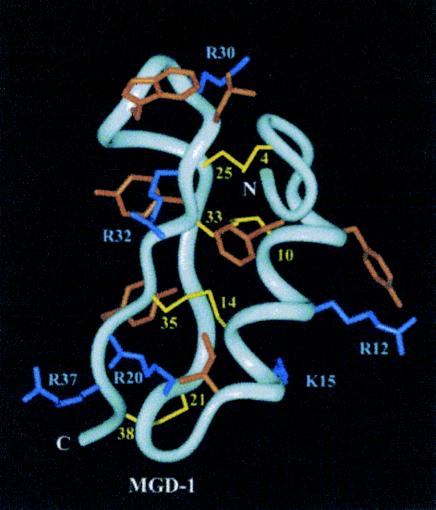
MGD-1 solution structure. The location of the hydrophobic (orange) and positively charged (blue) side chains are clearly shown. Disulfide bonds are drawn as yellow lines. Only Lys and Arg side chains are labeled for the sake of clarity. (Reprinted from reference with the permission of the publisher.)
References
-
- Aketagawa, J., T. Miyata, S. Ohtsubo, T. Nakamura, T. Morita, H. Hayashida, S. Iwanaga, T. Takao, and Y. Shimonishi. 1986. Primary structure of Limulus anticoagulant anti-lipopolysaccharide factor. J. Biol. Chem. 261:7357-7365. - PubMed
-
- Ammerman, J. W., J. A. Fuhrman, A. Hagstrom, and F. Azam. 1984. Bacterioplankton growth in seawater. 1. Growth kinetics and cellular characteristics in seawater cultures. Mar. Ecol. Prog. Ser. 18:31-39.
-
- Anderson, R., and A. Beaven. 2001. Antibacterial activities of oyster (Crassostrea virginica) and mussel (Mytilus edulis and Geukensia demissa) plasma. Aquat. Living Resource 14:343-349.
-
- Azumi, K., H. Yokosawa, and S. Ishi. 1990. Haolcyamines: novel antimicrobial tetrapeptide-like substances isolated from the hemocytes of the solitary ascidian Halocynthia roretzi. Biochemistry 29:156-165. - PubMed
-
- Azumi, K., H. Yokosawa, and S. Ishii. 1990. Presence of 3,4-dihydroxyphenylalanine containing peptides in hemocytes of the ascidian Halocynthia roretzi. Experientia 46:1020-1023.
Publication types
MeSH terms
Substances
LinkOut - more resources
Full Text Sources
Other Literature Sources
