. 2004 Sep 30:5:74.
doi: 10.1186/1471-2164-5-74.

Genome wide analysis of common and specific stress responses in adult drosophila melanogaster

Affiliations

Genome wide analysis of common and specific stress responses in adult drosophila melanogaster

Fabrice Girardot et al. BMC Genomics. .

Abstract

Background: During their life, multicellular organisms are challenged with oxidative stress. It is generated by several reactive oxygen species (ROS), may limit lifespan and has been related to several human diseases. ROS can generate a wide variety of defects in many cellular components and thus the response of the organism challenged with oxidative stress may share some features with other stress responses. Conversely, in spite of recent progress, a complete functional analysis of the transcriptional responses to different oxidative stresses in model organisms is still missing. In addition, the functional significance of observed transcriptional changes is still elusive.

Results: We used oligonucleotide microarrays to address the specificities of transcriptional responses of adult Drosophila to different stresses induced by paraquat and H2O2, two oxidative stressors, and by tunicamycin which induces an endoplasmic reticulum (ER) stress. Both specific and common responses to the three stressors were observed and whole genome functional analysis identified several important classes of stress responsive genes. Within some functional classes, we observed that isozymes do not all behave similarly, which may reflect unsuspected functional specificities. Moreover, genetic experiments performed on a subset of lines bearing mutations in genes identified in microarray experiments showed that a significant number of these mutations may affect resistance of adult Drosophila to oxidative stress.

Conclusions: A long term common stress response to paraquat- or H2O2-induced oxidative stresses and ER stress is observed for a significant number of genes. Besides this common response, the unexpected complexity of the stress responses to oxidative and ER stresses in Drosophila, suggest significant specificities in protective properties between genes associated to the same functional classes. According to our functional analysis, a large part of the genome may play a role in protective mechanisms against oxidative stress in Drosophila.


Figures
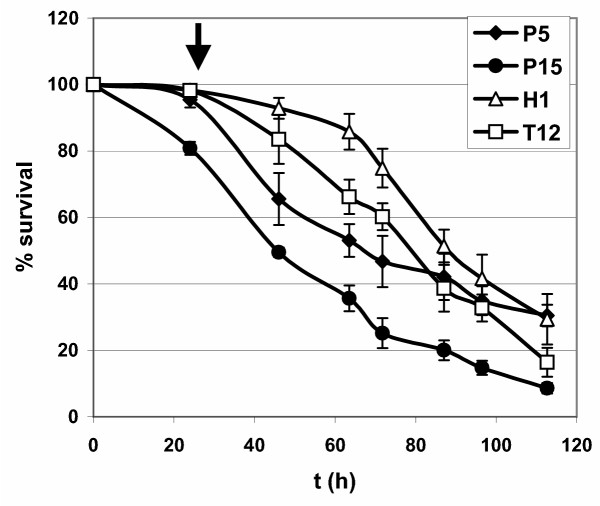
Figure 1
Figure 1
Lifespan reduction in Drosophila submitted to paraquat-, H2O2- and tunicamycin-induced stress 3-5 day-old Canton S wild type males were placed at t = 0 by groups of 30 in vials containing 15mM paraquat (P15: ●), 5 mM paraquat (P5: ◆), 1% H2O2 (H1: △) or 12 μM tunicamycin (T12: □). Dead flies were counted twice a day to determine survival. 3 vials of 30 individuals were used for each condition. When no toxic compound had been incorporated in the medium, more than 90% survival was observed at t = 120 h (not shown). Similar average lifespan was observed for P5, H1 and T12 around t = 80 h while it was significantly reduced in P15. Arrow indicates the time (t = 24 h) at which flies were collected for RNA extraction. Note the 20% lethality observed at this time for P15 condition. Dead flies were discarded before RNA extraction.
Figure 2
Figure 2
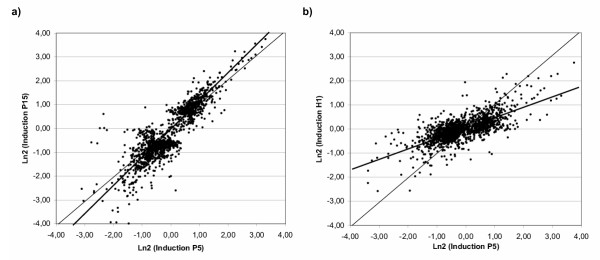
Correlations between P5 and P15 or H1 microarray measurements For each of the 1368 probe sets selected in the SAM analysis, the mean Ln2 ratios between the absolute values (AV) for stress and reference conditions were compared in two dimensional plots. Bold lines are the linear regression curves for the two comparisons, the thin lines correspond to a complete correlation for eye guidance. A good correlation is observed between P5 and P15 with a slope of 1.14, while it is much weaker between P5 and H1 (slope of 0.4).
Figure 3
Figure 3
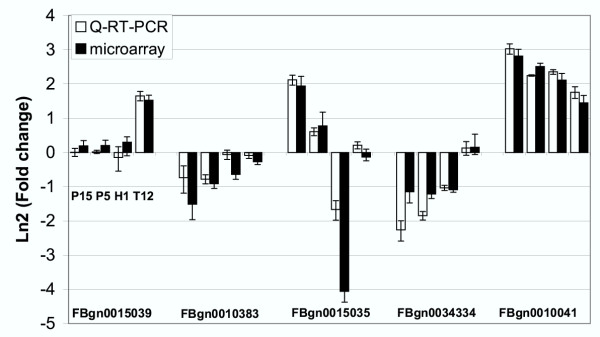
Comparison of transcript level variations detected with microarrays and with quantitative real-time PCR (Q-RT-PCR) Transcript levels were analyzed for genes encoding three P450 cytochromes (FBgn0015039, FBgn0010383 and FBgn0015035) and two glutathione transferases (FBgn0034334 and FBgn0010041). The Ln2 ratios between the transcript levels under stress conditions (P15, P5, H1 and T12) and the reference condition, obtained with Q-RT-PCR (white bars) and microarray analysis (black bars), are indicated for each gene. Error bars: standard errors.
Figure 4
Figure 4
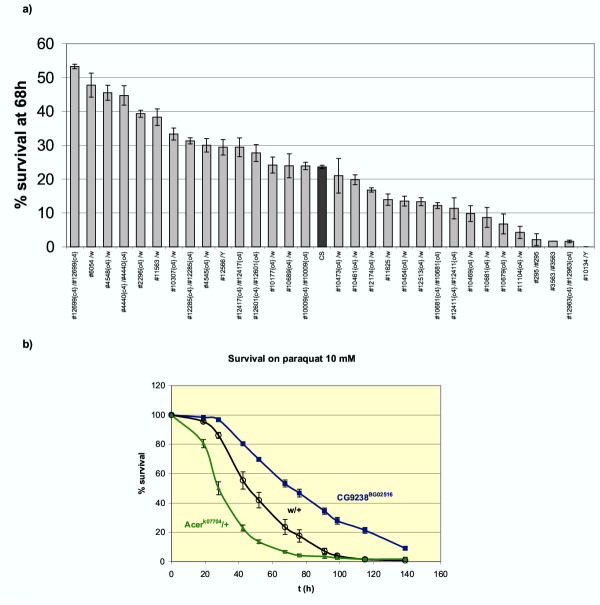
Resistance to paraquat-induced stress of flies mutant for genes identified in microarray experiments a) 29 Drosophila lines bearing mutations in genes identified in our microarray experiments as being stress-responsive were recovered from public stock centers. When the mutation was linked to a w+ transposon insertion these lines were outcrossed with a w+ Canton S reference line. 3–6 day old male flies were then tested for their resistance to oxidative stress 68 h after transfer to 10 mM paraquat medium. Tested flies were either homozygous (notation #i/#i in the X axis) for viable mutations or heterozygous (notation #i/w) for lethal mutations (in this case they are issued from a cross with w+ Canton S females). For simplicity, identification of lines (#i) refers to the Bloomington stock number and the genotype of the line is provided in Tab. 4. We present in this Figure the results of one of three independent experiments that we used for the complete statistical analysis presented in Table 4. Compared to male flies issued from a cross between w- males and Canton S females (noted w/+, dark bar), significant differences in resistance or sensitivity to paraquat can be observed for a large number of the lines tested. Error bars: standard error. b) Example of survival curves on 10 mM paraquat-containing medium of some mutant male flies. Flies heterozygous for a lethal mutation in the Angiotensin converting enzyme related (Acer) gene are sensitive to paraquat, while flies homozygous for an insertion in the gene CG9238 are clearly more resistant to paraquat than w/+ control flies. Neither of these genes was previously suspected to play a role in oxidative stress resistance.

References

    1. Guarente L, Kenyon C. Genetic pathways that regulate ageing in model organisms. Nature. 2000;408:255–62. doi: 10.1038/35041700. - DOI - PubMed
    1. Finkel T, Holbrook NJ. Oxidants, oxidative stress and the biology of ageing. Nature. 2000;408:239–47. doi: 10.1038/35041687. - DOI - PubMed
    1. Floyd RA. Antioxidants, oxidative stress, and degenerative neurological disorders. Proc Soc Exp Biol Med. 1999;222:236–45. doi: 10.1046/j.1525-1373.1999.d01-140.x. - DOI - PubMed
    1. Monnier V, Girardot F, Audin W, Tricoire H. Control of oxidative stress resistance by IP3 kinase in Drosophila melanogaster. Free Radic Biol Med. 2002;33:1250–9. doi: 10.1016/S0891-5849(02)01019-5. - DOI - PubMed
    1. Gasch AP, Werner-Washburne M. The genomics of yeast responses to environmental stress and starvation. Funct Integr Genomics. 2002;2:181–92. doi: 10.1007/s10142-002-0058-2. - DOI - PubMed

Publication types

MeSH terms