. 2005 Feb;288(2):G235-43.
doi: 10.1152/ajpgi.00334.2004. Epub 2004 Sep 30.

Effects of increased intracellular cAMP on carbachol-stimulated zymogen activation, secretion, and injury in the pancreatic acinar cell

Affiliations

Effects of increased intracellular cAMP on carbachol-stimulated zymogen activation, secretion, and injury in the pancreatic acinar cell

A Chaudhuri et al. Am J Physiol Gastrointest Liver Physiol. 2005 Feb.

Abstract

A characteristic of acute pancreatitis is the premature activation and retention of enzymes within the pancreatic acinar cell. Because ligands linked to cAMP production may prevent some forms of pancreatitis, we evaluated the effects of increased intracellular cAMP in the rat pancreatic acinar cell. Specifically, this study examined the effects of the cholinergic agonist carbachol and agents that increase cAMP [secretin and 8-bromoadenosine 3',5'-cyclic monophosphate (8-Br-cAMP)] on zymogen activation (trypsin and chymotrypsin), enzyme secretion, and cellular injury in isolated pancreatic acini. Although cAMP agonists affected the responses to physiological concentrations of carbachol (1 microM), their most prominent effects were observed with supraphysiological concentrations (1 mM). When secretin was added to 1 mM carbachol, there was a slight increase in zymogen activation, but no change in the secretion of amylase or chymotrypsin. Furthermore, coaddition of secretin increased parameters of cell injury (trypan blue exclusion, lactic dehydrogenase release, and morphological markers) compared with carbachol (1 mM) alone. Although directly increasing cellular cAMP by 8-Br-cAMP caused much greater zymogen activation than carbachol (1 mM) alone or with secretin, 8-Br-cAMP cotreatment reduced all parameters of injury to the level of unstimulated acini. Furthermore, 8-Br-cAMP dramatically enhanced the secretion of amylase and chymotrypsin from the acinar cell. This study demonstrates that increasing acinar cell cAMP can overcome the inhibition of enzyme secretion caused by high concentrations of carbachol and eliminate acinar cell injury.


Figures
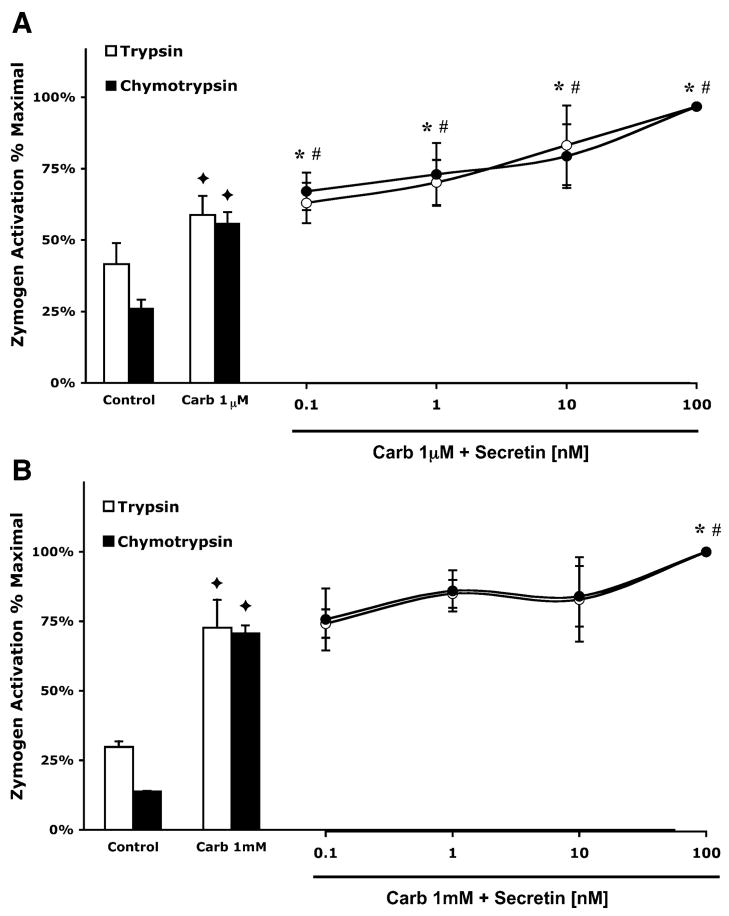
Fig. 1
Fig. 1
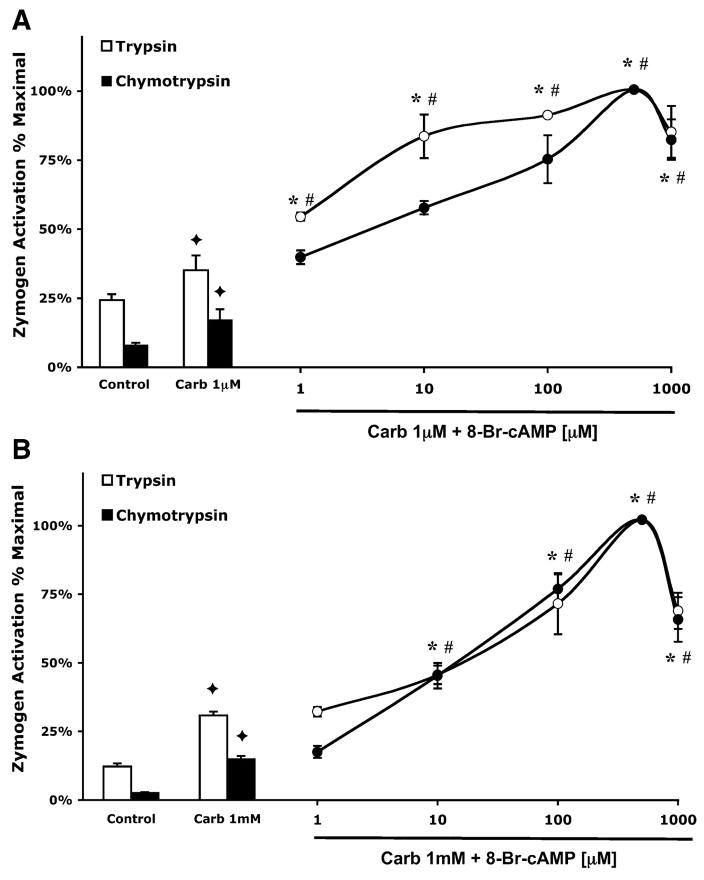
8-bromoadenosine 3′,5′-cyclic monophosphate (8-Br-cAMP) enhances carbachol-stimulated zymogen activation. Acini were incubated with or without 8-Br-cAMP (1–1,000 μM) in the presence of 1 μM carbachol (Carb; A) or 1 mM carbachol (B) for 1 h. Samples were assayed for trypsin and chymotrypsin activity. Results are expressed as a percentage of the treatment that produced maximum zymogen activation (1 μM or 1 mM carbachol + 500 μM 8-Br-cAMP). All samples represent the means ± SE from 3 separate experiments. ✦ P < 0.05 vs. control; *P < 0.05 vs. corresponding dose of carbachol alone for trypsin; #P < 0.05 vs. corresponding dose of carbachol alone for chymotrypsin.
Fig. 2
Fig. 2
Secretin enhances zymogen activation stimulated by physiological doses of carbachol. Secretin has a minimal effect on zymogen activation induced by supraphysiological carbachol. Acini were incubated with or without secretin (0.1–100 nM) in the presence of 1 μM carbachol (A) or 1 mM carbachol (B) for 1 h. Samples were assayed for trypsin and chymotrypsin activity. Results are expressed as a percentage of the treatment that produced maximum zymogen activation (1 μM or 1 mM carbachol + 100 nM secretin). All samples represent the means ± SE from 3 separate experiments. ✦ P < 0.05 vs. control; *P < 0.05 vs. corresponding dose of carbachol alone for trypsin; #P < 0.05 vs. corresponding dose of carbachol alone for chymotrypsin.
Fig. 3
Fig. 3
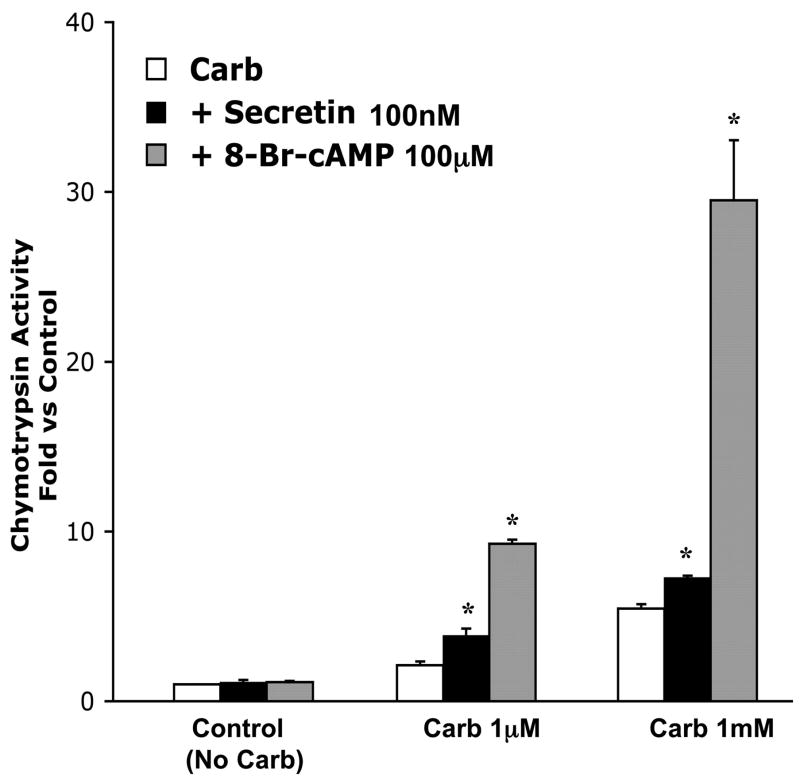
Magnitude of chymotrypsin activation caused by 8-Br-cAMP (100 μM) is greater than that caused by secretin (100 nM). Acini were incubated with or without 8-Br-cAMP (100 μM) or secretin (100 nM) in the presence of carbachol (1 μM and 1 mM) for 1 h and samples assayed for chymotrypsin activity. Results are expressed as fold vs. control. Note that control indicates no carbachol. Neither 100 μM 8-Br-cAMP nor 100 nM secretin had a significant effect on control cells. All samples represent the means ± SE from 3 separate experiments. *P < 0.05 vs. corresponding dose of carbachol alone.
Fig. 4
Fig. 4
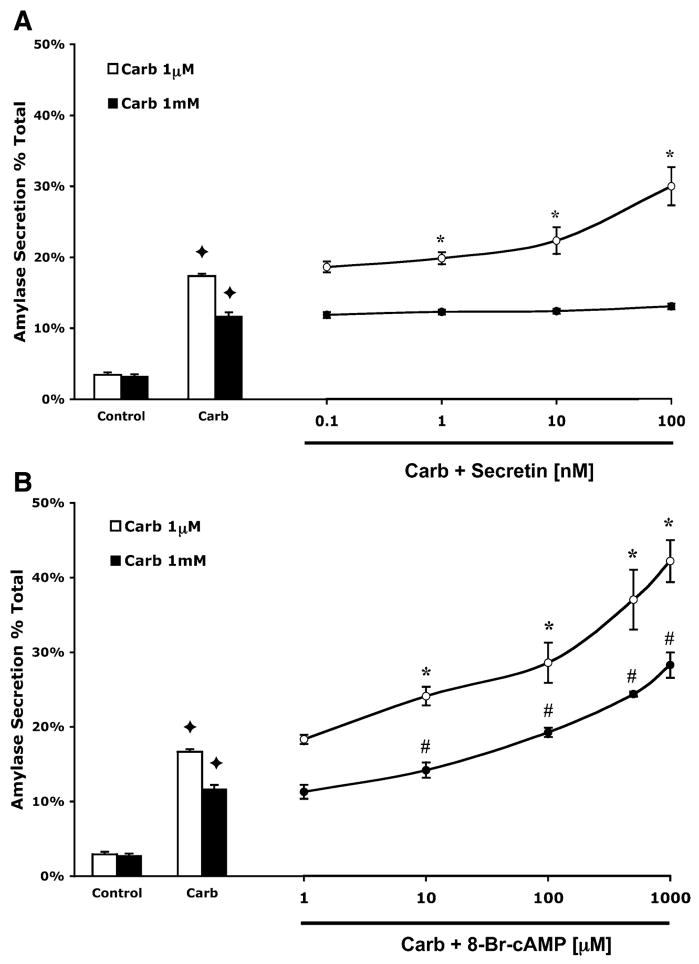
8-Br-cAMP enhances amylase secretion stimulated by physiological and supraphysiological carbachol. Secretin enhances amylase secretion induced by physiological, but not supraphysiological carbachol. Acini were incubated with or without either 1–1,000 μM 8-Br-cAMP (A) or 0.1–100 nM secretin (B) in the presence of carbachol (1 μM or 1 mM) and assayed for amylase secretion. All samples represent the means ± SE from 3 separate experiments. ✦ P < 0.05 vs. control; *P < 0.05 vs. 1 μM carbachol alone; #P < 0.05 vs. 1 mM carbachol alone.
Fig. 5
Fig. 5
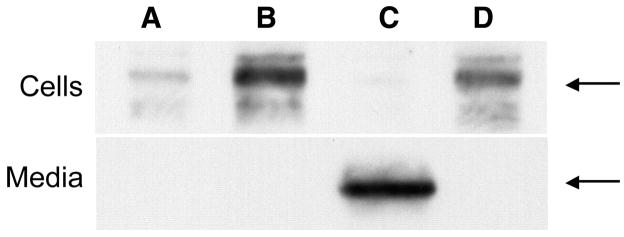
Addition of 8-Br-cAMP to isolated acini treated with supraphysiological carbachol causes the release of chymotrypsin into the medium. Autoradiograph depicting presence of chymotrypsin in cells (top) and medium (bottom). Bands indicated by arrows correspond to chymotrypsin in unstimulated control (A) and samples treated with 1 mM carbachol (B), 1 mM carbachol with 100 μM 8-Br-cAMP (C), and 1 mM carbachol with 100 nM secretin (D). Note that although all treatments (BD) increased the levels of chymotrypsin over control (A), the enzyme appeared in the medium only after treatment with carbachol and 8-Br-cAMP (C). This autoradiograph is representative of 3 studies.
Fig. 6
Fig. 6
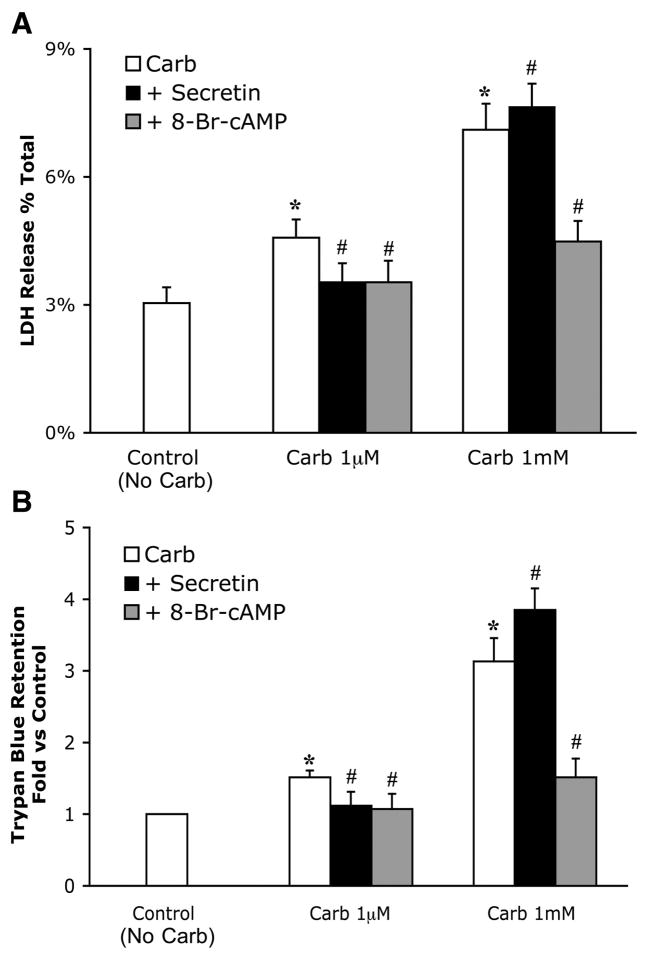
8-Br-cAMP and secretin reduce the small amount of injury caused by physiological carbachol. 8-Br-cAMP, but not secretin, reduces injury caused by supraphysiological carbachol. Acini were incubated with or without 8-Br-cAMP (100 μM) or secretin (100 nM) in the presence of carbachol (1 μM and 1 mM) for 2 h. Samples were assayed for LDH release as a percentage of total LDH (A). Trypan blue retention was determined as the ratio of λ583:λ260 and expressed as fold vs. control (B). Note that control indicates no carbachol. All samples represent the means ± SE from 3 separate experiments. *P < 0.05 vs. control; #P < 0.05 vs. carbachol alone.
Fig. 7
Fig. 7
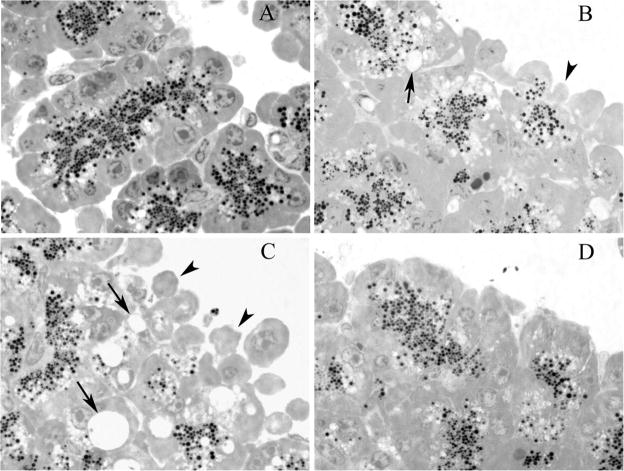
Morphological indicators demonstrate that 8-Br-cAMP, but not secretin, ameliorates injury caused by supraphysiological carbachol. Representative photograph showing basolateral blebbing (arrowheads) and vacuolization (arrows) in unstimulated controls (A) and samples treated with 1 mM carbachol (B), 1 mM carbachol with 100 nM secretin (C), and 1 mM carbachol with 100 μM 8-Br-cAMP (D). Note that the injury produced by 1 mM carbachol is ameliorated by the addition of 100 μM 8-Br-cAMP.

References

    1. Akiyama T, Hirohata Y, Okabayashi Y, Imoto I, Otsuki M. Supramaximal CCK and CCh concentrations abolish VIP potentiation by inhibiting adenylyl cyclase activity. Am J Physiol Gastrointest Liver Physiol. 1998;275:G1202–G1208. - PubMed
    1. Burnham DB, McChesney DJ, Thurston KC, Williams JA. Interaction of cholecystokinin and vasoactive intestinal polypeptide on function of mouse pancreatic acini in vitro. J Physiol. 1984;349:475–482. - PMC - PubMed
    1. Fallon M, Gorelick F, Anderson J, Mennone A, Saluja A, Steer M. Effect of cerulein hyperstimulation on the paracellular barrier of rat exocrine pancreas. Gastroenterology. 1995;108:1863–1872. - PubMed
    1. Grady T, Mah’moud M, Otani T, Rhee S, Lerch MM, Gorelick FS. Zymogen proteolysis within the pancreatic acinar cell is associated with cellular injury. Am J Physiol Gastrointest Liver Physiol. 1998;275:G1010–G1017. - PubMed
    1. Hofbauer B, Saluja AK, Lerch MM, Bhagat L, Bhatia M, Lee HS, Frossard JL, Adler G, Steer ML. Intra-acinar cell activation of trypsinogen during caerulein-induced pancreatitis in rats. Am J Physiol Gastrointest Liver Physiol. 1998;275:G352–G362. - PubMed

Publication types

MeSH terms

LinkOut - more resources