


Inflammation in ankylosing spondylitis: a systematic description of the extent and frequency of acute spinal changes using magnetic resonance imaging
- PMID: 15458963
- PMCID: PMC1755467
- DOI: 10.1136/ard.2004.029298
Inflammation in ankylosing spondylitis: a systematic description of the extent and frequency of acute spinal changes using magnetic resonance imaging
Abstract
Background: Magnetic resonance imaging (MRI) is increasingly used to detect inflammation in the spine of patients with ankylosing spondylitis (AS).
Objectives: To detect differentially the presence and extent of inflammation in the three spinal segments of patients with AS by MRI.
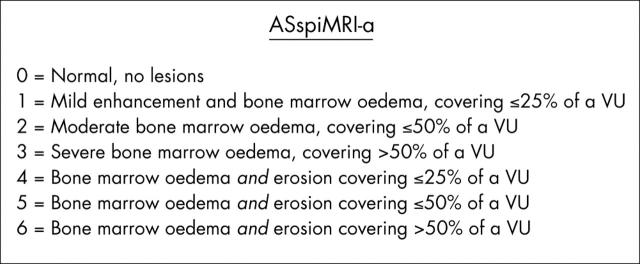
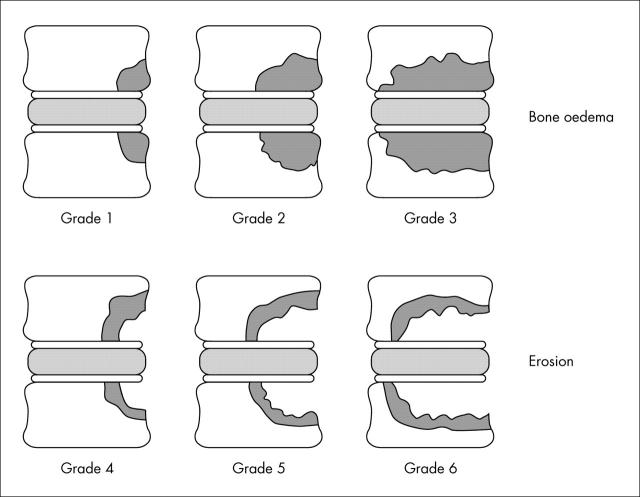
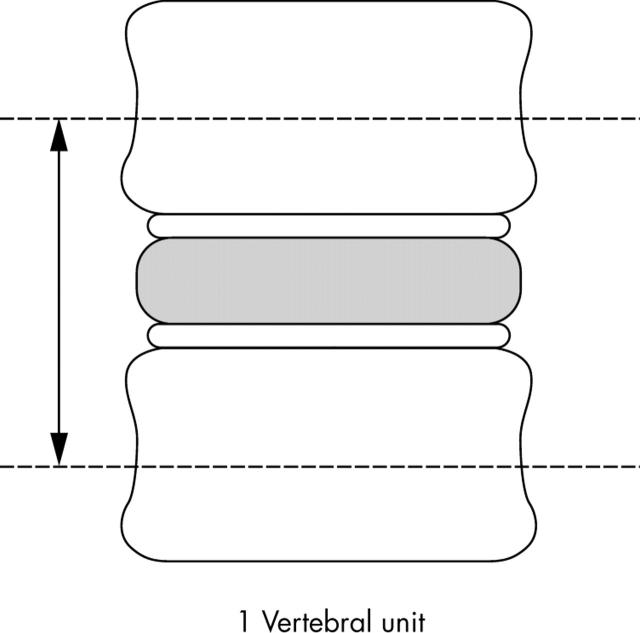
Methods: In 38 patients with active AS, acute spinal lesions were assessed by T(1) weighted, gadolinium enhanced, spin echo MRI (T(1)/Gd-DTPA) and short tau inversion recovery (STIR) sequences. MRI was quantified by the validated scoring system ASspiMRI-a. Acute spinal lesions were detected in the whole spine and in each spinal segment. One vertebral unit (VU) was defined as the region between two virtual lines drawn through the middle of each vertebral body.
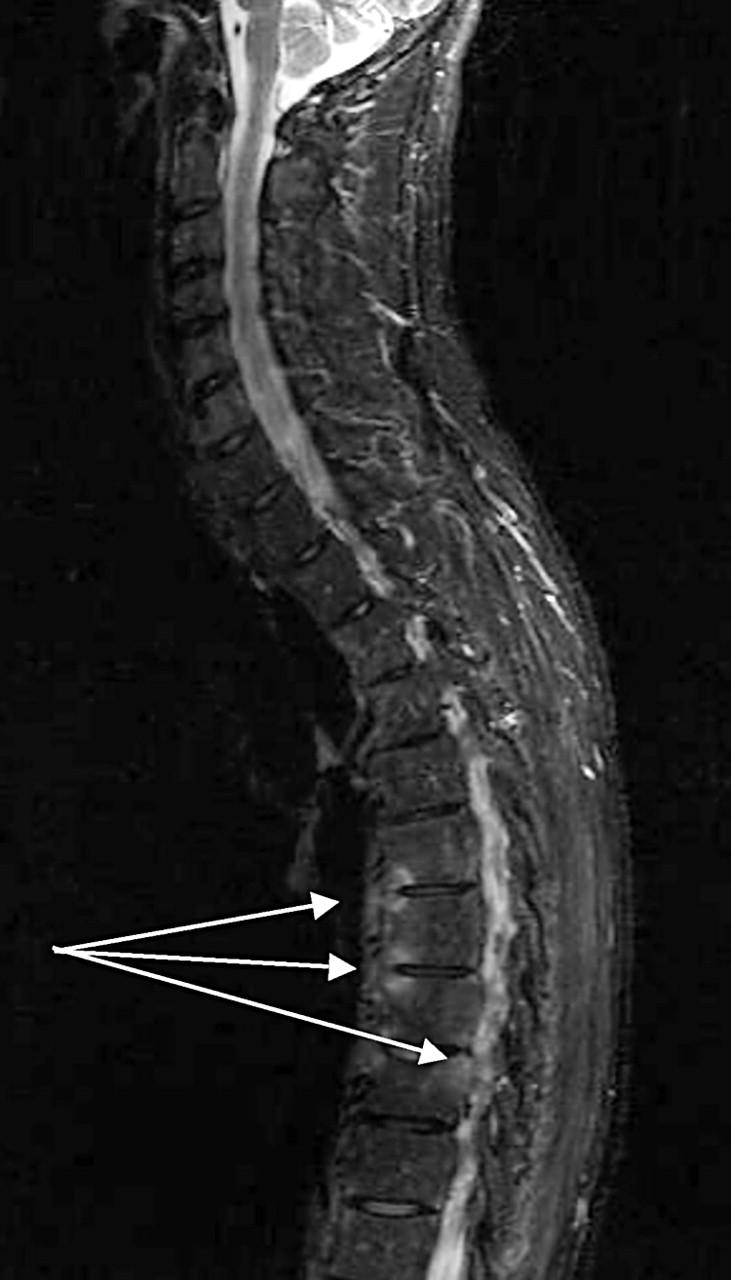
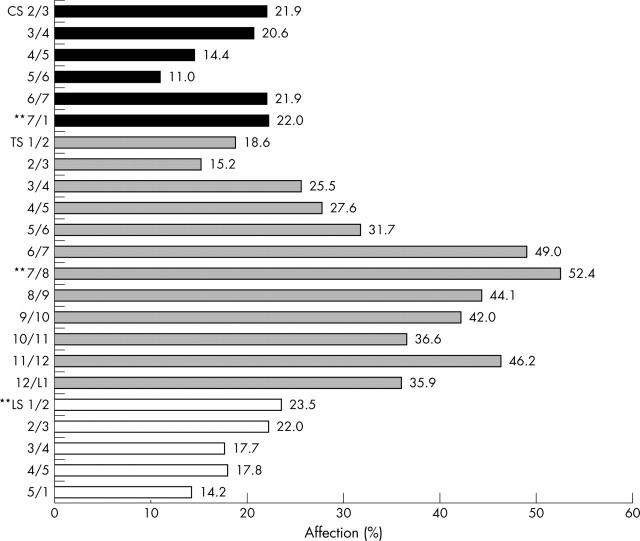
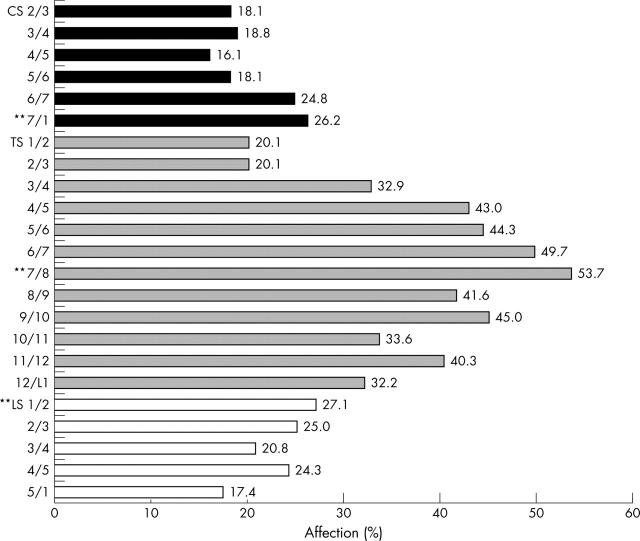
Results: A greater number of inflammatory spinal lesions were found by the STIR sequence than by Gd-DTPA: inflammation was present in 30.6% of the VUs as assessed by STIR, compared with 26.8% of the same VUs assessed by T(1)/Gd-DTPA. Inflammation was found more commonly in the thoracic spine (TS) than in the cervical (CS) or the lumbar spine (LS) with both techniques. When STIR was used, spinal inflammation in the CS, the TS, and LS was detected in 10/38 (26%), 28/38 (74%), and 9/38 (24%) patients, respectively. The VU T7/8 was found to be the VU most often affected by both techniques (27.8% by T(1)/Gd-DTPA and 34.5% by STIR).
Conclusions: Spinal inflammation is a common manifestation in patients with AS, and appears more frequently in the TS. The scoring system ASspiMRI-a can be used for evaluation of acute spinal changes in AS.
Figures
References
Publication types
MeSH terms
Substances
LinkOut - more resources
Full Text Sources
Medical
Research Materials
