Additional coiling of previously coiled cerebral aneurysms: clinical and angiographic results
- PMID: 15466335
- PMCID: PMC7975452
Additional coiling of previously coiled cerebral aneurysms: clinical and angiographic results
Abstract
Background and purpose: Some cerebral aneurysms that have been coiled reopen over time and additional treatment should be considered to reduce the risk of recurrent hemorrhage. Our purpose was to assess procedural complications and angiographic results of additional coiling in patients with previously coiled but reopened aneurysms and to evaluate protection against (re)bleeding.
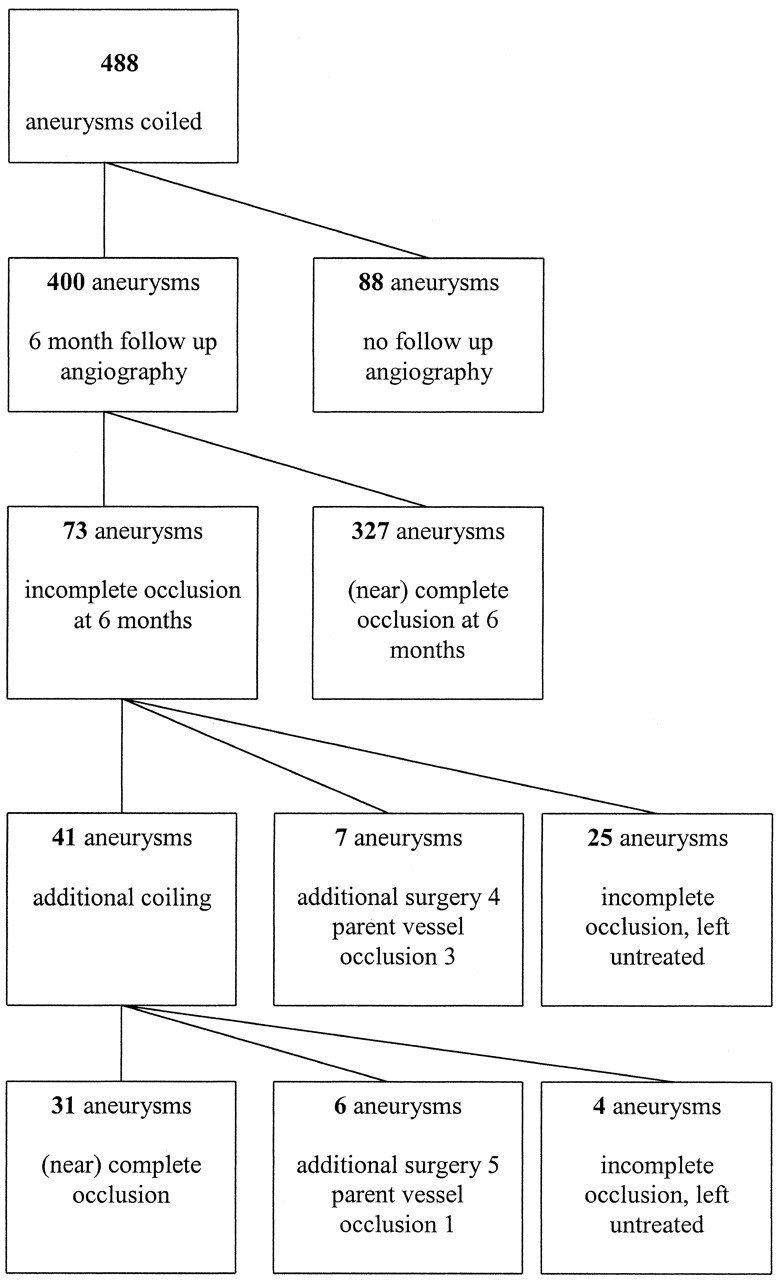
Methods: We compared procedural complications of initial coiling of 488 aneurysms in 439 patients with those of 53 additional coiling procedures in 41 reopened aneurysms in 40 patients. Angiographic results of additional coiling were assessed. We compared episodes of (re)bleeding in patients with complete or near-complete aneurysm occlusion after additional coiling with those of patients with incomplete aneurysm occlusion at 6-month follow-up angiography who were not additionally treated or who still had incomplete occlusion after additional coiling.
Results: Thirty-five procedural complications occurred in 488 initial coiling procedures, and no complications occurred in 53 additional procedures. Complete or near-complete angiographic occlusion after additional coiling was obtained in 31 (76%) of 41 aneurysms. Rebleeding occurred in two of 29 patients with incomplete aneurysm occlusion but in none of the 31 patients with complete or near-complete occlusion after additional coiling.
Conclusion: Additional coiling of previously coiled aneurysms has a low procedural complication rate and leads to sufficient occlusion in most aneurysms. The data indicate that successful additional coiling decreases the risk of rebleeding.
Figures
References
-
- Brilstra EH, Rinkel GJ, van der Graaf Y, van Rooij WJ, Algra A. Treatment of intracranial aneurysms by embolization with coils: a systematic review. Stroke 1999;30:470–476 - PubMed
-
- Molyneux A, Kerr R, Stratton I, et al. International Subarachnoid Aneurysm Trial (ISAT) of neurosurgical clipping versus endovascular coiling in 2143 patients with ruptured intracranial aneurysms: a randomised trial. Lancet 2002;360:1267–1274 - PubMed
-
- Sluzewski M, van Rooij WJ, Rinkel GJ, Wijnalda D. Endovascular treatment of ruptured intracranial aneurysms with detachable coils: long term clinical and serial angiographic results. Radiology 2003;227:720–724 - PubMed
-
- Byrne JV, Sohn MJ, Molyneux AJ, Chir B. Five-year experience in using coil embolization for ruptured intracranial aneurysms: outcomes and incidence of late rebleeding. J Neurosurg 1999;90:656–663 - PubMed
-
- Cognard C, Weill A, Castaings L, Rey A, Moret J. Intracranial berry aneurysms: angiographic and clinical results after endovascular treatment. Radiology 1998;206:499–510 - PubMed
MeSH terms
LinkOut - more resources
Full Text Sources
Medical