. 2004 Oct;70(10):5769-77.
doi: 10.1128/AEM.70.10.5769-5777.2004.

Riboflavin production in Lactococcus lactis: potential for in situ production of vitamin-enriched foods

Affiliations

Riboflavin production in Lactococcus lactis: potential for in situ production of vitamin-enriched foods

Catherine Burgess et al. Appl Environ Microbiol. 2004 Oct.

Abstract

This study describes the genetic analysis of the riboflavin (vitamin B(2)) biosynthetic (rib) operon in the lactic acid bacterium Lactococcus lactis subsp. cremoris strain NZ9000. Functional analysis of the genes of the L. lactis rib operon was performed by using complementation studies, as well as by deletion analysis. In addition, gene-specific genetic engineering was used to examine which genes of the rib operon need to be overexpressed in order to effect riboflavin overproduction. Transcriptional regulation of the L. lactis riboflavin biosynthetic process was investigated by using Northern hybridization and primer extension, as well as the analysis of roseoflavin-induced riboflavin-overproducing L. lactis isolates. The latter analysis revealed the presence of both nucleotide replacements and deletions in the regulatory region of the rib operon. The results presented here are an important step toward the development of fermented foods containing increased levels of riboflavin, produced in situ, thus negating the need for vitamin fortification.


Figures
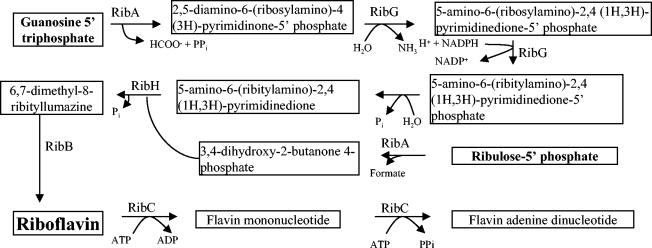
FIG. 1.
FIG. 1.
Riboflavin biosynthetic pathway in bacteria. The enzymes encoded by L. lactis responsible for each step are indicated. RibG, riboflavin-specific deaminase/reductase; RibB, riboflavin synthase (alpha subunit); RibA, GTP cyclohydrolase II/3,4-dihydroxy-2-butanone-4-phosphate synthase; RibH, lumazine synthase (beta subunit).
FIG. 2.
FIG. 2.
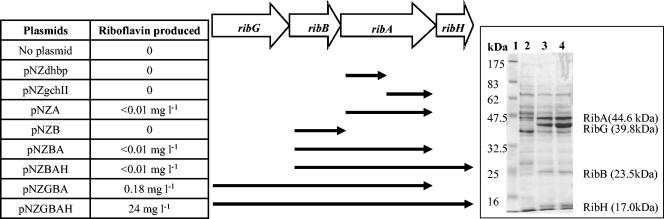
Constructs made in pNZ8048 and effect on extracellular riboflavin production upon nisin induction. The black arrows indicate the various regions of the rib operon cloned into pNZ8048. The effect of nisin induction on riboflavin production is indicated in the table. Sodium dodecyl sulfate-12.5% polyacrylamide gel electrophoresis shows a protein profile of NZ9000(pNZGBAH) after induction with various amounts of nisin. Lane 1 contains a size marker with sizes indicated in the left-hand margin, lane 2 contains uninduced NZ9000(pNZGBAH), lane 3 contains NZ9000(pNZGBAH) induced with 1 ng of nisin ml−1, and lane 4 contains NZ9000(pNZGBAH) induced with 5 ng of nisin ml−1. The overexpressed Rib proteins with their calculated molecular masses are indicated in the right-hand margin.
FIG. 3.
FIG. 3.
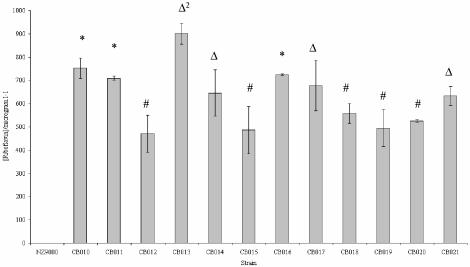
Riboflavin levels in the cell-free supernatant of roseoflavin-resistant strains grown in CDM for 8 h. ✽, values for isolates that were shown to carry a G→T mutation in the first stem of the RFN regulatory element; #, values for isolates that were shown to carry a G→A mutation in the third loop of the RFN element; Δ, values for isolates that were shown to carry a 90-bp deletion; Δ2, values for the isolate that was shown to carry a 138-bp deletion.
FIG. 4.
FIG. 4.
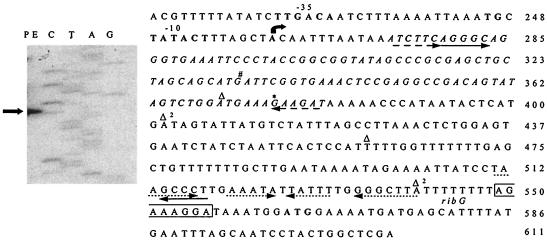
Primer extension (PE) analysis of the ribP1 promoter run alongside a sequencing ladder. The deduced −35 and 10 boxes are indicated in boldface type in the sequence displayed on the right-hand side of the figure. The bent arrow indicates the identified transcription start site. The identified RFN element is marked in italics. The assumed ribosomal binding site is boxed, and the ribG start codon is in boldface. The dotted arrows beneath the sequence indicate the terminator. The solid arrows indicate the antiterminator. The dashed arrows indicate the anti-antiterminator. ✽ and #, positions of mutations found in roseoflavin-resistant mutants; Δ, start and end of a 90-bp deletion found in three roseoflavin-resistant mutants; Δ2, start and end of a 138-bp deletion found in one strain.
FIG. 5.
FIG. 5.
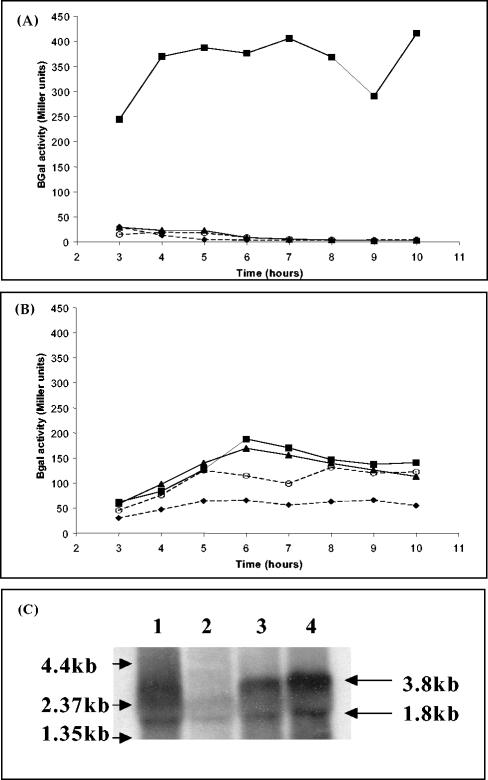
(A) β-Galactosidase activity of NZ9000(pPTPLop). (B) β-Galactosidase activity of CB010 (pPTPLcbop). The dashed line with solid diamonds represents growth in GM17, the solid line with solid squares represents growth in CDM, the solid line with solid triangles represents growth in CDM plus riboflavin, and the dashed lines with open circles represents growth in CDM plus FMN. (C) Northern blot with ribH as a probe. Lane 1, NZ9000 RNA from CDM; lane 2, NZ9000 RNA from CDM plus riboflavin; lane 3, CB010 RNA from CDM; lane 4, CB010 RNA from CDM plus riboflavin. An RNA size ladder is indicated on the left. The sizes of the transcripts are indicated on the right.

References

    1. Akompong, T., N. Ghori, and K. Haldar. 2000. In vitro activity of riboflavin against the human malaria parasite Plasmodium falciparum. Antimicrob. Agents Chemother. 44:88-96. - PMC - PubMed
    1. Altschul, S. F., T. L. Madden, A. A. Schaffer, J. Zhang, Z. Zhang, W. Miller, and D. J. Lipman. 1997. Gapped BLAST and PSI-BLAST: a new generation of protein database search programs. Nucleic Acids Res. 25:3389-3402. - PMC - PubMed
    1. Bacher, A., S. Eberhardt, M. Fischer, K. Kis, and G. Richter. 2000. Biosynthesis of vitamin B2 (riboflavin). Annu. Rev. Nutr. 20:153-167. - PubMed
    1. Bacher, A., S. Eberhardt, and G. Richter. 1996. Biosynthesis of riboflavin, p. 657-664. In F. C. Neidhardt, R. Curtiss III, J. L. Ingraham, E. C. C. Lin, K. B. Low, B. Magasanik, W. S. Reznikoff, M. Riley, M. Schaechter, and H. E. Umbarger (ed.), Escherichia coli and Salmonella: cellular and molecular biology, 2nd ed. ASM Press, Washington, D.C.
    1. Bandrin, S. V., P. M. Rabinovich, and A. I. Stepanov. 1983. Three linkage groups of the genes of riboflavin biosynthesis in Escherichia coli. Genetika 19:1419-1425. (In Russian.) - PubMed

Publication types

MeSH terms

Associated data

LinkOut - more resources