


Comment
doi: 10.1172/JCI23168.
Gene therapy for type 1 diabetes: a novel approach for targeted treatment of autoimmunity
Affiliations
- PMID: 15467826
- PMCID: PMC518674
- DOI: 10.1172/JCI23168
Item in Clipboard
Comment
Gene therapy for type 1 diabetes: a novel approach for targeted treatment of autoimmunity
J Clin Invest.
2004 Oct.
Abstract
It has been difficult to develop therapies that target those T cells initiating and mediating the pathogenesis of autoimmune disease. Indeed, most current treatments indiscriminately affect both the autoreactive T cells and the "good" T cells, putting the patient at risk of compromised immune function. A new approach raises the possibility of targeted therapy for autoimmunity. Transplantation of hematopoietic stem cells modified to express a protective form of MHC class II corrects a defect in central tolerance. This method contrasts with other targeted therapies that attempt to modify peripheral tolerance, which is also defective in type 1 diabetes mellitus.
Figures
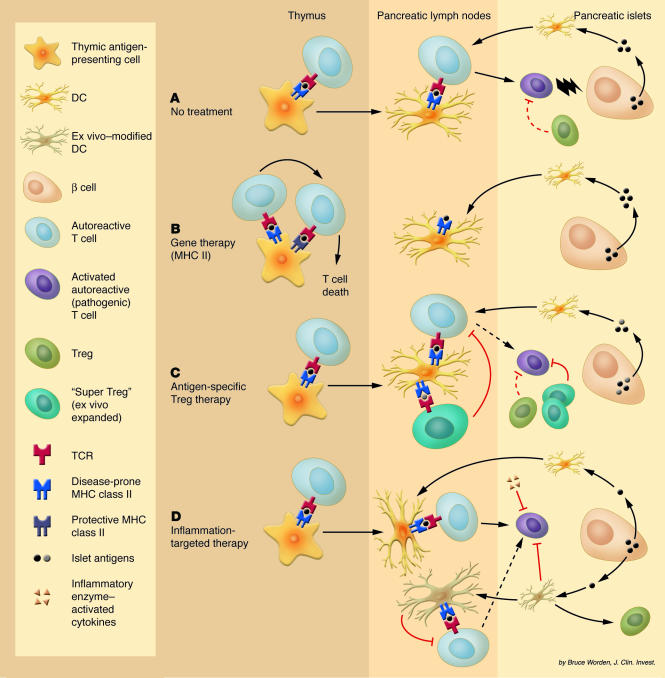
(A) Due to several combined defects, autoreactive T cells in NOD mice escape negative selection in the thymus and become activated in the pancreatic lymph nodes. The resulting effector T cells are kept under control for a limited period (resulting in peri-insulitis) until regulation (likely to involve Treg’s) is no longer sufficient, and overt T1DM develops. (B) In irradiated NOD mice reconstituted with HSCs expressing a protective form of MHC class II, autoreactive T cells are efficiently deleted in the thymus and absolutely no insulitis is observed. (C) Antigen-specific Treg’s from the islet infiltrate may be isolated and expanded ex vivo. When reintroduced, these cells prove to be efficient suppressors and may do so both in the pancreatic lymph nodes and in the pancreatic lesions. (D) DCs (or antigen-specific T cells) may be isolated and modified ex vivo to express: (a) immunoregulatory proteins that induce tolerance, apoptosis, or immune deviation of autoreactive T cells; and (b) appropriate receptors to enhance their trafficking into the sites of inflammation. Alternatively, inhibitory cytokines that have been engineered to become activated only under inflammatory conditions can be injected. These two strategies favor local versus systemic action of inhibitory products.
Comment on
-
Prevention of type 1 diabetes by gene therapy.J Clin Invest. 2004 Oct;114(7):969-78. doi: 10.1172/JCI22103. J Clin Invest. 2004. PMID: 15467836 Free PMC article.
References
-
- McDevitt HO. The role of MHC class II molecules in susceptibility and resistance to autoimmunity. Curr. Opin. Immunol. 1998;10:677–681. - PubMed
-
- Ridgway WM, Fasso M, Fathman CG. A new look at MHC and autoimmune disease. Science. 1999;284:749–751. - PubMed
-
- Kishimoto H, Sprent J. A defect in central tolerance in NOD mice. Nat. Immunol. 2001;2:1025–1031. - PubMed
Publication types
MeSH terms
LinkOut - more resources
Full Text Sources
Other Literature Sources
Medical
Research Materials
