Review
. 2004 Oct;8(5):356-62.
doi: 10.1186/cc2862. Epub 2004 May 13.

Bench-to-bedside review: iron metabolism in critically ill patients

Affiliations
Review

Bench-to-bedside review: iron metabolism in critically ill patients

Martin Darveau et al. Crit Care. 2004 Oct.

Abstract

Critically ill patients frequently develop anemia due to several factors. Iron-withholding mechanisms caused by inflammation contribute to this anemia. The iron metabolism imbalances described or reported in all intensive care studies are similar to the values observed in anemia of inflammation. The administration of iron could be useful in the optimization of recombinant human erythropoietin activity, but this could be at the expense of bacterial proliferation. Since there is a lack of evidence to support either oral or intravenous iron administration in intensive care patients, further studies are necessary to determine the efficacy and safety of iron supplementation in conjunction with recombinant human erythropoietin in critically ill patients. We review the mechanisms leading to iron sequestration in the presence of inflammation. The present article also reviews the literature describing the iron status in critically ill patients and explores the role of iron supplementation in this setting.


Figures
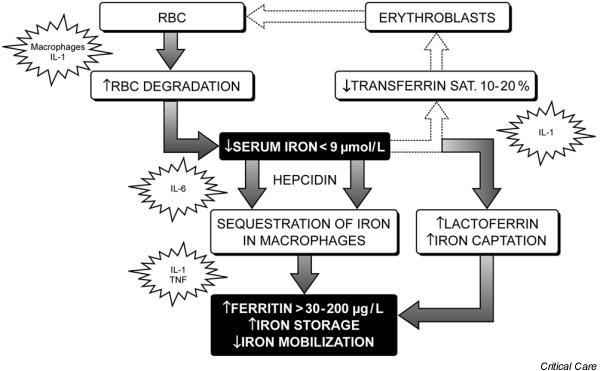
Figure 1
Figure 1
Decrease in iron recycling in the presence of inflammation: iron metabolism in critically ill patients. Most of the iron available for erythropoiesis comes from the catabolism of senescent red blood cells (RBC) by the macrophages in the reticuloendothelial system. Under normal conditions, there is a balance between the iron transport paths and the iron stores: serum iron, 9–27 μmol/l; transferrin, 3–6 g/l; transferrin saturation (sat.), 30–50%; ferritin, 50–150 μg/l. In the presence of inflammation, the synthesis of ferritin is increased by IL-1 and by tumor necrosis factor (TNF). Hypoferremia rapidly sets in due to an increase in the iron-binding capacity of ferritin to the detriment of transferrin. IL-l also stimulates lactoferrin synthesis. Iron bound to lactoferrin is captured by the macrophages and is stored in the form of ferritin. Hepcidin could be a central mediator of iron sequestration in macrophages. Grey arrows, pathways increased by inflammation; broken arrows, pathways decreased by inflammation.

References

    1. Vincent JL, Baron JF, Reinhart K, Gattinoni L, Thijs L, Webb A, Meier-Hellmann A, Nollet G, Peres-Bota D. Anemia and blood transfusion in critically ill patients. JAMA. 2002;288:1499–1507. doi: 10.1001/jama.288.12.1499. - DOI - PubMed
    1. Corwin HL, Gettinger A, Pearl RG, Fink MP, Levy MM, Abraham E, MacIntyre NR, Shabot M, Duh MS, Shapiro MJ. The CRIT study: anemia and blood transfusion in the critically ill – current clinical practice in the United States. Crit Care Med. 2004;32:39–52. doi: 10.1097/01.CCM.0000104112.34142.79. - DOI - PubMed
    1. von Ahsen N, Müller C, Serke S, Frei U, Eckardt KU. Important role of nondiagnostic blood loss and blunted erythropoietic response in the anemia of medical intensive care patients. Crit Care Med. 1999;27:2630–2639. doi: 10.1097/00003246-199912000-00005. - DOI - PubMed
    1. Ba VN, Bota DP, Mélot C, Vincent J. Time course of hemoglobin concentrations in non bleeding intensive care unit patients. Crit Care Med. 2003;31:406–410. doi: 10.1097/01.CCM.0000048623.00778.3F. - DOI - PubMed
    1. Means RT. Recent developments in the anemia of chronic disease. Curr Hematol Rep. 2003;2:116–121. - PubMed

Publication types
