. 2004 Oct 9:5:18.
doi: 10.1186/1471-2199-5-18.

Transcriptional oscillation of canonical clock genes in mouse peripheral tissues

Affiliations

Transcriptional oscillation of canonical clock genes in mouse peripheral tissues

Takuro Yamamoto et al. BMC Mol Biol. .

Abstract

Background: The circadian rhythm of about 24 hours is a fundamental physiological function observed in almost all organisms from prokaryotes to humans. Identification of clock genes has allowed us to study the molecular bases for circadian behaviors and temporal physiological processes such as hormonal secretion, and has prompted the idea that molecular clocks reside not only in a central pacemaker, the suprachiasmatic nuclei (SCN) of hypothalamus in mammals, but also in peripheral tissues, even in immortalized cells. Furthermore, previous molecular dissection revealed that the mechanism of circadian oscillation at a molecular level is based on transcriptional regulation of clock and clock-controlled genes.

Results: We systematically analyzed the mRNA expression of clock and clock-controlled genes in mouse peripheral tissues. Eight genes (mBmal1, mNpas2, mRev-erbalpha, mDbp, mRev-erbbeta, mPer3, mPer1 and mPer2; given in the temporal order of the rhythm peak) showed robust circadian expressions of mRNAs in all tissues except testis, suggesting that these genes are core molecules of the molecular biological clock. The bioinformatics analysis revealed that these genes have one or a combination of 3 transcriptional elements (RORE, DBPE, and E-box), which are conserved among human, mouse, and rat genome sequences, and indicated that these 3 elements may be responsible for the biological timing of expression of canonical clock genes.

Conclusions: The observation of oscillatory profiles of canonical clock genes is not only useful for physiological and pathological examination of the circadian clock in various organs but also important for systematic understanding of transcriptional regulation on a genome-wide basis. Our finding of the oscillatory expression of canonical clock genes with a temporal order provides us an interesting hypothesis, that cyclic timing of all clock and clock-controlled genes may be dependent on several transcriptional elements including 3 known elements, E-box, RORE, and DBPE.


Figures
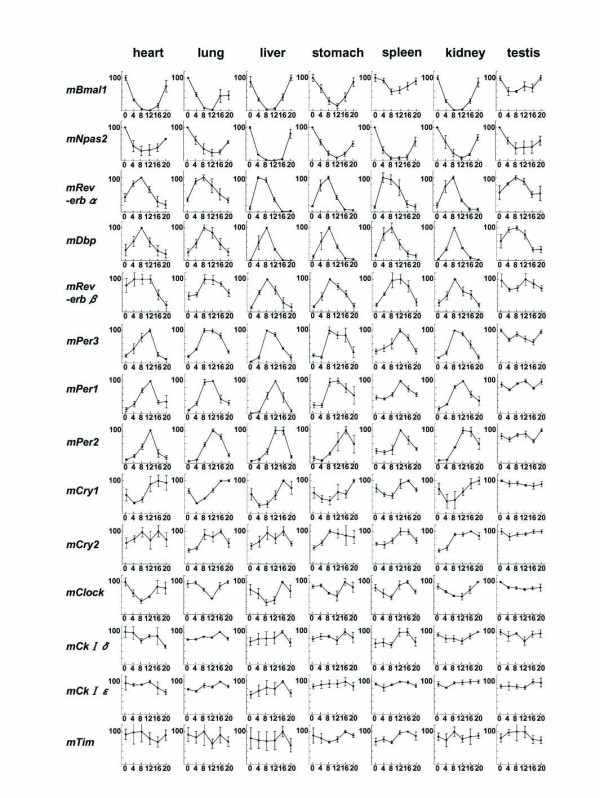
Figure 1
Figure 1
Temporal mRNA expression of clock and clock-related genes in mouse peripheral tissues Abscissa presents time at CT (circadian time); and ordinate, mRNA amounts. The relative levels of each RNA were normalized to the corresponding G3-PDH RNA levels. The maximum RNA amount was set to 100. Data are presented as the mean ± SE of triplicate samples.
Figure 2
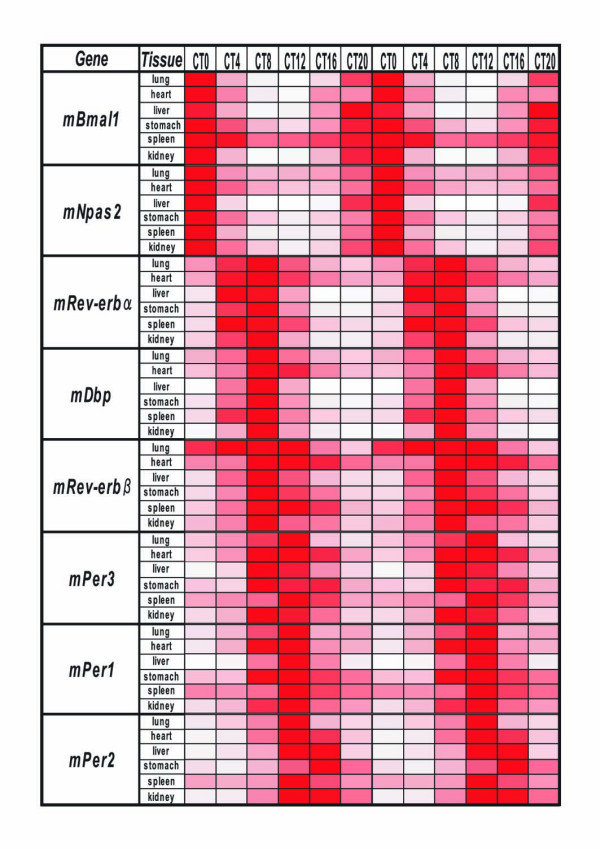
Figure 2
Circadian mRNA expression of canonical clock genes in mouse peripheral tissues The maximum RNA amount in a 24-h period is indicated by the darkest red (100), while no RNA (0) shown by white. The depth of the color corresponds to the RNA amount.
Figure 4
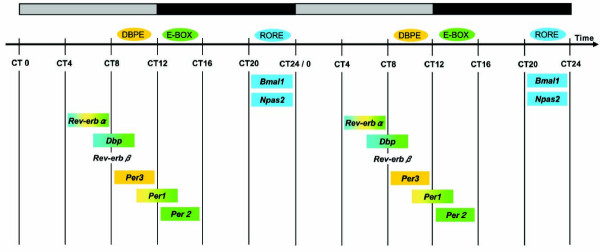
Figure 4
Diagram representing the relationship between 3 transcriptional elements and the peak mRNA expression of canonical clock genes The peak of Per3 mRNA expression is at CT8-12, and its regulatory region includes only conserved DBPEs (yellow) among the 3 elements. The peak of Per2 mRNA is at CT12-16, and its promoter region includes only an E-box (green). The peaks of Bmal1 and Npas2 mRNA are at CT20-0, and their regulatory regions contain only ROREs (blue). The peaks for the other clock genes, which contain 2 or 3 elements, are placed as indicated. The bar at the top represents light (gray) and dark (black) cycles.
Figure 3
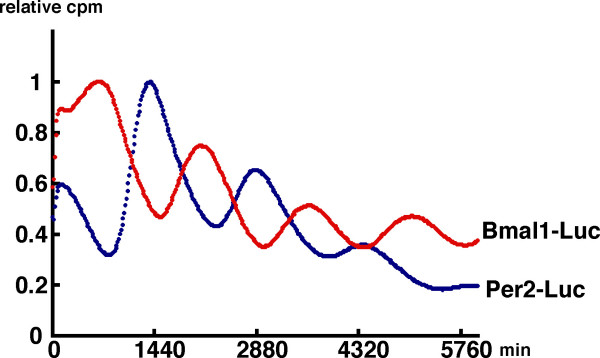
Figure 3
Transcriptional oscillation of Bmal1 and Per2 Transcriptional oscillation of Bmal1 (red) and Per2 (blue) was monitored by using a cell culture-based luminescence reporter assay. NIH3T3 cells were transfected with the hBmal1 -Luc or mPer2 -Luc constructs and then stimulated with a high concentration of serum. After the serum shock, in the presence of luciferin, light emission was measured and integrated for 1 min at intervals of 15 min. Ordinate and abscissa represent relative counts and time after serum shock, respectively. The peak of the count was set to 1. 1440 minutes = 1 day.
Figure 5
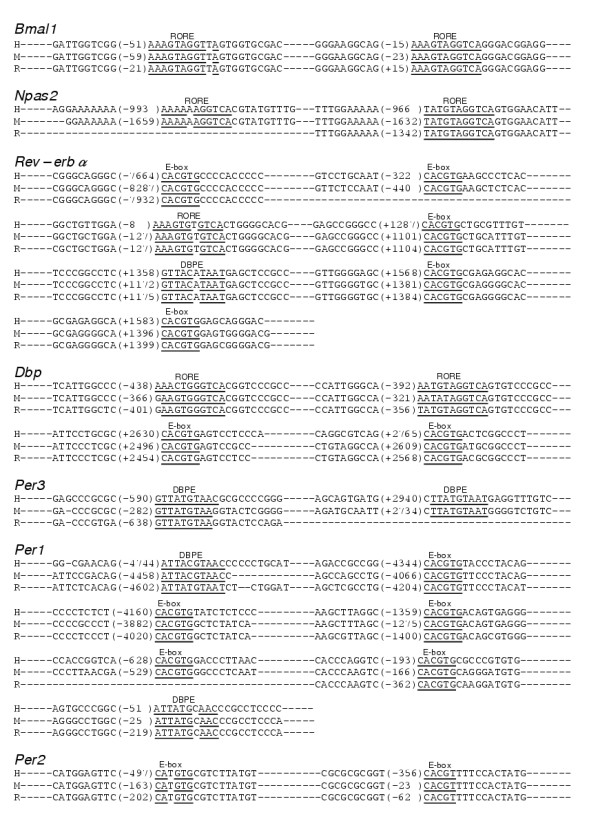
Figure 5
Table 1. Three transcriptional elements (RORE, E-box, and DBPE) conserved among the sequences of 3 species (human, mouse, and rat) Numbers in parenthesis indicate the number from the transcriptional start site. The sequences of the binding elements are in bold type, and the sequences matching the consensus sequence are underlined. H: human, M: mouse, R: rat.

References

    1. Yoo SH, Yamazaki S, Lowrey PL, Shimomura K, Ko CH, Buhr ED, Siepka SM, Hong HK, Oh WJ, Yoo OJ, Menaker M, Takahashi JS. PERIOD2::LUCIFERASE real-time reporting of circadian dynamics reveals persistent circadian oscillations in mouse peripheral tissues. Proc Natl Acad Sci U S A. 2004;101:5339–5346. doi: 10.1073/pnas.0308709101. - DOI - PMC - PubMed
    1. Reppert SM, Weaver DR. Coordination of circadian timing in mammals. Nature. 2002;418:935–941. doi: 10.1038/nature00965. - DOI - PubMed
    1. Schibler U, Sassone-Corsi P. A web of circadian pacemakers. Cell. 2002;111:919–922. doi: 10.1016/S0092-8674(02)01225-4. - DOI - PubMed
    1. Roenneberg T, Merrow M. The network of time: understanding the molecular circadian system. Curr Biol. 2003;13:R198–207. doi: 10.1016/S0960-9822(03)00124-6. - DOI - PubMed
    1. Fu L, Lee CC. The circadian clock: pacemaker and tumour suppressor. Nat Rev Cancer. 2003;3:350–361. doi: 10.1038/nrc1072. - DOI - PubMed

Publication types

MeSH terms

Substances

LinkOut - more resources