Combinations of maternal KIR and fetal HLA-C genes influence the risk of preeclampsia and reproductive success
- PMID: 15477349
- PMCID: PMC2211839
- DOI: 10.1084/jem.20041214
Combinations of maternal KIR and fetal HLA-C genes influence the risk of preeclampsia and reproductive success
Abstract
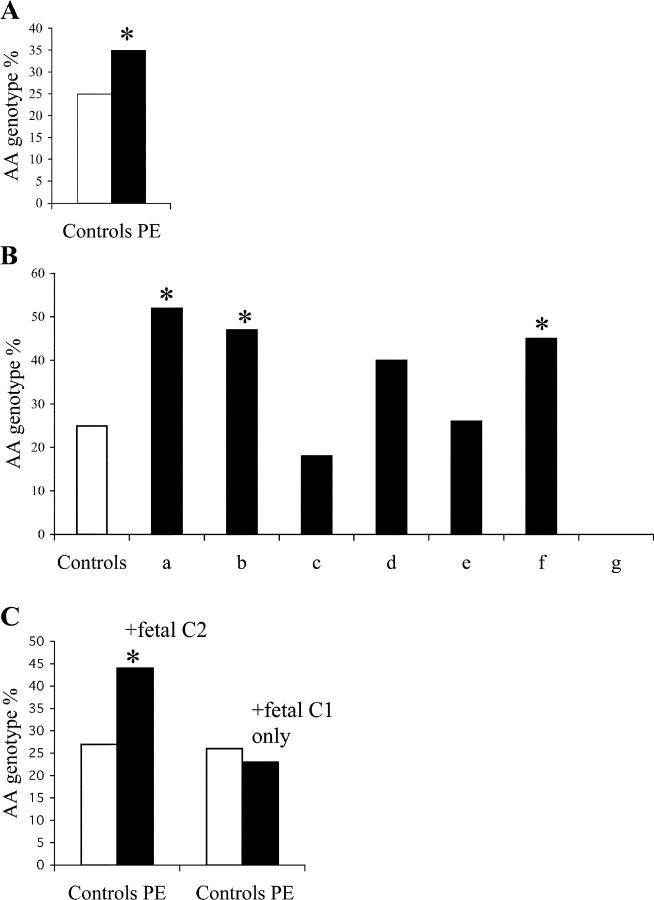
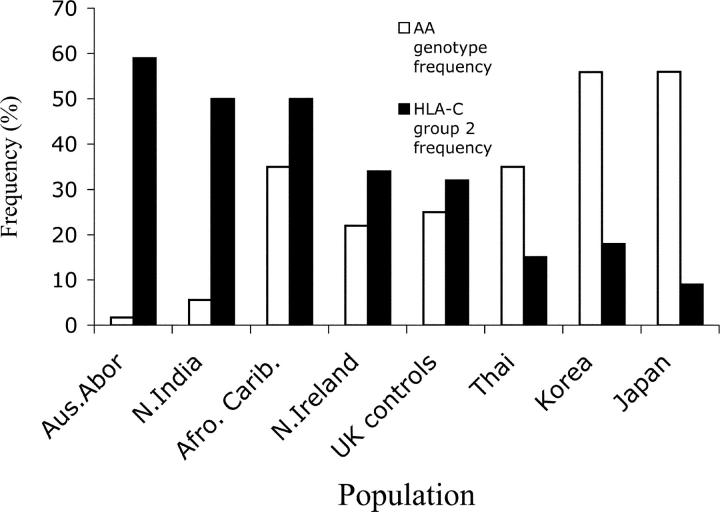
Preeclampsia is a serious complication of pregnancy in which the fetus receives an inadequate supply of blood due to failure of trophoblast invasion. There is evidence that the condition has an immunological basis. The only known polymorphic histocompatibility antigens on the fetal trophoblast are HLA-C molecules. We tested the idea that recognition of these molecules by killer immunoglobulin receptors (KIRs) on maternal decidual NK cells is a key factor in the development of preeclampsia. Striking differences were observed when these polymorphic ligand: receptor pairs were considered in combination. Mothers lacking most or all activating KIR (AA genotype) when the fetus possessed HLA-C belonging to the HLA-C2 group were at a greatly increased risk of preeclampsia. This was true even if the mother herself also had HLA-C2, indicating that neither nonself nor missing-self discrimination was operative. Thus, this interaction between maternal KIR and trophoblast appears not to have an immune function, but instead plays a physiological role related to placental development. Different human populations have a reciprocal relationship between AA frequency and HLA-C2 frequency, suggesting selection against this combination. In light of our findings, reproductive success may have been a factor in the evolution and maintenance of human HLA-C and KIR polymorphisms.
Figures
References
-
- Loke, Y.W., and A. King. 1995. Human Implantation: Cell Biology and Immunology. Cambridge University Press, Cambridge, UK. 299 pp.
-
- Moffett-King, A. 2002. Natural killer cells and pregnancy. Nat. Rev. Immunol. 2:656–663. - PubMed
-
- King, A., D.S.J. Allan, J.M. Bowen, S.J. Powis, S. Joseph, S. Verma, S.E. Hiby, A.J. McMichael, Y.W. Loke, and V.M. Braud. 2000. HLA-E is expressed on trophoblast and interacts with CD94/NKG2 receptors on decidual NK cells. Eur. J. Immunol. 30:1623–1631. - PubMed
-
- King, A., T.D. Burrows, S.E. Hiby, S. Joseph, S. Verma, P.B. Lim, L. Gardner, J.M. Bowen, A. Ziegler, B. Uchanska-Ziegler, et al. 2000. Surface expression of HLA-C antigen by human extravillous trophoblast. Placenta. 21:376–387. - PubMed
-
- Hiby, S.E., A. King, A. Sharkey, and Y.W. Loke. 1999. Molecular studies of trophoblast HLA-G polymorphism, isoforms, imprinting and expression in pre-implantation embryo. Tissue Ant. 53:1–13. - PubMed
Publication types
MeSH terms
Substances
Grants and funding
LinkOut - more resources
Full Text Sources
Other Literature Sources
Research Materials
Miscellaneous