. 2004 Oct 19;101(42):15058-63.
doi: 10.1073/pnas.0405700101. Epub 2004 Oct 11.

Growth retardation and abnormal maternal behavior in mice lacking testicular orphan nuclear receptor 4

Affiliations

Growth retardation and abnormal maternal behavior in mice lacking testicular orphan nuclear receptor 4

Loretta L Collins et al. Proc Natl Acad Sci U S A. .

Abstract

Testicular orphan nuclear receptor 4 (TR4) is a member of the nuclear receptor superfamily for which a ligand has not yet been found. In vitro data obtained from various cell lines suggest that TR4 functions as a master regulator to modulate many signaling pathways, yet the in vivo physiological roles of TR4 remain unclear. Here, we report the generation of mice lacking TR4 by means of targeted gene disruption (TR4(-/-)). The number of TR4(-/-) pups generated by the mating of TR4(+/-) mice is well under that predicted by the normal Mendelian ratio, and TR4(-/-) mice demonstrate high rates of early postnatal mortality, as well as significant growth retardation. Additionally, TR4(-/-) females show defects in reproduction and maternal behavior, with pups of TR4(-/-) dams dying soon after birth with no indication of milk intake. These results provide in vivo evidence that TR4 plays important roles in growth, embryonic and early postnatal pup survival, female reproductive function, and maternal behavior.


Figures
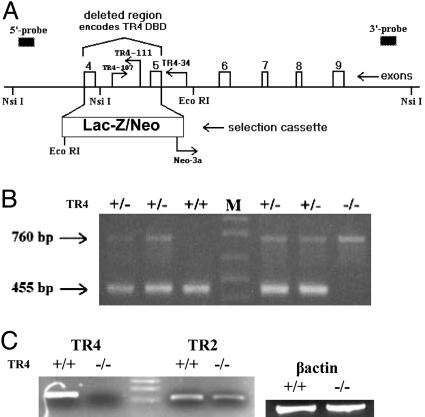
Fig. 1.
Fig. 1.
TR4–/– targeting construct and genotype confirmation. (A) A segment of TR4 genomic DNA is shown. The Lac-Z/Neo selection cassette is inserted between introns 3 and 5. DBD, DNA-binding domain. (B) PCR genotyping yielded 455-bp fragments for wild-type (+/+) and 760-bp fragments for targeted (–/–) alleles. (C) Expression of TR4 and TR2 mRNA in cerebellar tissue from TR4+/+ and TR4–/– mice by means of RT-PCR. β-actin levels were determined as a control for template amount.
Fig. 2.
Fig. 2.
Growth retardation in TR4–/– mice. (A) Male mice at 2 months of age. (B) Mouse growth curves. TR4–/– pups display a range of significant weight reduction (P < 0.05), except on day 4 in males (16% reduction, P < 0.1). For both sexes: TR4+/+, n = 15; TR4+/–, n = 15; male TR4–/–, n = 6; female TR4–/–, n = 5 up to day 22, and n = 3 from day 24 to day 86.
Fig. 3.
Fig. 3.
Reduced levels of IGF-1 in TR4–/– mice. (A) Serum levels of IGF-1 in 7-month-old male mice by means of RIA. A significantly lower serum IGF-1 level was observed in TR4–/– mice compared with TR4+/+ (P = 0.05, n = 3 for each genotype). (B) Immunostaining for IGF-1 in liver tissue from 4-month-old TR4+/+ and TR4–/– male mice. Light brown color designates positive staining. The tissues were counterstained with hematoxylin, ×400 magnification.
Fig. 4.
Fig. 4.
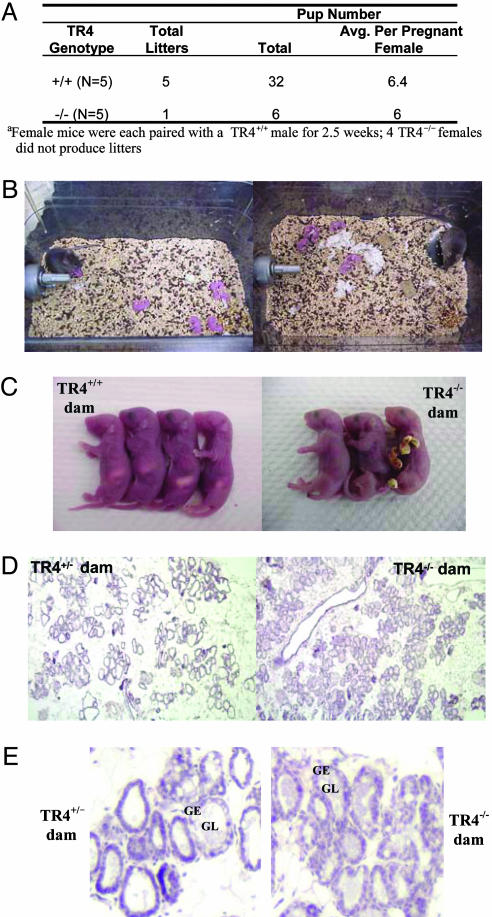
Reproductive deficiencies and lack of maternal behavior among TR4–/– dams. (A) Female reproductive results after short-term pairing (2.5 weeks). (B) Observations of TR4–/– dams with pups at postpartum days 1 (Left) and2(Right). TR4–/– dams do not build nests, collect pups to a single location, crouch over pups, or nurse their offspring. (C) Pups of TR4–/– dams die within 24–36 h after birth with no milk in their stomachs. (D) Histology of mammary gland tissue from a TR4+/– female and from a TR4–/– female, on postpartum day 1. The presence of luminal secretions (pink staining) suggests normal milk production in TR4–/– mice. The images were obtained at ×1,000 magnification, with subsequent digital reduction of image size. (E) A portion of the mammary gland sections stained in D at full ×1,000 magnification. GL, glandular lumen; GE, glandular epithelium.
Fig. 5.
Fig. 5.
Eye pathology in TR4–/– mice. Male mice at 10 weeks of age are pictured. In the TR4–/– mouse, secretions have accumulated around the eye, and the eyelids appear inflamed.

References

    1. Evans, R. M. (1988) Science 240, 889–895. - PMC - PubMed
    1. Laudet, V. (1997) J. Mol. Endocrinol. 19, 207–226. - PubMed
    1. Lee, Y. F., Pan, H. J., Burbach, P. H., Morkin, E. & Chang, C. (1997) J. Biol. Chem. 272, 12215–12220. - PubMed
    1. Young, W. J., Smith, S. M. & Chang, C. (1997) J. Biol. Chem. 272, 3109–3116. - PubMed
    1. Young, W. J., Lee, Y. F., Smith, S. M. & Chang, C. (1998) J. Biol. Chem. 273, 20877–20885. - PubMed

Publication types

MeSH terms