


A rapid bioassay for single bacterial cell quantitation using bioconjugated nanoparticles
- PMID: 15477593
- PMCID: PMC524056
- DOI: 10.1073/pnas.0404806101
A rapid bioassay for single bacterial cell quantitation using bioconjugated nanoparticles
Abstract
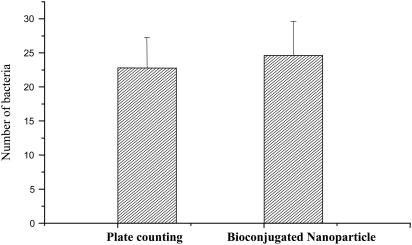
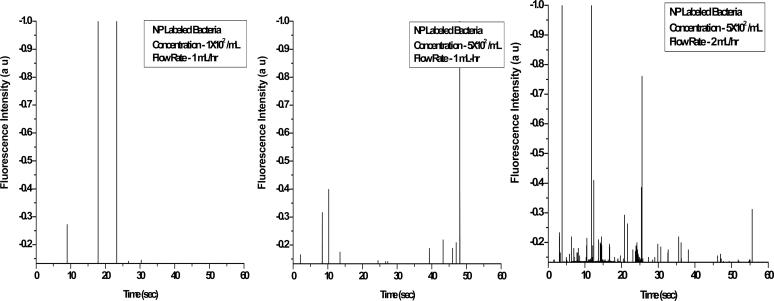
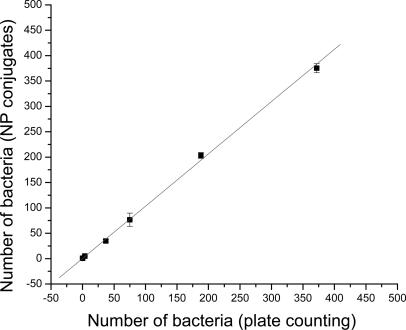
The rapid and sensitive determination of pathogenic bacteria is extremely important in biotechnology, medical diagnosis, and the current fight against bioterrorism. Current methods either lack ultrasensitivity or take a long time for analysis. Here, we report a bioconjugated nanoparticle-based bioassay for in situ pathogen quantification down to single bacterium within 20 min. The bioconjugated nanoparticle provides an extremely high fluorescent signal for bioanalysis and can be easily incorporated with biorecognition molecules, such as antibody. The antibody-conjugated nanoparticles can readily and specifically identify a variety of bacterium, such as Escherichia coli O157:H7, through antibody-antigen interaction and recognition. The single-bacterium-detection capability within 20 min has been confirmed by the plate-counting method and realized by using two independent optical techniques. The two detection methods correlated extremely well. Furthermore, we were able to detect multiple bacterial samples with high throughput by using a 384-well microplate format. To show the usefulness of this assay, we have accurately detected 1-400 E. coli O157 bacterial cells in spiked ground beef samples. Our results demonstrate the potential for a broad application of bioconjugated nanoparticles in practical biotechnological and medical applications in various biodetection systems. The ultimate power of integrating bionanotechnology into complex biological systems will emerge as a revolutionary tool for ultrasensitive detection of disease markers and infectious agents.
Figures
References
-
- Phillips, C. A. (1999) J. Sci. Food Agric. 79, 1367–1381.
-
- Groseclose, S. L., Brathwaite, W. S., Hall, P. A., Conner, F. J., Sharp, P., Anderson, W. J., Fagan, R. F., Aponte, J. J., Jones, G. F., Nitschke, D. A., et al. (2004) Morbid. Mortal. Wkly. Rep. 51, 1–84. - PubMed
-
- Varma, J. K., Greene, K. D., Reller, M. E., DeLong, S. M., Trottier, J., Nowicki, S. F., DiOrio, M., Koch, E. M., Bannerman, T. L., York, S. T., et al. (2003) J. Am. Med. Assoc. 290, 2709–2712. - PubMed
-
- Bruce, M.G., Curtis, M. B., Payne, M. M., Gautom, R. K., Thompson, E. C., Bennett, A. L. & Kobayashi, J. I. (2003) Arch. Pediatr. Adolescent Med. 157, 1016–1021. - PubMed
-
- Mohle-Boetani, J. C., Farrar, J. A., Werner, S. B., Minassian, D., Bryant, R., Abbott, S., Slutsker, L. & Vugia, D. J. (2001) Ann. Intern. Med. 135, 239–247. - PubMed
Publication types
MeSH terms
Substances
LinkOut - more resources
Full Text Sources
Other Literature Sources
