. 2004 Nov;24(21):9305-16.
doi: 10.1128/MCB.24.21.9305-9316.2004.

Genetic steps of mammalian homologous repair with distinct mutagenic consequences

Affiliations

Genetic steps of mammalian homologous repair with distinct mutagenic consequences

Jeremy M Stark et al. Mol Cell Biol. 2004 Nov.

Abstract

Repair of chromosomal breaks is essential for cellular viability, but misrepair generates mutations and gross chromosomal rearrangements. We investigated the interrelationship between two homologous-repair pathways, i.e., mutagenic single-strand annealing (SSA) and precise homology-directed repair (HDR). For this, we analyzed the efficiency of repair in mammalian cells in which double-strand break (DSB) repair components were disrupted. We observed an inverse relationship between HDR and SSA when RAD51 or BRCA2 was impaired, i.e., HDR was reduced but SSA was increased. In particular, expression of an ATP-binding mutant of RAD51 led to a >90-fold shift to mutagenic SSA repair. Additionally, we found that expression of an ATP hydrolysis mutant of RAD51 resulted in more extensive gene conversion, which increases genetic loss during HDR. Disruption of two other DSB repair components affected both SSA and HDR, but in opposite directions: SSA and HDR were reduced by mutation of Brca1, which, like Brca2, predisposes to breast cancer, whereas SSA and HDR were increased by Ku70 mutation, which affects nonhomologous end joining. Disruption of the BRCA1-associated protein BARD1 had effects similar to those of mutation of BRCA1. Thus, BRCA1/BARD1 has a role in homologous repair before the branch point of HDR and SSA. Interestingly, we found that Ku70 mutation partially suppresses the homologous-repair defects of BARD1 disruption. We also examined the role of RAD52 in homologous repair. In contrast to yeast, Rad52(-)(/)(-) mouse cells had no detectable HDR defect, although SSA was decreased. These results imply that the proper genetic interplay of repair factors is essential to limit the mutagenic potential of DSB repair.


Figures
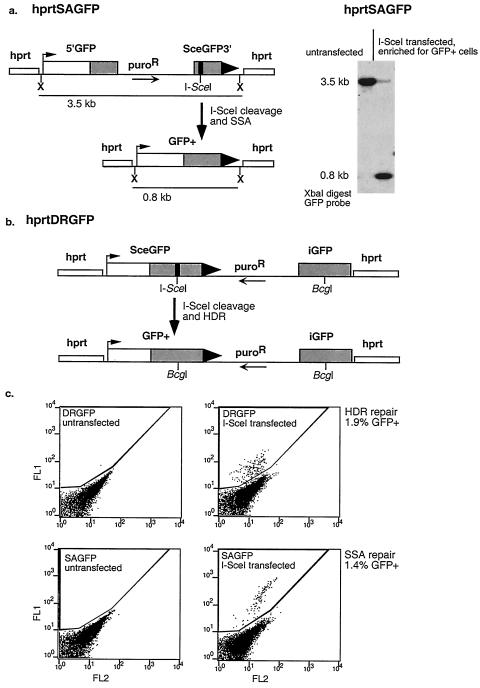
FIG. 1.
FIG. 1.
Reporters for measuring homologous DSB repair by SSA and HDR. (a) hprtSAGFP reporter. The structure of the reporter is shown before and after I-SceI cleavage and SSA. Note that repair by SSA results in a 2.7-kb deletion in the chromosome. Southern blot analysis is shown from an untransfected cell line with the SA-GFP reporter and from the same line after I-SceI expression and flow sorting to enrich for a pool of GFP+ cells. Large black triangles depict the 3′ end of the AFP cassette. (b) hprtDRGFP reporter. The structure of the reporter is shown before and after I-SceI cleavage and HDR. Note that repair by HDR converts the I-SceI site but otherwise maintains the structure of the reporter, as confirmed previously by Southern blot analysis (37). (c) Flow cytometric analysis of wild-type ES cells containing the hprtDRGFP and hprtSAGFP reporters targeted to the hprt locus, either untransfected or transfected with the I-SceI expression plasmid. Green fluorescence (FL1) is plotted on the y axis, with orange fluorescence (FL2) on the x axis.
FIG. 2.
FIG. 2.
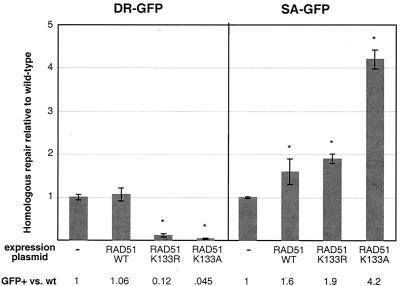
RAD51-K133R and RAD51-K133A expression reduces HDR but increases SSA. Wild-type (wt) ES cells with either the DR-GFP or SA-GFP reporter were cotransfected with the I-SceI and RAD51 expression vectors, as indicated. The efficiency of homologous repair is indicated relative to transfection with the I-SceI expression vector alone, which is set to 1. The asterisks indicate a statistically significant difference from transfection with the I-SceI expression vector alone, with P ≤ 0.0001, except for SA-GFP repair with RAD51-WT, with P = 0.02. The error bars indicate standard deviations.
FIG. 3.
FIG. 3.
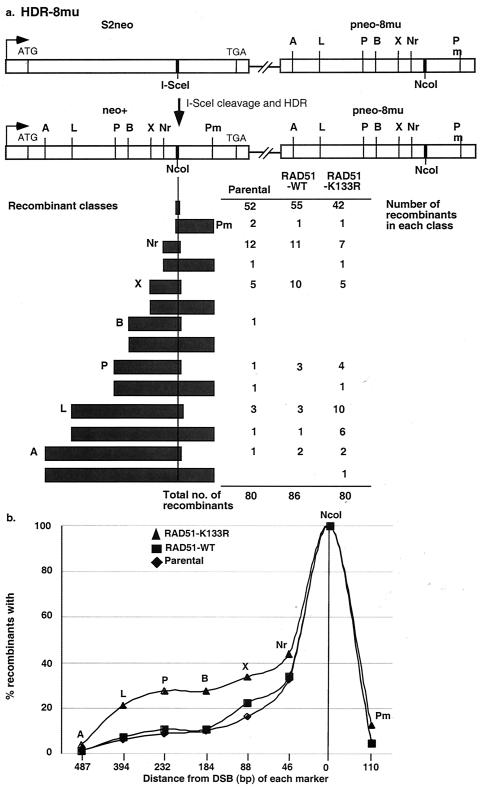
Expression of RAD51-K133R increases gene conversion of markers distant from the DSB during HDR. (a) Structure of the H-DR-8mu reporter and summary of gene conversion tracts in neo+ recombinants. The pneo-8mu fragment contains the wild-type NcoI site at the site of the DSB, along with 1-bp silent mutations, which create the following restriction site polymorphisms: A, ApaI; L, ApaL1; P, PstI; B, BamHI; X, XbaI; Nr, NruI; and Pm, PmlI. HDR of the I-SceI-generated DSB in S2neo, using the pneo-8mu gene as the template for repair, results in restoration of a wild-type neo+ gene, so that all recombinants have an NcoI site incorporated. HDR may be associated with incorporation of the other restriction sites. The filled bars represent the incorporation of all restriction site markers up to and including the indicated site for various recombinants derived from the parental cell line or after expression of RAD51-WT or RAD51-K133R. (b) Summary of gene conversion frequencies of each restriction site marker for the recombinants shown in panel a. The conversion frequency for each restriction site is graphed as a function of distance from the DSB.
FIG. 4.
FIG. 4.
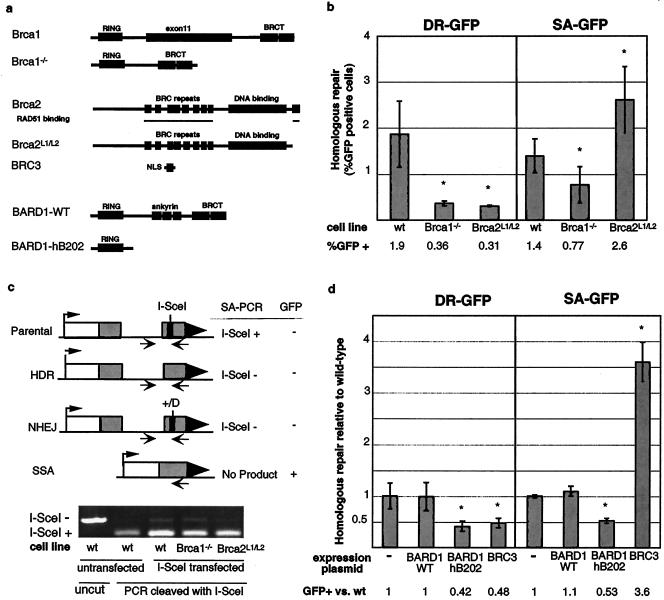
BRCA1/BARD1 promotes both HDR and SSA, whereas BRCA2, like RAD51, promotes HDR and suppresses SSA. (a) Schematic of wild-type and mutant proteins used in this analysis. Note that although the Brca1 mutant is indicated as Brca1−/− for simplicity, an exon 11-deleted peptide is expressed in this mutant (58). For BRCA2, RAD51 binding regions at the BRC repeats and C terminus are indicated. Brca2L1/L2 has the C-terminal RAD51 binding domain in exon 27 deleted. BRC3 is tagged with a nuclear localization signal (NLS). BARD1-hB202 is the N-terminal 202 amino acids of human BARD1, which interacts with BRCA1 (58). (b) Homologous repair in Brca1/ and Brca2L1/L2 cell lines. The efficiency of homologous repair after I-SceI expression is indicated for the wild-type (wt) and mutant cell lines. SA-GFP repair frequencies are the mean (± standard deviation) of 11 and 6 independent transfections for the Brca1/ and Brca2L1/L2 cell lines, respectively. The asterisks indicate a statistically significant difference from the wild type, with P ≤ 0.004, except for DR-GFP repair in Brca2L1/L2, with P = 0.008. (c) Analysis of I-SceI site loss in the SA-GFP reporter arising from non-SSA repair. The genomic region surrounding the I-SceI site in SceGFP3′ was PCR amplified using the primers depicted as arrows. The PCR product from untransfected wild-type cells is efficiently cleaved by I-SceI, whereas after I-SceI expression and HDR or NHEJ, a portion of the PCR product is not cleaved by I-SceI. (Note that the SSA product is not amplified because the upstream primer is lost during SSA repair.) After I-SceI expression, Brca1/ cells have a portion of noncleaved PCR product similar to that of wild-type cells, whereas Brca2L1/L2 cells reproducibly show a smaller amount of noncleaved product, consistent with the shift toward SSA. (d) Expression of peptides predicted to interfere with BRCA1 and BRCA2 function mimics the effects of Brca1 and Brca2 mutation on homologous repair. Wild-type ES cells with either the DR-GFP or SA-GFP reporter were cotransfected with the I-SceI and BARD1-WT, BARD1-hB202, or BRC3 expression vectors, as indicated. The efficiency of homologous repair is indicated relative to transfection with the I-SceI expression vector alone, which is set to 1. The asterisks indicate a statistically significant difference from transfection with the I-SceI expression vector alone, with P ≤ 0.002, except for DR-GFP repair with BRC3, with P = 0.01.
FIG. 5.
FIG. 5.
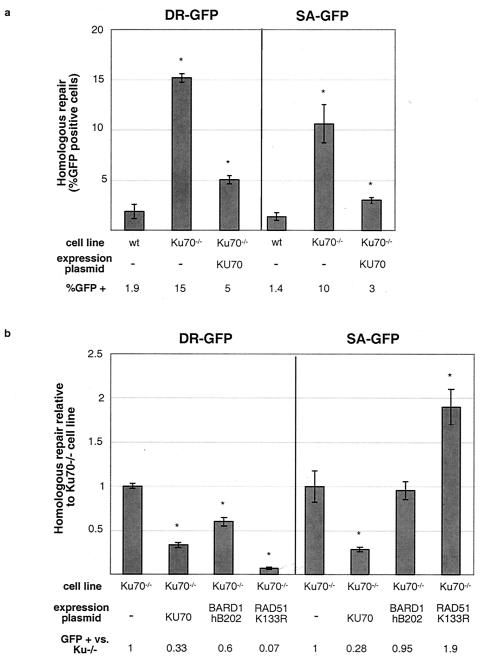
Ku70 mutation results in elevated HDR and SSA and suppresses the effect of BARD1-hB202 on homologous repair. (a) Homologous repair in Ku70/ ES cells. The efficiencies of homologous repair after I-SceI expression are indicated for the wild-type (wt) and Ku70/ cell lines, as well as the Ku70/ cell line in which the I-SceI and KU70 expression vectors were cotransfected. The asterisks indicate a statistically significant difference from the wild type, with P ≤ 0.0001. The error bars indicate standard deviations. (b) Influence of BARD1-hB202 on homologous repair in Ku70/ cells. Ku70/ cells with either the DR-GFP or SA-GFP reporter were transfected with the I-SceI expression vector alone or together with the expression vector for KU70, BARD1-hB202, or RAD51-K133R. The efficiency of homologous repair is indicated relative to transfection with the I-SceI expression vector alone, which is set to 1. The asterisks indicate a statistically significant difference from the Ku70/ cells transfected with the I-SceI expression vector alone, with P ≤ 0.004.
FIG. 6.
FIG. 6.
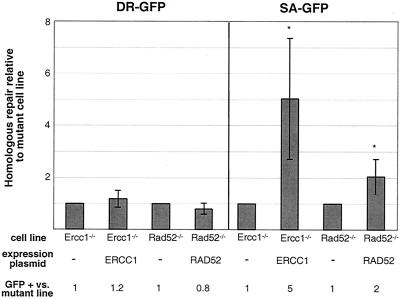
RAD52 and ERCC1 promote SSA but are not essential for HDR. The efficiency of homologous repair is indicated for the Ercc1/ and Rad52/ ES cells transfected with the I-SceI expression vector alone or together with the ERCC1 or RAD52 complementing expression vector, respectively. The efficiency of homologous repair in individual transfections is calculated relative to transfection with the I-SceI expression vector alone for each mutant, which is set to 1 (see Materials and Methods). SA-GFP repair frequencies are the means (± standard deviations) of seven and six independent transfections for the Rad52/ and Ercc1/ cell lines, respectively. The asterisks indicate a statistically significant difference from the mutant transfected with the I-SceI expression vector alone, with P ≤ 0.008.
FIG. 7.
FIG. 7.
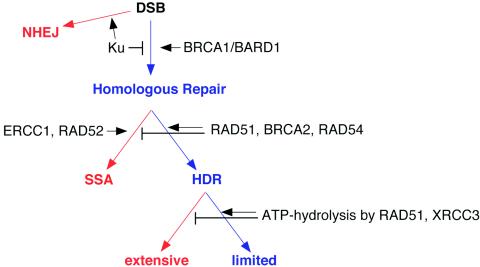
Genetic steps of homologous repair with distinct mutagenic consequences. Shown are different pathways of DSB repair and the roles of individual factors in pathway choice. Whereas homologous repair by HDR with limited gene conversion (blue) is a precise type of repair, SSA, NHEJ, and HDR with extensive gene conversion (red), as well as crossing over (not shown), are much more prone to being mutagenic. The arrows do not necessarily reflect a temporal order of events. Homologous-repair results were obtained using DR-GFP and SA-GFP, except for RAD54 and XRCC3 (see the text).

References

    1. Adair, G. M., R. L. Rolig, D. Moore-Faver, M. Zabelshansky, J. H. Wilson, and R. S. Nairn. 2000. Role of ERCC1 in removal of long non-homologous tails during targeted homologous recombination. EMBO J. 19:5552-5561. - PMC - PubMed
    1. Adams, M. D., M. McVey, and J. J. Sekelsky. 2003. Drosophila BLM in double-strand break repair by synthesis-dependent strand annealing. Science 299:265-267. - PubMed
    1. Albertson, D. G., C. Collins, F. McCormick, and J. W. Gray. 2003. Chromosome aberrations in solid tumors. Nat. Genet. 34:369-376. - PubMed
    1. Allen, C., A. Kurimasa, M. A. Brenneman, D. J. Chen, and J. A. Nickoloff. 2002. DNA-dependent protein kinase suppresses double-strand break-induced and spontaneous homologous recombination. Proc. Natl. Acad. Sci. USA 99:3758-3763. - PMC - PubMed
    1. Brenneman, M. A., B. M. Wagener, C. A. Miller, C. Allen, and J. A. Nickoloff. 2002. XRCC3 controls the fidelity of homologous recombination: roles for XRCC3 in late stages of recombination. Mol. Cell 10:387-395. - PubMed

Publication types

MeSH terms