. 2004 Nov 9;101(45):15944-8.
doi: 10.1073/pnas.0404136101. Epub 2004 Oct 14.

Neuronal nitric oxide synthase negatively regulates xanthine oxidoreductase inhibition of cardiac excitation-contraction coupling

Affiliations

Neuronal nitric oxide synthase negatively regulates xanthine oxidoreductase inhibition of cardiac excitation-contraction coupling

Shakil A Khan et al. Proc Natl Acad Sci U S A. .

Abstract

Although interactions between superoxide (O(2)(.-)) and nitric oxide underlie many physiologic and pathophysiologic processes, regulation of this crosstalk at the enzymatic level is poorly understood. Here, we demonstrate that xanthine oxidoreductase (XOR), a prototypic superoxide O(2)(.-) -producing enzyme, and neuronal nitric oxide synthase (NOS1) coimmunoprecipitate and colocalize in the sarcoplasmic reticulum of cardiac myocytes. Deficiency of NOS1 (but not endothelial NOS, NOS3) leads to profound increases in XOR-mediated O(2)(.-) production, which in turn depresses myocardial excitation-contraction coupling in a manner reversible by XOR inhibition with allopurinol. These data demonstrate a unique interaction between a nitric oxide and an O(2)(.-) -generating enzyme that accounts for crosstalk between these signaling pathways; these findings demonstrate a direct antioxidant mechanism for NOS1 and have pathophysiologic implications for the growing number of disease states in which increased XOR activity plays a role.


Figures
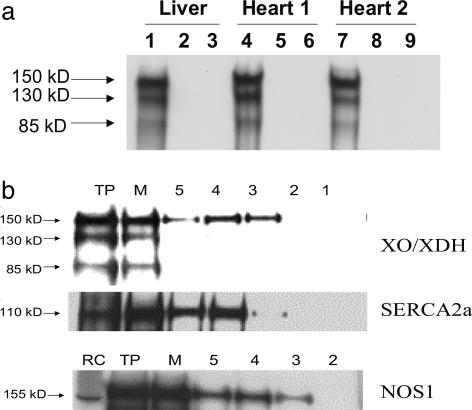
Fig. 1.
Fig. 1.
Subcellular localization of XOR. (a) Coimmunoprecipitation demonstrates association between NOS1 and XOR proteins. XOR coimmunoprecipitates with NOS1 (bands 1, 4, and 7) but not with NOS3 (bands 3, 6, or 9). The lysate bands (bands 2, 5, and 8) represent total heart protein extract revealing little XOR protein. (b) Purified SR fractions were probed with anti-XOR, anti-SERCA2a, and anti-NOS1 antibodies. As depicted, the 150-kDa monomer of XOR appears in the SR, with highest intensity in lane 4. Both NOS1 and SERCA2a are identified in the same fractions. TP, total heart protein; M, microsomal fraction; RC, rat cerebellum.
Fig. 2.
Fig. 2.
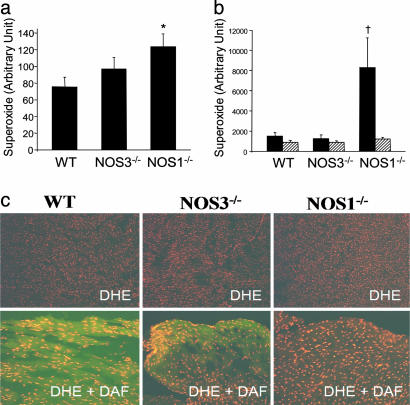
Superoxide production in cardiac tissue from NOS knockout mice. (a) Basal lucigenin-enhanced chemiluminescence recordings were elevated in NOS1–/– (n = 7) but not NOS3–/– (n = 7) compared to WT (n = 9) hearts (*, P < 0.05 vs. WT). (b) Incubation with xanthine (filled bars) produced dramatic increases in lucigenin-detected formula image. Importantly, this increase was 4-fold greater in NOS1–/– compared with WT and NOS3–/– hearts (†, P < 0.05; n = 4 mice of each strain), indicating that NOS1 deficiency leads to augmented cardiac XOR formula image production. Inhibition by allopurinol (striped bars) demonstrates that this increase is caused by XO production of formula image. (c) Oxidative fluorescent microtopography using the fluorescent probe DHE demonstrates increased staining in NOS1–/– (orange-staining nuclei) relative to WT. (Lower) A combination of DHE with the NO probe (DAF, green staining) indicating decreased NO activity accompanying increased oxidative stress in NOS1–/–hearts.
Fig. 3.
Fig. 3.
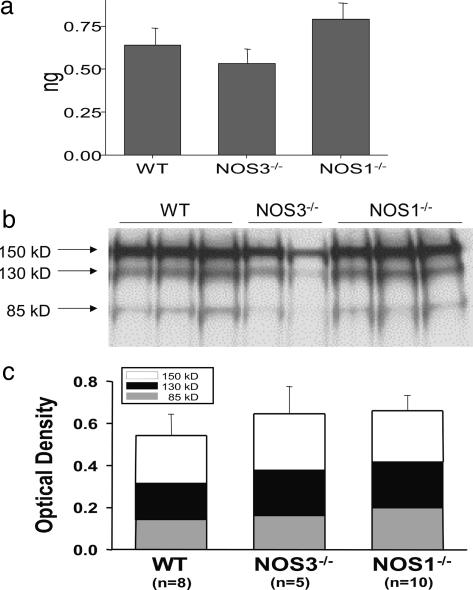
XOR expression and abundance. Increased XOR stimulated formula image production in NOS1–/– was not caused by increased production or abundance of XOR. (a) XOR mRNA expression (by quantitative PCR) is similar among hearts from WT, NOS3–/–, and NOS1–/– mice (n = 3 mice for each strain). (b) Cardiac XOR protein abundance, measured by Western blot analysis, is not different between the three mouse stains. (c) Optical density bar chart depicting quantification of bands corresponding to both XOR products, XDH (150 kDa) and XO (130 kDa and 85 kDa).
Fig. 4.
Fig. 4.
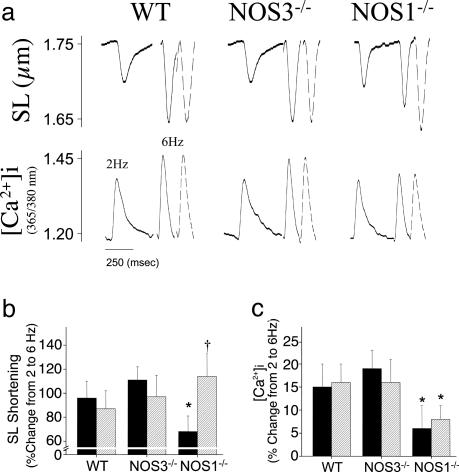
Calcium sensitizing effect of allopurinol in NOS1–/– myocytes. (a) Sample transients are shown at 2-Hz baseline, 6 Hz (solid line), and 6 Hz with allopurinol treatment (dashed line). NOS1–/– myocytes have attenuated sarcomere shortening (b) and calcium transient (c) compared to WT and NOS3–/– as pacing frequency is raised from 2 to 6 Hz (solid bar; *, P < 0.05, NOS1–/– vs. WT and NOS3–/–). Allopurinol infusion (10–4 M; striped bar) augments contractility in NOS1–/– to the level of WT (†, P < 0.05 vs. NOS1–/– without allopurinol), without increasing systolic Ca2+ transients, representing a Ca2+ sensitizing effect. In contrast, neither sarcomere shortening nor calcium transient increase with allopurinol treatment (striped bar) in WT and NOS3–/– myocytes.
Fig. 5.
Fig. 5.
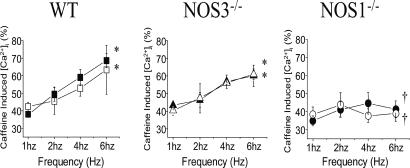
SR Ca2+ stores. SR Ca2+ stores did not increase with rising pacing frequencies (1–6 Hz) in NOS1–/– myocytes, as it did in WT and NOS3–/– myocytes (*, P < 0.05 vs. 1-Hz baseline; †, P < 0.05, NOS1–/– vs. WT and NOS3–/–). Importantly, allopurinol (10–4 M, open symbols) had no effect on SR Ca2+ stores in NOS1–/–, NOS3–/–, or WT myocytes.

Comment in

References

    1. Saavedra, W. F., Paolocci, N., St. John, M. E., Skaf, M. W., Stewart, G. C., Xie, J. S., Harrison, R. W., Zeichner, J., Mudrick, D., Marbán, E., et al. (2002) Circ. Res. 90, 297–304. - PubMed
    1. Ekelund, U. E. G., Harrison, R. W., Shokek, O., Thakkar, R. N., Tunin, R. S., Senzaki, H., Kass, D. A., Marbán, E. & Hare, J. M. (1999) Circ. Res. 85, 437–445. - PubMed
    1. de Jong, J. W., Schoemaker, R. G., de Jonge, R., Bernocchi, P., Keijzer, E., Harrison, R., Sharma, H. S. & Ceconi, C. (2000) J. Mol. Cell Cardiol. 32, 2083–2089. - PubMed
    1. Cappola, T. P., Kass, D. A., Nelson, G. S., Berger, R. D., Rosas, G. O., Kobeissi, Z. A., Marbán, E. & Hare, J. M. (2001) Circulation 104, 2407–2411. - PubMed
    1. McCord, J. M. (1985) N. Eng. J. Med. 312, 159–163. - PubMed

Publication types

MeSH terms

LinkOut - more resources