. 2004 Nov;16(11):2923-39.
doi: 10.1105/tpc.104.021725. Epub 2004 Oct 14.

A gene regulatory network model for cell-fate determination during Arabidopsis thaliana flower development that is robust and recovers experimental gene expression profiles

Affiliations

A gene regulatory network model for cell-fate determination during Arabidopsis thaliana flower development that is robust and recovers experimental gene expression profiles

Carlos Espinosa-Soto et al. Plant Cell. 2004 Nov.

Abstract

Flowers are icons in developmental studies of complex structures. The vast majority of 250,000 angiosperm plant species have flowers with a conserved organ plan bearing sepals, petals, stamens, and carpels in the center. The combinatorial model for the activity of the so-called ABC homeotic floral genes has guided extensive experimental studies in Arabidopsis thaliana and many other plant species. However, a mechanistic and dynamical explanation for the ABC model and prevalence among flowering plants is lacking. Here, we put forward a simple discrete model that postulates logical rules that formally summarize published ABC and non-ABC gene interaction data for Arabidopsis floral organ cell fate determination and integrates this data into a dynamic network model. This model shows that all possible initial conditions converge to few steady gene activity states that match gene expression profiles observed experimentally in primordial floral organ cells of wild-type and mutant plants. Therefore, the network proposed here provides a dynamical explanation for the ABC model and shows that precise signaling pathways are not required to restrain cell types to those found in Arabidopsis, but these are rather determined by the overall gene network dynamics. Furthermore, we performed robustness analyses that clearly show that the cell types recovered depend on the network architecture rather than on specific values of the model's gene interaction parameters. These results support the hypothesis that such a network constitutes a developmental module, and hence provide a possible explanation for the overall conservation of the ABC model and overall floral plan among angiosperms. In addition, we have been able to predict the effects of differences in network architecture between Arabidopsis and Petunia hybrida.


Figures
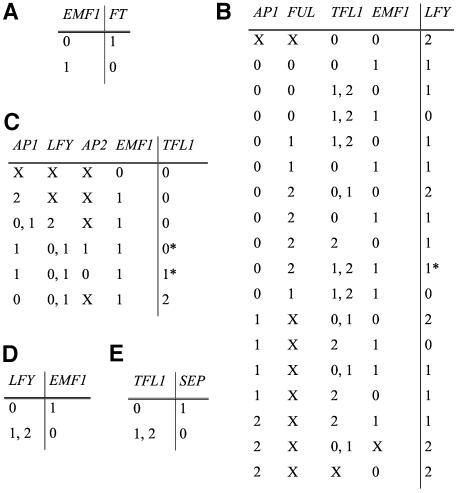
Figure 1.
Figure 1.
Logical Rules for FT, LFY, TFL1, EMF1, and SEP. The state of each network node (rightmost column in each table) depends on the combination of activity states of its input nodes (all other columns in each table). X represents any possible value. An asterisk denotes cases where subjective decisions had to be made and where we tested the alternative. The alternatives produced equivalent results to those obtained with the original values (see text). FT (A), LFY (B), TFL1 (C), EMF1 (D), and SEP (E).
Figure 2.
Figure 2.
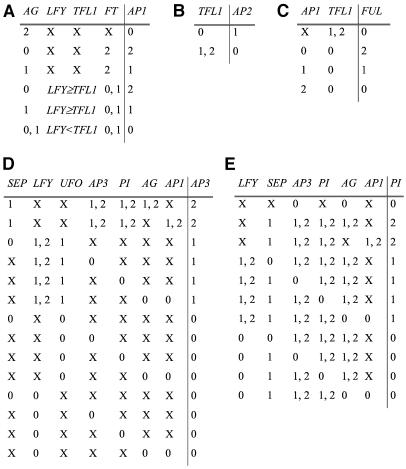
Logical Rules for AP1, AP2, FUL, AP3, and PI. The state of each network node (rightmost column in each table) depends on the combination of activity states of its input nodes (all other columns in each table). X represents any possible value. Comparative symbols (< and >) are used when the relative values are important to determine the state of activity of the target node. AP1 (A), AP2 (B), FUL (C), AP3 (D), and PI (E).
Figure 3.
Figure 3.
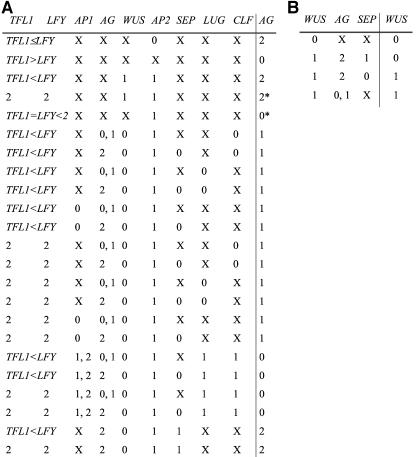
Logical Rules for AG and WUS. The state of each network node (rightmost column in each table) depends on the combination of activity states of its input nodes (all other columns in each table). X represents any possible value. Comparative symbols (< and >) are used when the relative values are important to determine the state of activity of the target node. Asterisks denote cases where subjective decisions had to be made and where we tested the alternative. The alternatives produced equivalent results to those obtained with the original values (see text). AG (A) and WUS (B).
Figure 4.
Figure 4.
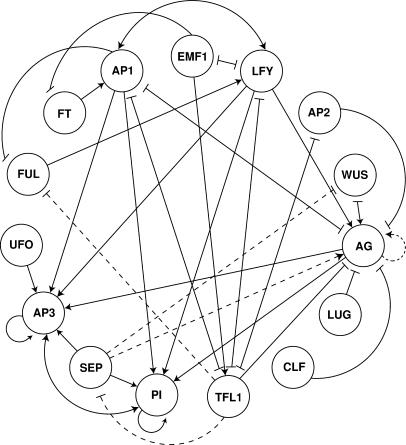
Gene Network Architecture for the Arabidopsis Floral Organ Fate Determination. Network nodes represent active proteins of corresponding genes, and the edges represent the regulatory interactions between node pairs (arrows are positive, and blunt-end lines are negative). Dashed lines are hypothetical interactions for which there is no experimental support (see logical rules). The network includes F-box proteins (UFO), membrane bound signaling molecules (TFL1 and FT), cofactors involved in transcriptional regulation (EMF1 and LUG), chromatin remodeling proteins (CLF), and transcription factors (all others). Interactions have been confirmed to be direct transcriptional regulations in a few cases (LFY on AG, Busch et al., 1999; LFY on AP1, Wagner et al., 1999), and the rest can either be direct or indirect and can be transcriptional or other. See Results and Methods for model details.
Figure 5.
Figure 5.
Arabidopsis and Petunia Wild Type (left), ap3 Mutant (right) Flowers, and Corresponding Network Models. Single petunia mutant for PhDEF is shown in the top part of (B) and a scheme of the predicted double mutant for PhDEF and PhTM6 is shown below (see also prediction in Vandenbussche et al., 2004). Arabidopsis is shown in (A). The networks indicate which nodes were turned off (yellow) to simulate mutants. Network architecture as in Figure 4 for Arabidopsis and as in Supplemental Figure 2 online for petunia. Steady states for wild type and mutant simulations found respectively in Tables 1 and 6 for Arabidopsis and Tables 9, 10 (single mutant for PhDEF gene), and 11 (double mutant for PhDEF and PhTM6 genes) for petunia. Note that Arabidopsis gene names are used if the corresponding gene has not been characterized in petunia (also in Tables 9 to 11 and Supplemental Figure 2 online). The Arabidopsis orthologs of the cloned petunia genes are as follows: FLORAL BINDING PROTEIN26 (FBP26) is an AP1 ortholog (Immink et al., 1999), PhDEF (formerly known as GREEN PETALS) is an AP3 and DEFICIENS (DEF; from A. majus) ortholog, PhGLO1 (FBP1) and PhGLO2 (PETUNIA MADS BOX GENE2; pMADS2) are PI and GLOBOSA (GLO; from A. majus) orthologs (Vandenbussche et al., 2004), pMADS3 is an AG ortholog (Kapoor et al., 2002), PhAP2A is an AP2 ortholog (Maes et al., 2001), FBP2 and FBP5 are SEP orthologs (Ferrario et al., 2003; Vandenbussche et al., 2003), PhCLF1 and PhCLF2 are CLF orthologs (Mayama et al., 2003), and PETUNIA HYBRIDA TM6 (PhTM6) is a paleoAP3 gene (Vandenbussche et al., 2004). Drawings are not to scale. Drawings based on photographs from http://www.weigelworld.org ([A], left), http://www.salk.edu/LABS/pbio-w/gallery.html ([A], right), and Van Tunen et al. (1994) ([B], left and top right).

References

    1. Albert, R., Jeong, H., and Barabási, A.-L. (2000). Error and attack tolerance of complex networks. Nature 406, 378–382. - PubMed
    1. Albert, R., and Othmer, H.G. (2003). The topology of the regulatory interactions predicts the expression pattern of the segment polarity genes in Drosophila melanogaster. J. Theor. Biol. 223, 1–18. - PMC - PubMed
    1. Aldana, M., and Cluzel, P. (2003). A natural class of robust networks. Proc. Natl. Acad. Sci. USA 100, 8710–8714. - PMC - PubMed
    1. Ambrose, B.A., Lerner, D.R., Ciceri, P., Padilla, C.M., Yanofsky, M.F., and Schmidt, R.J. (2000). Molecular and genetic analyses of the Silky1 gene reveal conservation of floral organ specification between Eudicots and Monocots. Mol. Cell 5, 569–579. - PubMed
    1. Aubert, D., Chen, L., Moon, Y., Martin, D., Castle, L.A., Yang, C., and Sung, Z.R. (2001). EMF1, a novel protein involved in the control of shoot architecture and flowering in Arabidopsis. Plant Cell 13, 1865–1875. - PMC - PubMed

Publication types

MeSH terms

Substances