doi: 10.1371/journal.pbio.0020306.
Epub 2004 Oct 12.
Nature's nanotechnologists: unveiling the secrets of diatoms
Affiliations
- PMID: 15486572
- PMCID: PMC521728
- DOI: 10.1371/journal.pbio.0020306
Item in Clipboard
Nature's nanotechnologists: unveiling the secrets of diatoms
PLoS Biol.
2004 Oct.
Abstract
Diatoms are unicellular algae with ornate silica shells. Their dazzling ability to build tiny structures could inspire applications in the semiconductor industry, drug delivery, and engineering
Figures
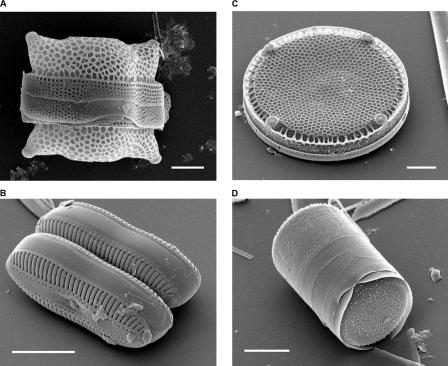
(A) Biddulphia reticulata. The whole shell or frustule of a centric diatom showing valves and girdle bands (size bar = 10 micrometres). (B) Diploneis sp. This picture shows two whole pennate diatom frustules in which raphes or slits, valves, and girdle bands can be seen (size bar = 10 micrometres). (C) Eupodiscus radiatus. View of a single valve of a centric diatom (size bar = 20 micrometres) (D) Melosira varians. The frustule of a centric diatom, showing both valves and some girdle bands (size bar = 10 micrometres). (Images courtesy of Mary Ann Tiffany, San Diego State University.)
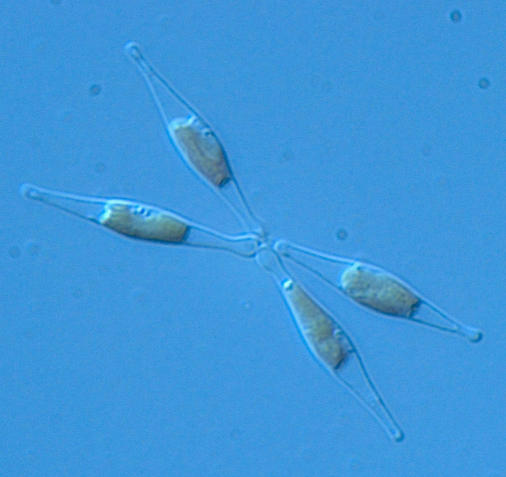
This pennate diatom is the ‘lab rat’ of diatoms, and its genome sequence is currently being determined. (Image courtesy of Alessandra de Martino and Chris Bowler, Stazione Zoologica and Ecole Normale Supérieure.)
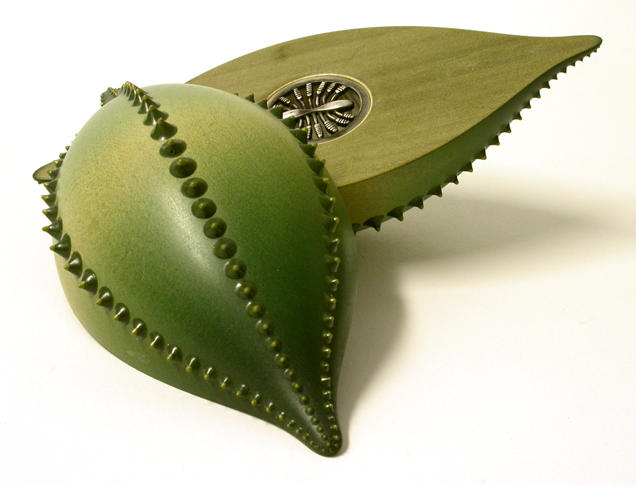
(Image courtesy of David Roberts, University of Wales, Bangor, UK.)
References
-
- Armbrust VE, Berges JA, Bowler C, Green BR, Martinez D, et al. The genome of the diatom Thalassiosira pseudomona: Ecology, evolution, and metabolism. Science. 2004;306:79–86. - PubMed
-
- Drum RW, Gordon R. Star Trek replicators and diatom nanotechnology. Trends Biotechnol. 2003;21:325–328. - PubMed
-
- Papers presented at a workshop on Diatoms and Nanotechnology at the North American Diatom Symposium in October 2003, to be published in a forthcoming special issue of the Journal of Nanoscience and Nanotechnology.— http://aspbs.com/jnn/
MeSH terms
Substances
LinkOut - more resources
Full Text Sources
Other Literature Sources