. 2004 Nov 1;18(21):2652-62.
doi: 10.1101/gad.1241204. Epub 2004 Oct 15.

Genome-wide mRNA surveillance is coupled to mRNA export

Affiliations

Genome-wide mRNA surveillance is coupled to mRNA export

Haley Hieronymus et al. Genes Dev. .

Abstract

Nuclear export of mRNA is a central step in gene expression that shows extensive coupling to transcription and transcript processing. However, little is known about the fate of mRNA and its export under conditions that damage the DNA template and RNA itself. Here we report the discovery of four new factors required for mRNA export through a screen of all annotated nonessential Saccharomyces cerevisiae genes. Two of these factors, mRNA surveillance factor Rrp6 and DNA repair protein Lrp1, are nuclear exosome components that physically interact with one another. We find that Lrp1 mediates specific mRNA degradation upon DNA-damaging UV irradiation as well as general mRNA degradation. Lrp1 requires Rrp6 for genomic localization to genes encoding its mRNA targets, and Rrp6 genomic localization in turn correlates with transcription. Further, Rrp6 and Lrp1 are both required for repair of UV-induced DNA damage. These results demonstrate coupling of mRNA surveillance to mRNA export and suggest specificity of the RNA surveillance machinery for different transcript populations. Broadly, these findings link DNA and RNA surveillance to mRNA export.


Figures

Figure 1.
Figure 1.
A screen of all annotated nonessential S. cerevisiae genes reveals four novel mRNA export factors, Rrp6, Lrp1, Apq12, and Slx9, which interact genetically. (A) A screen of a comprehensive deletion strain collection identified four new strains with poly(A)+ RNA nuclear accumulation, shown here by Cy3-dT50 fluorescence in situ hybridization (FISH) with DAPI costaining. (B) Δslx9, Δapq1, Δlrp1, and Δrrp6 strains show nuclear accumulation of YOR095C mRNA as determined by FISH and DAPI staining. (C) Lrp1 and Rrp6 genetically interact with each other and other mRNA export factors. The Δlrp1 Δslx9, Δrrp6 Δapq1, and Δlrp1 Δrrp6 double mutants have synthetic slow growth phenotypes. Dilution series grown for 2 d are shown. All mutants are in the BY4741/2 background except for Δrrp6 (BP0-12F) crossed with Δapq1.
Figure 2.
Figure 2.
Chromatin immunoprecipitation profiling reveals Lrp1 and Rrp6 genomic localization. (A) Rrp6 binding levels are relatively uniform across the genome, while Lrp1 binding levels vary more widely. The distributions of Lrp1 (gray line) and Rrp6 (black line) binding levels in wild-type cells are shown as the log of coimmunoprecipitated chromatin to input chromatin ratio. Binding level distributions for genes bound by Lrp1 (gray) or Rrp6 (black) above the mean binding level with P < 0.01 are shown by the color-filled region. (B) Lrp1 and Rrp6 show code-pendent genome-wide DNA localization, with Lrp1 localization exhibiting particularly strong dependence on Rrp6. Lrp1 and Rrp6 ChIP profiles were clustered by principal component analysis (PCA). Their similarity scores are represented chromatically for all enriched genes (left) and genes exhibiting more than twofold enrichment and de-enrichment (right). (C) Lrp1 binding levels become more uniform in the absence of Rrp6, while the Rrp6 binding level distribution is largely unchanged by Lrp1 deletion. The distributions of Lrp1 (gray line) and Rrp6 (black line) binding levels in deletion cells lacking the other factor are shown as the log of coimmunoprecipitated chromatin to input chromatin ratio. Distributions of binding levels for genes bound by Lrp1 in Δrrp6 cells (gray) or Rrp6 in Δlrp1 cells (black) above the mean binding level for P < 0.01 are indicated by the color-filled region. (D) Rrp6 binding levels correlate with transcriptional frequency. The histogram of median transcriptional frequency as a function of binding level is shown.
Figure 3.
Figure 3.
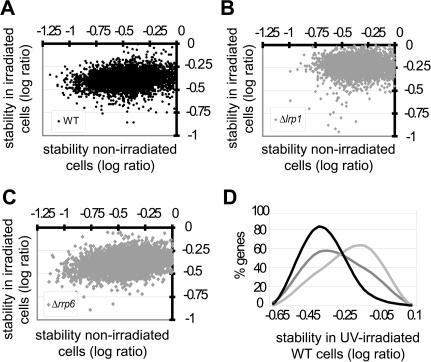
Lrp1 is required for UV-induced RNA degradation. (A) Upon UV-irradiation, wild-type cells show destabilization of the most stable mRNA subpopulation (black). The stability of each transcript in nonirradiated cells is plotted against its stability after UV irradiation, as the log ratio of abundance after 45-min degradation to original abundance. (B) Transcripts in Δlrp1 cells (gray) do not exhibit the UV-induced degradation pattern of wild-type cells. (C) Transcripts in Δrrp6 cells show the same UV-induced degradation phenotype as do wild-type cells. (D) The distribution of mRNAs over the mRNA stability range of UV-irradiated wild-type cells is shown for mRNAs that exhibit Lrp1-dependent degradation in UV-irradiated cells (black) and increased (dark gray) and unaltered (light gray) degradation in UV-irradiated wild-type cells.
Figure 4.
Figure 4.
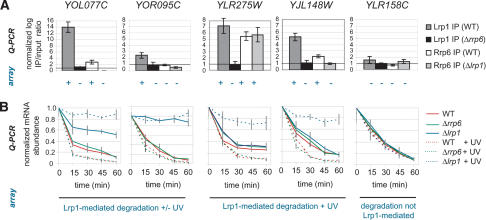
Quantitative PCR validates location and degradation profiling. (A) Quantitative PCR (Q-PCR) confirms the microarray analysis of Lrp1 and Rrp6 genomic localization at five genes, YOL077C, YOR095C, YLR275W, YJL148W, and YLR158C. Lrp1 binding levels in the presence (dark gray) and absence (black) of Rrp6 and Rrp6 binding levels in the presence (white) and absence (light gray) of Lrp1 to these genes are shown as the normalized log ratio of IP to input chromatin. The log IP/input chromatin ratios were normalized to that of a control intergenic region. Error bars represent the standard deviation of three experiments. Microarray-determined binding above or below the mean binding level are indicated by plus and minus signs below each column. (B) Degradation time courses of YOL077C, YOR095C, YLR275W, YJL148W, and YLR158C mRNA in wild-type (red), Δlrp1 (blue), and Δrrp6 (green) cells with (solid line) and without (dashed line) UV irradiation over 60 min validate the role of Lrp1 in general and UV-mediated mRNA degradation. mRNA abundance was normalized to starting abundance and to the abundance of a spiked-in control Arabidopsis mRNA. Error bars represent the standard deviation of three experiments.
Figure 5.
Figure 5.
Rrp6 and Lrp1 are involved in DNA repair. (A) Lrp1 and Rrp6 are required for repair of UV-induced cyclobutane pyrimidine dimers (CPDs). The repair of UV-induced CPDs at the RPB2 gene in wild-type (black), Δlrp1 (light gray), and Δrrp6 (dark gray) strains over 60 min is shown at 15-min intervals, as the percent of wild-type DNA repair after 120 min. The error bars represent the standard deviation of three replicates. (B) Deletion of RAD26 results in a synthetic growth defect with deletion of RRP6. Dilution series grown for 2 d are shown.

References

    1. Allmang C., Petfalski, E., Podtelejnikov, A., Mann, M., Tollervey, D., and Mitchell, P. 1999. The yeast exosome and human PM-Scl are related complexes of 3′ → 5′ exonucleases. Genes Dev. 13: 2148-2158. - PMC - PubMed
    1. Amberg D.C., Goldstein, A.L., and Cole, C.N. 1992. Isolation and characterization of RAT1: An essential gene of Saccharomyces cerevisiae required for the efficient nucleocytoplasmic trafficking of mRNA. Genes & Dev. 6: 1173-1189. - PubMed
    1. Anderson J.S. and Parker, R.P. 1998. The 3′ to 5′ degradation of yeast mRNAs is a general mechanism for mRNA turnover that requires the SKI2 DEVH box protein and 3′ to 5′ exonucleases of the exosome complex. EMBO J. 17: 1497-1506. - PMC - PubMed
    1. Andrulis E.D., Werner, J., Nazarian, A., Erdjument-Bromage, H., Tempst, P., and Lis, J.T. 2002. The RNA processing exosome is linked to elongating RNA polymerase II in Drosophila. Nature 420: 837-841. - PubMed
    1. Aoki K., Suzuki, K., Sugano, T., Tasaka, T., Nakahara, K., Kuge, O., Omori, A., and Kasai, M. 1995. A novel gene, Translin, encodes a recombination hotspot binding protein associated with chromosomal translocations. Nat. Genet. 10: 167-174. - PubMed

Publication types

MeSH terms