


Nucleotide polymorphism and linkage disequilibrium within and among natural populations of European aspen (Populus tremula L., Salicaceae)
- PMID: 15489521
- PMCID: PMC1449109
- DOI: 10.1534/genetics.104.034959
Nucleotide polymorphism and linkage disequilibrium within and among natural populations of European aspen (Populus tremula L., Salicaceae)
Abstract
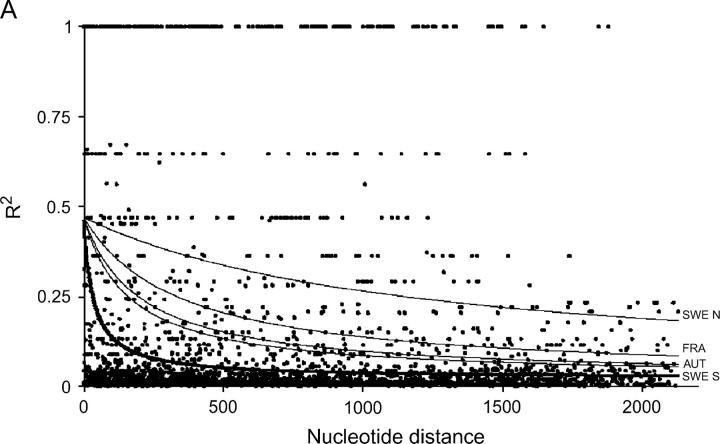
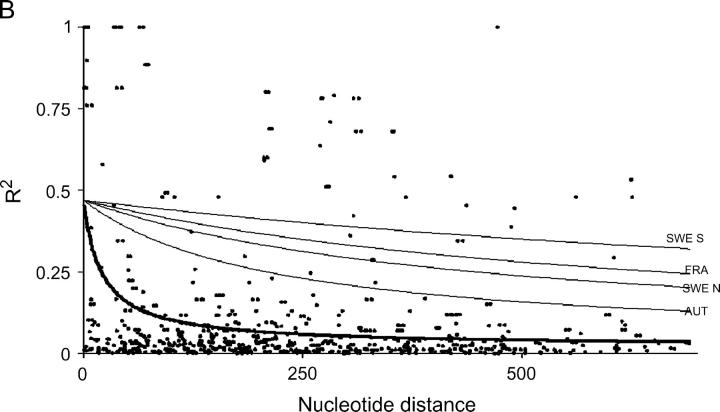
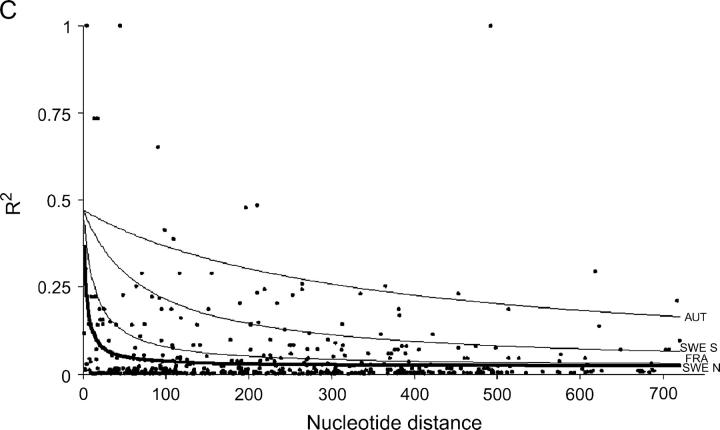
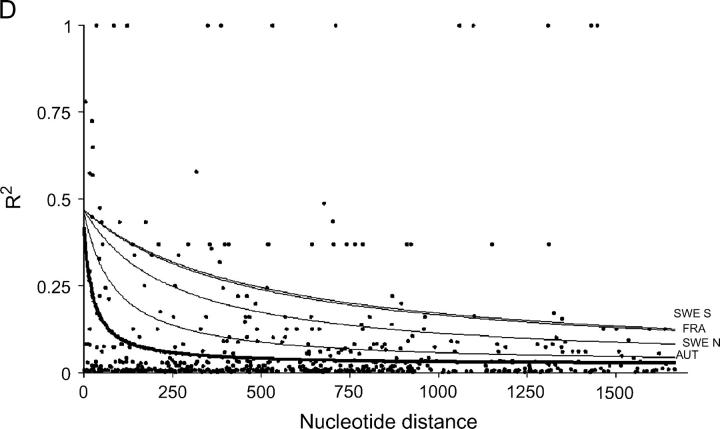
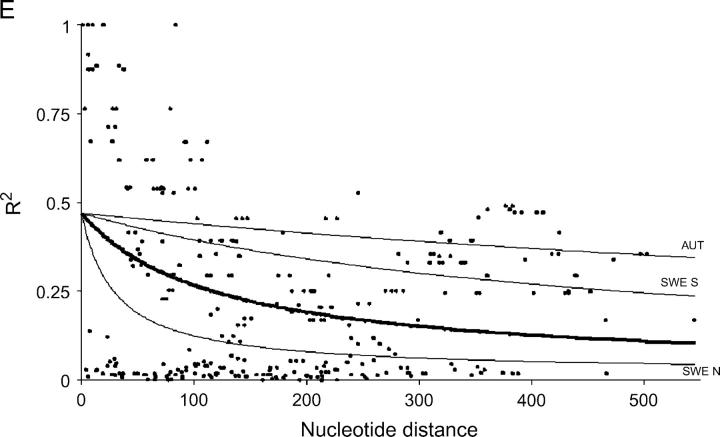
Populus is an important model organism in forest biology, but levels of nucleotide polymorphisms and linkage disequilibrium have never been investigated in natural populations. Here I present a study on levels of nucleotide polymorphism, haplotype structure, and population subdivision in five nuclear genes in the European aspen Populus tremula. Results show substantial levels of genetic variation. Levels of silent site polymorphisms, pi(s), averaged 0.016 across the five genes. Linkage disequilibrium was generally low, extending only a few hundred base pairs, suggesting that rates of recombination are high in this obligate outcrossing species. Significant genetic differentiation was found at all five genes, with an average estimate of F(ST) = 0.116. Levels of polymorphism in P. tremula are 2- to 10-fold higher than those in other woody, long-lived perennial plants, such as Pinus and Cryptomeria. The high levels of nucleotide polymorphism and low linkage disequilibrium suggest that it may be possible to map functional variation to very fine scales in P. tremula using association-mapping approaches.
Figures
References
-
- Aguade, M., 2001. Nucleotide sequence variation at two genes of the phenylpropanoid pathway, the FAH1 and F3H genes in Arabidopsis thaliana. Mol. Biol. Evol. 18: 1–9. - PubMed
-
- Blumenthal, B. E., 1942. Studier angående aspens förekomst i Finland. Silv. Fenn. 56: 1–63.
-
- Brunner, A. M., V. B. Busov and S. H. Strauss, 2004. Poplar genome sequence: functional genomics in an ecologically dominant plant species. Trends Plant Sci. 9: 49–56. - PubMed
-
- Charlesworth, B., 1998. Measures of divergence between populations and the effects of forces that reduce variability. Mol. Biol. Evol. 15: 538–543. - PubMed
Publication types
MeSH terms
LinkOut - more resources
Full Text Sources
Research Materials
Miscellaneous
