


Low-Level Laser Therapy Facilitates Superficial Wound Healing in Humans: A Triple-Blind, Sham-Controlled Study
- PMID: 15496990
- PMCID: PMC522143
Low-Level Laser Therapy Facilitates Superficial Wound Healing in Humans: A Triple-Blind, Sham-Controlled Study
Abstract
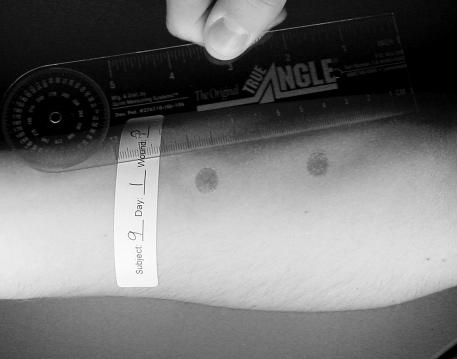
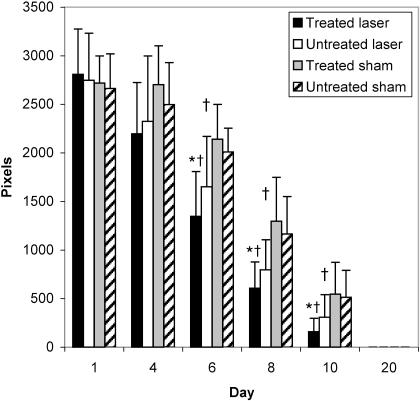
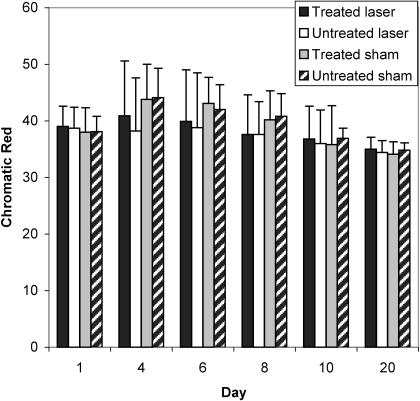
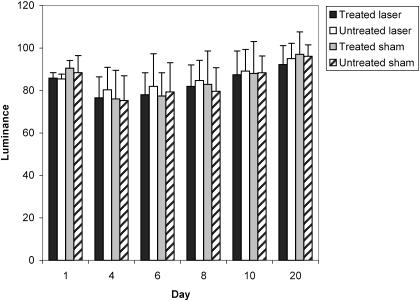
OBJECTIVE: Low-level laser therapy (LLLT) has been promoted for its beneficial effects on tissue healing and pain relief. However, according to the results of in vivo studies, the effectiveness of this modality varies. Our purpose was to assess the putative effects of LLLT on healing using an experimental wound model. DESIGN AND SETTING: We used a randomized, triple-blind, placebo-controlled design with 2 within-subjects factors (wound and time) and 1 between-subjects factor (group). Data were collected in the laboratory setting. SUBJECTS: Twenty-two healthy subjects (age = 21 +/- 1 years, height = 175.6 +/- 9.8 cm, mass = 76.2 +/- 14.2 kg). MEASUREMENTS: Two standardized 1.27-cm(2) abrasions were induced on the anterior forearm. After wound cleaning, standardized digital photos were recorded. Each subject then received LLLT (8 J/cm(2); treatment time = 2 minutes, 5 seconds; pulse rate = 700 Hz) to 1 of the 2 randomly chosen wounds from either a laser or a sham 46-diode cluster head. Subjects reported back to the laboratory on days 2 to 10 to be photographed and receive LLLT and on day 20 to be photographed. Data were analyzed for wound contraction (area), color changes (chromatic red), and luminance. RESULTS: A group x wound x time interaction was detected for area measurements. At days 6, 8, and 10, follow-up testing revealed that the laser group had smaller wounds than the sham group for both the treated and the untreated wounds (P < .05). No group x wound x time differences were detected for chromatic red or luminance. CONCLUSIONS: The LLLT resulted in enhanced healing as measured by wound contraction. The untreated wounds in subjects treated with LLLT contracted more than the wounds in the sham group, so LLLT may produce an indirect healing effect on surrounding tissues. These data indicate that LLLT is an effective modality to facilitate wound contraction of partial-thickness wounds.
Figures
References
-
- Chromey PA. The efficacy of carbon dioxide laser surgery for adjunct ulcer therapy. Clin Podiat Med Surg. 1992;9:709–719. - PubMed
-
- Gogia PP, Hurt BS, Zirn TT. Wound management with whirlpool and infrared cold laser treatment: a clinical report. Phys Ther. 1988;68:1239–1242. - PubMed
-
- Schindl A, Schindl M, Schindl L. Successful treatment of persistent radiation ulcer by low power laser therapy. J Am Acad Dermatol. 1997;37:646–648. - PubMed
-
- Schindl M, Kerschan K, Schindl A, Schon H, Heinzl H, Schindl L. Induction of complete wound healing in recalcitrant ulcers by low-intensity laser irradiation depends on ulcer cause and size. Photodermatol Photoimmunol Photomed. 1999;15:18–21. - PubMed
-
- Sugrue ME, Carolan J, Leen EJ, Feeley TM, Moore DJ, Shanik GD. The use of infrared laser therapy in the treatment of venous ulceration. Ann Vasc Surg. 1990;4:179–181. - PubMed
LinkOut - more resources
Full Text Sources
Other Literature Sources
Medical