


Expression profiles frame the promoter specificity dilemma of the ETS family of transcription factors
- PMID: 15498926
- PMCID: PMC524310
- DOI: 10.1093/nar/gkh906
Expression profiles frame the promoter specificity dilemma of the ETS family of transcription factors
Abstract
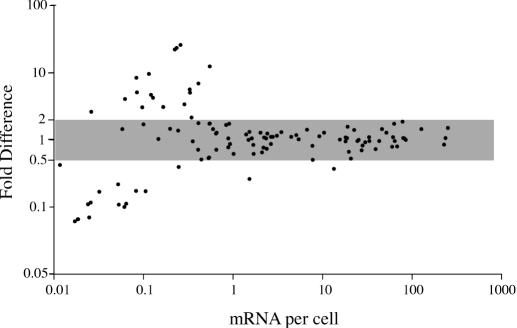
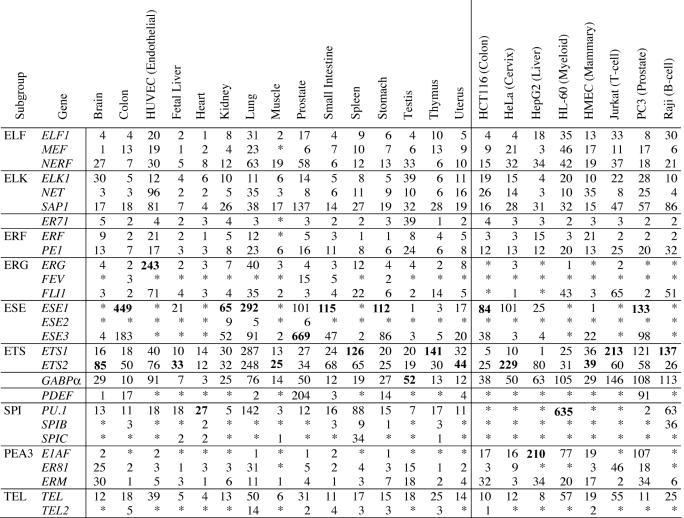
Sequence-specific DNA binding proteins that function as transcription factors are frequently encoded by gene families. Such proteins display highly conserved DNA binding properties, yet are expected to retain promoter selectivity. In this report we investigate this problem using the ets gene family, a group of metazoan genes whose members regulate cell growth and differentiation and are mutated in human cancers. We tested whether the level of mRNA can serve as a specificity determinant. The mRNA levels of the 27 paralogous human ets genes were measured in 23 tissues and cell lines. Real-time RT-PCR provided accurate measurement of absolute mRNA levels for each gene down to one copy per cell. Surprisingly, at least 16 paralogs were expressed in each cell sample and over half were expressed ubiquitously. Tissues and complementary cell lines showed similar expression patterns, indicating that tissue complexity was not a limitation. There was no unique, highly expressed gene for each cell type. Instead, one of only eight ets genes showed the highest expression in all samples. DNA binding studies illustrate both overlapping and unique specificities for ubiquitous ETS proteins. These findings establish the parameters of the promoter specificity dilemma within the ets family of transcription factors.
Figures


References
-
- Sharrocks A.D. (2001) The ETS-domain transcription factor family. Nature Rev. Mol. Cell Biol., 2, 827–837. - PubMed
-
- Graves B.J. and Petersen,J.M. (1998) In Woude,G.V. and Klein,G. (eds), Advances in Cancer Research. Academic Press, San Diego, Vol. 75, pp. 1–55. - PubMed
-
- Szymczyna B.R. and Arrowsmith,C.H. (2000) DNA binding specificity studies of four ETS proteins support an indirect read-out mechanism of protein-DNA recognition. J. Biol. Chem., 275, 28363–28370. - PubMed
-
- Galang C.K., Muller,W.J., Foos,G., Oshima,R.G. and Hauser,C.A. (2004) Changes in the expression of many Ets family transcription factors and of potential target genes in normal mammary tissue and tumors. J. Biol. Chem., 279, 11281–11292. - PubMed
-
- Hsu T. and Schulz,R.A. (2000) Sequence and functional properties of Ets genes in the model organism Drosophila. Oncogene, 19, 6409–6416. - PubMed
Publication types
MeSH terms
Substances
Grants and funding
LinkOut - more resources
Full Text Sources
Other Literature Sources
