


Antibodies to the N-terminal block 2 of Plasmodium falciparum merozoite surface protein 1 are associated with protection against clinical malaria
- PMID: 15501780
- PMCID: PMC522997
- DOI: 10.1128/IAI.72.11.6492-6502.2004
Antibodies to the N-terminal block 2 of Plasmodium falciparum merozoite surface protein 1 are associated with protection against clinical malaria
Abstract
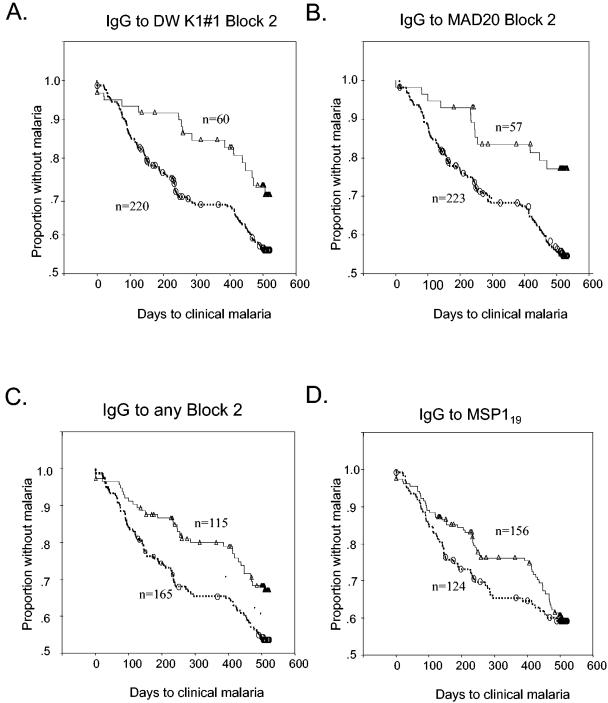
This longitudinal prospective study shows that antibodies to the N-terminal block 2 region of the Plasmodium falciparum merozoite surface protein 1 (MSP-1) are associated with protection against clinical malaria in an area of stable but seasonal malaria transmission of Ghana. Antibodies to the block 2 region of MSP-1 were measured in a cohort of 280 children before the beginning of the major malaria transmission season. The cohort was then actively monitored for malaria, clinically and parasitologically, over a period of 17 months. Evidence is presented for an association between antibody responses to block 2 and a significantly reduced risk of subsequent clinical malaria. Furthermore, statistical survival analysis provides new information on the duration of the effect over time. The results support a conclusion that the block 2 region of MSP-1 is a target of protective immunity against P. falciparum and, thus, a promising new candidate for the development of a malaria vaccine.
Figures
References
-
- Afari, E. A., M. Appawu, S. Dunyo, A. Baffoe-Wilmot, and F. K. Nkrumah. 1995. Malaria infection, morbidity and transmission in two ecological zones in southern Ghana. Afr. J. Health Sci. 2:312-316. - PubMed
-
- Beck, H. P., I. Felger, B. Genton, N. Alexander, F. al-Yaman, R. F. Anders, and M. Alpers. 1995. Humoral and cell-mediated immunity to the Plasmodium falciparum ring-infected erythrocyte surface antigen in an adult population exposed to highly endemic malaria. Infect. Immun. 63:596-600. - PMC - PubMed
-
- Branch, O. H., V. Udhayakumar, A. W. Hightower, A. J. Oloo, W. Hawley, B. L. Nahlen, P. B. Bloland, D. C. Kaslow, and A. A. Lal. 1998. A longitudinal investigation of IgG and IgM antibody responses to the merozoite surface protein-1 19-kilodalton domain of Plasmodium falciparum in pregnant women and infants: associations with febrile illness, parasitemia, and anemia. Am. J. Trop. Med. Hyg. 58:211-219. - PubMed
-
- Burghaus, P. A., and A. A. Holder. 1994. Expression of the 19-kilodalton carboxy-terminal fragment of the Plasmodium falciparum merozoite surface protein-1 in Escherichia coli as a correctly folded protein Mol. Biochem. Parasitol. 64:165-169. - PubMed
Publication types
MeSH terms
Substances
LinkOut - more resources
Full Text Sources
Other Literature Sources
Research Materials
