


doi: 10.1128/IAI.72.11.6685-6688.2004.
Human factor in Staphylococcus aureus nasal carriage
Affiliations
- PMID: 15501803
- PMCID: PMC523019
- DOI: 10.1128/IAI.72.11.6685-6688.2004
Item in Clipboard
Human factor in Staphylococcus aureus nasal carriage
Infect Immun.
2004 Nov.
Abstract
Persistent nasal carriers and noncarriers of Staphylococcus aureus were inoculated with a mixture of different S. aureus strains. The majority of noncarriers and nearly all persistent carriers returned to their original carrier state after artificial inoculation. Furthermore, the majority of persistent carriers tested positive again for their original resident strain. Using a human nasal inoculation model, we here demonstrate that the human factor is an important determinant of S. aureus nasal carriage.
Figures
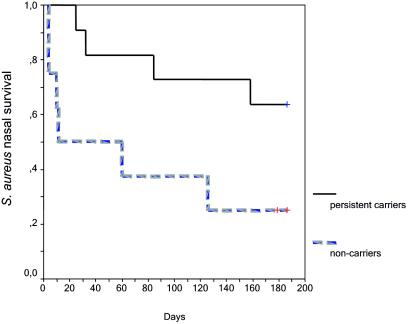
S. aureus survival after artificial nasal inoculation in long-term persistent S. aureus nasal carriers and nasal noncarriers. Kaplan-Meier curves of S. aureus nasal survival in persistent carriers (solid line) and in noncarriers (broken grey line) are shown. Survival ended when at least two consecutive nasal swab cultures were negative. After artificial inoculation with a mixture of S. aureus strains, the median nasal survival of S. aureus was 186 days in persistent carriers versus 35.5 days in noncarriers (P = 0.0427; log rank test).
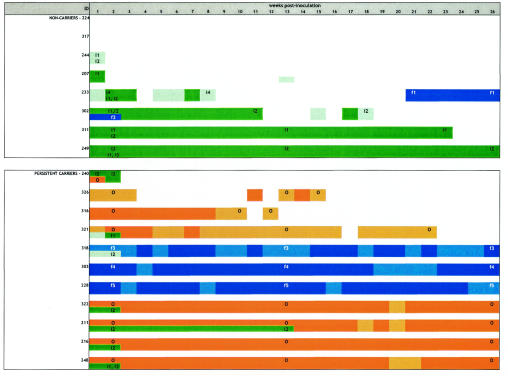
Postartificial nasal inoculation culture results for 11 long-term persistent and 8 non-S. aureus nasal carriers during 26 weeks of follow-up. ID, identification number of individual participants. At time points 2 and 13 days postinoculation of the last positive culture, all S. aureus strains cultured were genotyped. The various genotypically distinct S. aureus strains cultured are identified by colors and codes. The original resident strains of the persistent carriers are colored orange and coded O (“own”). The four S. aureus strains used in the inoculation mixture are colored (mint) green and coded i1 (inoculation S. aureus strain 502A), i2 (inoculation S. aureus strain 274 [persistent-carrier strain]), i3 (inoculation S. aureus strain 1036 [intermittent-carrier strain]), and i4 (inoculation S. aureus strain DU 5819 [protein A-deficient strain]). Five unique foreign S. aureus strains, which were neither resident strains from persistent carriers nor inoculation strains from the inoculation mixture, were cultured in five participants. These foreign S. aureus strains are colored blue and coded f1, f2, f3, f4, and f5. Multiple genotypically distinct S. aureus strains can thus be cultured at each point in time during follow-up. The shading of colors indicates the total number of CFU of S. aureus per culture: dark coloring, more than 100 CFU; light coloring,1 to 99 CFU; no coloring, cultures negative at that point in time.
References
-
- Aly, R., H. R. Shinefield, C. Litz, and H. I. Maibach. 1980. Role of teichoic acid in the binding of Staphylococcus aureus to nasal epithelial cells. J. Infect. Dis. 141:463-465. - PubMed
-
- Armstrong-Esther, C. A. 1976. Carriage patterns of Staphylococcus aureus in a healthy non-hospital population of adults and children. Ann. Hum. Biol. 3:221-227. - PubMed
-
- Bogaert, D., A. van Belkum, M. Sluijter, A. Luijendijk, R. de Groot, H. C. Rümke, H. A. Verbrugh, and P. W. Hermans. 2004. Colonisation by Streptococcus pneumoniae and Staphylococcus aureus in healthy children. Lancet 363:1871-1872. - PubMed
-
- Bruun, J. N. 1970. Post-operative wound infection: predisposing factors and the effect of a reduction in dissemination of staphylococci. Acta Med. Scand. 514:1-89. - PubMed
MeSH terms
LinkOut - more resources
Full Text Sources
Medical
