


A reexamination of the evidence for the somatic marker hypothesis: what participants really know in the Iowa gambling task
- PMID: 15501919
- PMCID: PMC528759
- DOI: 10.1073/pnas.0406666101
A reexamination of the evidence for the somatic marker hypothesis: what participants really know in the Iowa gambling task
Abstract
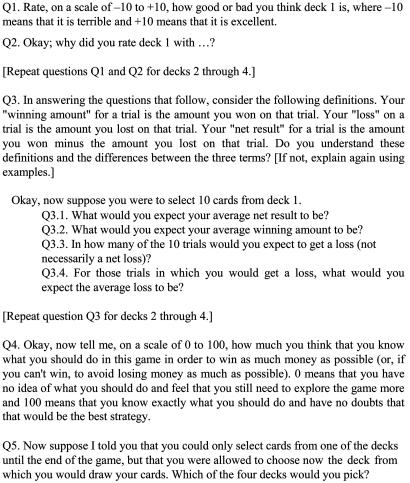
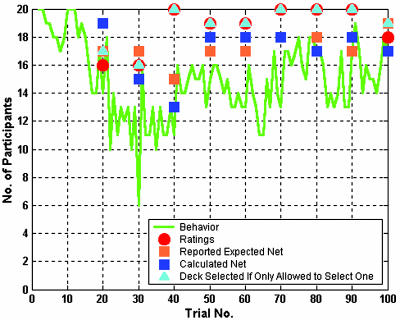
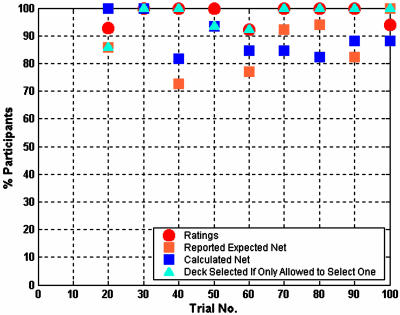
Bechara, Damasio, and coworkers [Bechara, A., Damasio, H., Tranel, D. & Damasio, A. R. (1997) Science 275, 1293-1295] have reported that normal participants decide advantageously before knowing the advantageous strategy in a simple card game designed to mimic real-life decision-making. Bechara et al. have used this result to support their view that nonconscious somatic markers can guide advantageous behavior. By using more sensitive methods, we show that participants have much more knowledge about the game than previously thought. In fact, participants report knowledge of the advantageous strategy more reliably than they behave advantageously. Furthermore, when they behave advantageously, their verbal reports nearly always reveal evidence of quantitative knowledge about the outcomes of the decks that would be sufficient to guide such advantageous behavior. In addition, there is evidence that participants also have access to more qualitative reportable knowledge. These results are compatible with the view that, in this task, both overt behavior and verbal reports reflect sampling from consciously accessible knowledge; there is no need to appeal to nonconscious somatic markers. We also discuss the findings of other studies that similarly suggest alternative interpretations of other evidence previously used to support a role for somatic markers in decision-making.
Figures
Comment in
-
Is knowing always feeling?Proc Natl Acad Sci U S A. 2004 Nov 30;101(48):16709-10. doi: 10.1073/pnas.0407200101. Epub 2004 Nov 22. Proc Natl Acad Sci U S A. 2004. PMID: 15557557 Free PMC article. No abstract available.
-
The Iowa Gambling Task and the somatic marker hypothesis: some questions and answers.Trends Cogn Sci. 2005 Apr;9(4):159-62; discussion 162-4. doi: 10.1016/j.tics.2005.02.002. Trends Cogn Sci. 2005. PMID: 15808493 Review.
References
-
- Damasio, A. R. (1994) Descartes' Error: Emotion, Reason, and the Human Brain (Putnam, New York).
-
- Bechara, A., Damasio, H. & Damasio, A. R. (2000) Cereb. Cortex 10, 295–307. - PubMed
-
- Bechara, A., Damasio, H., Tranel, D. & Damasio, A. R. (1997) Science 275, 1293–1295. - PubMed
-
- Bechara, A., Damasio, A. R., Damasio, H. & Anderson, S. W. (1994) Cognition 50, 7–15. - PubMed
-
- Cleeremans, A., Destrebecqz, A. & Boyer, M. (1998) Trends Cogn. Sci. 2, 406–416. - PubMed
Publication types
MeSH terms
Grants and funding
LinkOut - more resources
Full Text Sources
Other Literature Sources
Medical
