Review
. 2004 Oct;10(10):1729-35.
doi: 10.3201/eid1010.030981.

Strain typing methods and molecular epidemiology of Pneumocystis pneumonia

Affiliations
Review

Strain typing methods and molecular epidemiology of Pneumocystis pneumonia

Charles Ben Beard et al. Emerg Infect Dis. 2004 Oct.

Abstract

Pneumocystis pneumonia (PCP) caused by the opportunistic fungal agent Pneumocystis jirovecii (formerly P. carinii) continues to cause illness and death in HIV-infected patients. In the absence of a culture system to isolate and maintain live organisms, efforts to type and characterize the organism have relied on polymerase chain reaction-based approaches. Studies using these methods have improved understanding of PCP epidemiology, shedding light on sources of infection, transmission patterns, and potential emergence of antimicrobial resistance. One concern, however, is the lack of guidance regarding the appropriateness of different methods and standardization of these methods, which would facilitate comparing results reported by different laboratories.


Figures
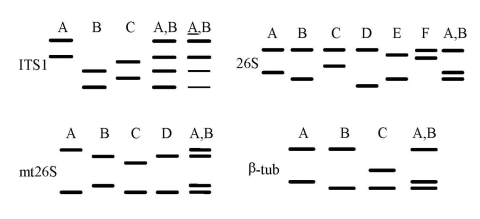
Figure 1
Figure 1
Schematic representation of the single-strand conformation polymorphism (SSCP) patterns of four variable regions used to type Pneumocystis jirovecii. Each lane corresponds to a hypothetical sample. All simple patterns with two bands for each region are shown. Each uppercase letter represents a simple SSCP pattern. For each region, the complex SSCP pattern A,B corresponding to the superimposition of simple patterns A and B is represented. The complex ITS1 pattern A,B, is demonstrated, in which pattern A is more abundant than pattern B. Reprinted with permission from reference . Hauser et al. 2001, AIDS:15(4):461–466.
Figure 2
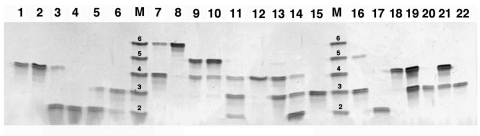
Figure 2
Representative denaturing gel electrophoresis analysis of Pneumocystis jirovecii tandem repeats in clinical isolates. Numbers above each lane represent individual isolates. Lane M is a mixture of polymerase chain reaction products from five isolates, of which the number of repeats was 2, 3, 4, 5, and 6 (shown above DNA bands), as determined by sequencing. Reprinted from (33) with permission from the University of Chicago Press.
Figure 3
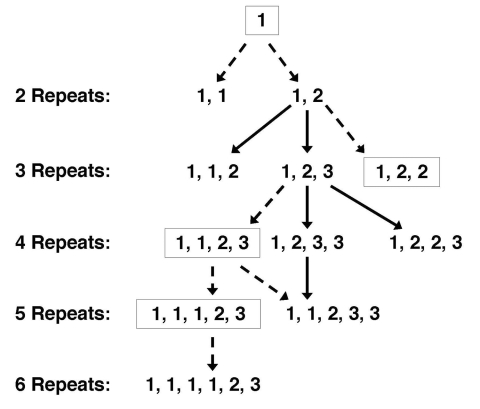
Figure 3
A model for the evolution of tandem repeats in Pneumocystis jirovecii, for repeat patterns that have been identified to date. The number of repeats is indicated on the left. The specific pattern of repeats is indicated on the right. The numbers 1, 2, and 3 represent three different repeat types with sequence variation in the first and fourth nucleotides. The repeat patterns that were not identified in this study but are postulated to exist, on the basis of identified patterns, are boxed. Solid arrows indicate potential evolution between isolates that have been identified, and dashed arrows indicate evolution between postulated isolates. Reprinted from (33) with permission from the University of Chicago Press.

References

    1. Vaneck J, Jirovec O, Lukes J. Interstitial plasma cell pneumonia in infants. Ann Pediatr (Paris). 1953;180:1–20. - PubMed
    1. Edman JC, Kovacs JA, Masur H, Santi DV, Elwood HJ, Sogin ML. Ribosomal RNA sequence shows Pneumocystis carinii to be a member of the Fungi. Nature. 1988;334:519–22. - PubMed
    1. Stringer SL, Stringer JL, Blase MA, Walzer PD, Cushion MT. Pneumocystis carinii: sequence from ribosomal RNA implies a close relationship with fungi. Exp Parasitol. 1989;68:450–61. - PubMed
    1. Stringer JR, Beard CB, Miller RF, Wakefield AE. A new name (Pneumocystis jirovecii) for pneumocystis from humans. Emerg Infect Dis. 2002;8:891–6. - PMC - PubMed
    1. Erikson OE. Pneumocystis carinii, a parasite in lungs of mammals, referred to a new family and order (Pneumocystidaceae, Pneumocystidales, Ascomycota). Systema Ascomycetum. 1994;13:165–80.

MeSH terms

LinkOut - more resources