. 2004 Nov;78(22):12179-88.
doi: 10.1128/JVI.78.22.12179-12188.2004.

The l2 minor capsid protein of human papillomavirus type 16 interacts with a network of nuclear import receptors

Affiliations

The l2 minor capsid protein of human papillomavirus type 16 interacts with a network of nuclear import receptors

Medha S Darshan et al. J Virol. 2004 Nov.

Abstract

The L2 minor capsid proteins enter the nucleus twice during viral infection: in the initial phase after virion disassembly and in the productive phase when, together with the L1 major capsid proteins, they assemble the replicated viral DNA into virions. In this study we investigated the interactions between the L2 protein of high-risk human papillomavirus type 16 (HPV16) and nuclear import receptors. We discovered that HPV16 L2 interacts directly with both Kapbeta(2) and Kapbeta(3). Moreover, binding of Ran-GTP to either Kapbeta(2) or Kapbeta(3) inhibits its interaction with L2, suggesting that the Kapbeta/L2 complex is import competent. In addition, we found that L2 forms a complex with the Kapalpha(2)beta(1) heterodimer via interaction with the Kapalpha(2) adapter. In agreement with the binding data, nuclear import of L2 in digitonin-permeabilized cells could be mediated by either Kapalpha(2)beta(1) heterodimers, Kapbeta(2), or Kapbeta(3). Mapping studies revealed that HPV16 L2 contains two nuclear localization signals (NLSs), in the N terminus (nNLS) and C terminus (cNLS), that could mediate its nuclear import. Together the data suggest that HPV16 L2 interacts via its NLSs with a network of karyopherins and can enter the nucleus via several import pathways mediated by Kapalpha(2)beta(1) heterodimers, Kapbeta(2), and Kapbeta(3).


Figures
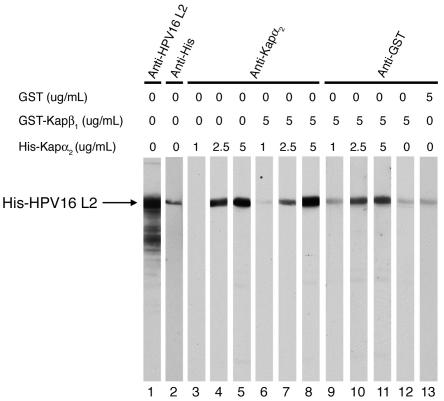
FIG. 1.
FIG. 1.
HPV16 L2 forms a complex with the Kapα2β1 heterodimer via interaction with the Kapα2 adapter. Purified L2 was subjected to SDS-PAGE and transferred onto a nitrocellulose membrane. Two L2 blots were detected with anti-HPV16 L2 (lane 1) and anti-His (lane 2) antibodies. Other L2 blots were incubated with increasing concentrations of Kapα2 in the absence (lanes 3 to 5) or the presence (lanes 6 to 11) of 5 μg of GST-Kapβ1 per ml. Separate L2 blots were incubated with GST-Kapβ1 alone (lane 12) or with GST as a negative control (lane 13). Bound Kapα2 was detected with an anti-Kapα2 antibody (lanes 3 to 8), and bound GST-Kapβ1 and GST were detected with an anti-GST antibody (lanes 9 to 13).
FIG. 2.
FIG. 2.
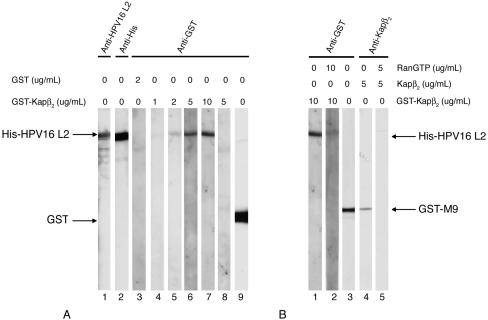
HPV16 L2 interacts specifically with Kapβ2, and Ran-GTP inhibits the interaction. (A) L2 (lanes 1 to 7), BSA (lane 8), and GST (lane 9) were subjected to SDS-PAGE and transferred onto nitrocellulose membrane. Two L2 blots were detected with anti-HPV16 L2 (lane 1) and anti-His (lane 2) antibodies. Other L2 blots were incubated with increasing concentrations of GST-Kapβ2 (lanes 4 to 7) or with 2 μg of GST per ml (lane 3). The BSA blot was incubated with 5 μg of GST-Kapβ2 per ml (lane 8). Bound GST-Kapβ2 and GST were detected with an anti-GST antibody. (B) L2 blots were incubated with GST-Kapβ2 in the absence (lane 1) or presence of Ran-GTP (lane 2), and bound GST-Kapβ2 was detected with an anti-GST antibody. GST-M9 blots were incubated with Kapβ2 in the absence (lane 4) or presence (lane 5) of Ran-GTP, and bound Kapβ2 was detected with an anti-Kapβ2 antibody. GST-M9 was detected with an anti-GST antibody (lane 3).
FIG. 3.
FIG. 3.
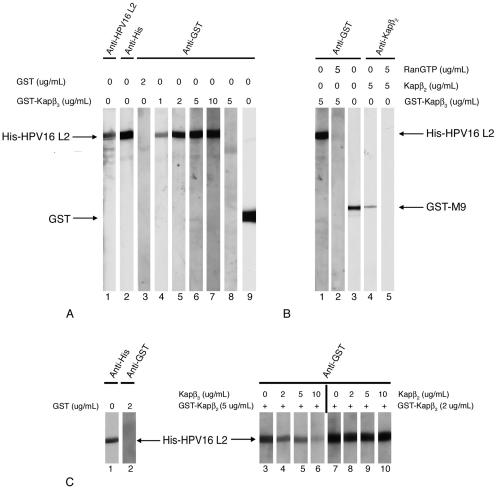
HPV16 L2 interacts specifically with Kapβ3, and Ran-GTP inhibits the interaction. (A) L2 (lanes 1 to 7), BSA (lane 8), and GST (lane 9) were subjected to SDS-PAGE and transferred onto a nitrocellulose membrane. Two L2 blots were detected with anti-HPV16 L2 (lane 1) and anti-His (lane 2) antibodies. Other L2 blots were incubated with increasing concentrations of GST-Kapβ3 (lanes 4 to 7) or with 2 μg of GST per ml (lane 3). The BSA blot was incubated with 5 μg of GST-Kapβ3 per ml (lane 8). Bound GST-Kapβ3 and GST were detected with an anti-GST antibody. (B) L2 blots were incubated with GST-Kapβ3 in the absence (lane 1) or presence (lane 2) of Ran-GTP, and bound GST-Kapβ3 was detected with an anti-GST antibody. GST-M9 blots were incubated with Kapβ2 in the absence (lane 4) or presence (lane 5) of Ran-GTP, and bound Kapβ2 was detected with an anti-Kapβ2 antibody. GST-M9 was detected with an anti-GST antibody (lane 3). (C) Kapβ3 competes with Kapβ2 for binding to HPV16 L2 minor capsid protein. L2 blots were incubated with either 5 μg of GST-Kapβ2 per ml in the absence or presence of increasing concentrations of Kapβ3 (lanes 3 to 6) or 2 μg of GST-Kapβ3 per ml in the absence or presence of increasing concentrations of Kapβ2 (lanes 7 to 10). Bound GST-Kapβ2 and GST-Kapβ3 were detected with an anti-GST antibody.
FIG. 4.
FIG. 4.
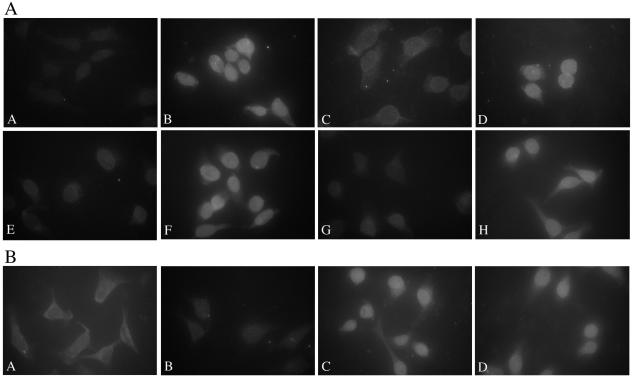
HPV16 L2 can enter the nucleus via Kapα2β1-, Kapβ2-, and Kapβ3-mediated pathways. (A) Digitonin-permeabilized HeLa cells were incubated with either wild-type L2 (panels A to D) or GST-NLSHPV16L1 (panels E to H) in the presence of either transport buffer (panels A and E), cytosol (panels B and F), Kapβ1 plus Ran-GDP (panels C and G), or Kapα2β1 plus Ran-GDP (panels D and H). Note the nuclear import in panels B, D, F, and H. (B) Digitonin-permeabilized HeLa cells were incubated with wild-type L2 in the presence of either transport buffer (panel A), Ran-GDP (panel B), Kapβ2 plus Ran-GDP (panel C), or Kapβ3 plus Ran-GDP (panel D). Note the nuclear import in panels C and D.
FIG. 5.
FIG. 5.
Both the nNLS and cNLS of HPV16 L2 can mediate the nuclear import of a GST reporter protein. Digitonin-permeabilized HeLa cells were incubated with either GST-nNLS (panels A and E), GST-mNLS (panels B and F), GST-cNLS (panels C and G), or GST (panels D and H) in the presence of either only transport buffer (panels A to D) or HeLa cytosol (panels E to H). Note the nuclear import in panels E and G.
FIG. 6.
FIG. 6.
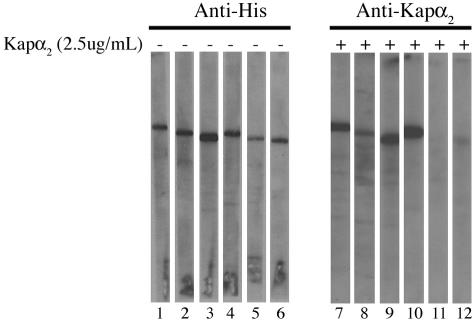
Deletion of both the N and C termini of HPV16 L2 abolishes interaction with the Kapα2 adapter. Blots containing wild-type L2 protein (lanes 1 and 7), L2ΔN mutant protein (lanes 2 and 8), L2ΔM mutant protein (lanes 3 and 9), L2ΔC mutant protein (lanes 4 and 10), L2ΔNΔC double mutant protein (lanes 5 and 10), and L2ΔNΔMΔC triple mutant protein (lanes 6 and 12) were either probed with an anti-His antibody (lanes 1 to 6) or incubated with 2.5 μg of Kapα2 per ml, and bound Kapα2 was detected with an anti-Kapα2 antibody (lanes 7 to 12).
FIG. 7.
FIG. 7.
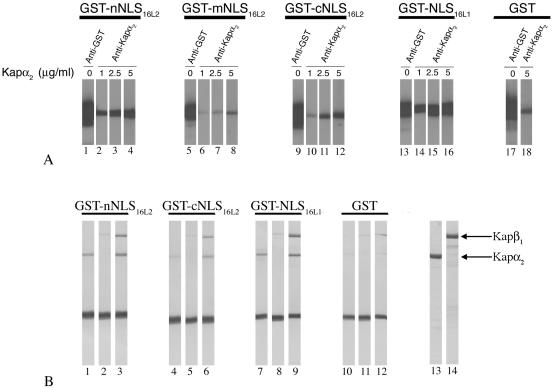
Both the nNLS and cNLS of HPV16 L2 interact with the Kapα2 adapter and form a complex with Kapα2β1 heterodimers. (A) Blots containing GST-nNLS16L2 (lanes 2 to 4), GST-mNLS16L2 (lanes 6 to 8), GST-cNLS16L2 (lanes 10 to 12), GST-NLS16L1 (positive control; lanes 14 to 16), or GST (negative control; lane 18) were incubated with increasing amounts of Kapα2, and bound Kapα2 was detected with an anti-Kapα2 antibody. The different GST-NLS proteins and GST were detected with an anti-GST antibody (lanes 1, 5, 9, 13, and 17, respectively). (B) GST-nNLS16L2 (lanes 1 to 3), GST-cNLS16L2 (lanes 4 to 6), GST-NLSHPV16L1 (lanes 7 to 9), and GST (lanes 10 to 12) immobilized on glutathione-Sepharose (2 μg/10 μl of beads) were incubated with either Kapα2 (lanes 1, 4, 7, and 10), Kapβ1 (lanes 2, 5, 8, and 11), or Kapβ1 plus Kapα2 (lanes 3, 6, 9, and 12). Bound proteins were eluted with sample buffer and analyzed by SDS-PAGE and Coomassie blue staining. The input of Kapα2 and Kapβ1 is shown in lanes 13 and 14.
FIG. 8.
FIG. 8.
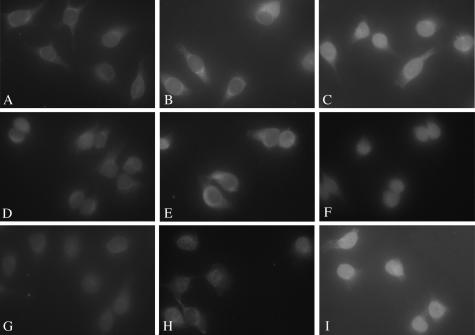
The nNLS of HPV16 L2 efficiently mediates the nuclear import of a GST reporter via the Kapα2β1 pathway. Digitonin-permeabilized cells were incubated with either GST-nNLS (panels A to C), GST-cNLS (panels D to F), or GST-NLSHPV16L1 (panels G to I) in the presence of either transport buffer (panels A, D, and G), Kapβ1 plus Ran-GDP (panels B, E, and H), or Kapα2 plus Kapβ1 plus Ran-GDP (panels C, F, and I). Nuclear import of the GST-NLSs was detected with an anti-GST antibody.
FIG. 9.
FIG. 9.
The N terminus of HPV16 L2 is essential for the interaction with Kapβ2 and Kapβ3 nuclear import receptors. (A) Blots containing wild-type L2 protein (lanes 1 and 7), L2ΔN mutant protein (lanes 2 and 8), L2ΔM mutant protein (lanes 3 and 9), L2ΔC mutant protein (lanes 4 and 10), L2ΔNΔC double mutant protein (lanes 5 and 10), and L2ΔNΔMΔC triple mutant protein (lanes 6 and 12) were either probed with anti-His antibody (lanes 1 to 6) or incubated with 10 μg of GST-Kapβ2 per ml, and bound GST-Kapβ2 was detected with an anti-GST antibody (lanes 7 to 12). (B) Blots containing wild-type L2 protein (lanes 1 and 7), L2ΔN mutant protein (lanes 2 and 8), L2ΔM mutant protein (lanes 3 and 9), L2ΔC mutant protein (lanes 4 and 10), L2ΔNΔC double mutant protein (lanes 5 and 10), and L2ΔNΔMΔC triple mutant protein (lanes 6 and 12) were either probed with an anti-His antibody (lanes 1 to 6) or incubated with 10 μg of GST-Kapβ3 per ml, and bound GST-Kapβ3 was detected with an anti-GST antibody (lanes 7 to 12).
FIG. 10.
FIG. 10.
The nNLS is essential for Kapβ2- or Kapβ3-mediated nuclear import of HPV16 L2. Digitonin-permeabilized HeLa cells were incubated with either wild-type L2 protein (panels A to C) or L2ΔN mutant protein (panels D to F) in the presence of either transport buffer (panels A and D), Kapβ2 plus Ran-GDP (panels B and E), or Kapβ3 plus Ran-GDP (panels C and F). Note the nuclear import in panels B and C.

References

    1. Becker, K. A., L. Florin, C. Sapp, and M. Sapp. 2003. Dissection of human papillomavirus type 33 L2 domains involved in nuclear domains (ND) 10 homing and reorganization. Virology 314:161-167. - PubMed
    1. Chen, X. S., R. L. Garcea, I. Goldberg, G. Casini, and S. C. Harrison. 2000. Structure of small virus-like particles assembled from the L1 protein of human papillomavirus 16. Mol. Cell 5:557-567. - PubMed
    1. Chi, N. C., E. J. Adam, G. D. Visser, and S. A. Adam. 1996. RanBP1 stabilizes the interaction of Ran with p97 nuclear protein import. J. Cell Biol. 135:559-569. - PMC - PubMed
    1. Chook, Y. M., and G. Blobel. 1999. Structure of the nuclear transport complex karyopherin-β2-Ran x GppNHp. Nature 399:230-237. - PubMed
    1. Coutavas, E., M. Ren, J. D. Oppenheim, P. D'Eustachio, and M. G. Rush. 1993. Characterization of proteins that interact with the cell-cycle regulatory protein Ran/TC4. Nature 366:585-587. - PubMed

Publication types

MeSH terms

LinkOut - more resources