


Evolutionary dynamics of the glycan shield of the human immunodeficiency virus envelope during natural infection and implications for exposure of the 2G12 epitope
- PMID: 15507649
- PMCID: PMC525068
- DOI: 10.1128/JVI.78.22.12625-12637.2004
Evolutionary dynamics of the glycan shield of the human immunodeficiency virus envelope during natural infection and implications for exposure of the 2G12 epitope
Abstract
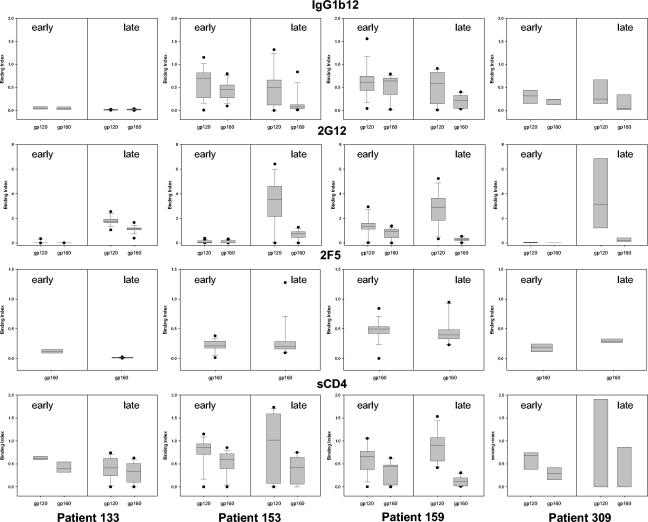
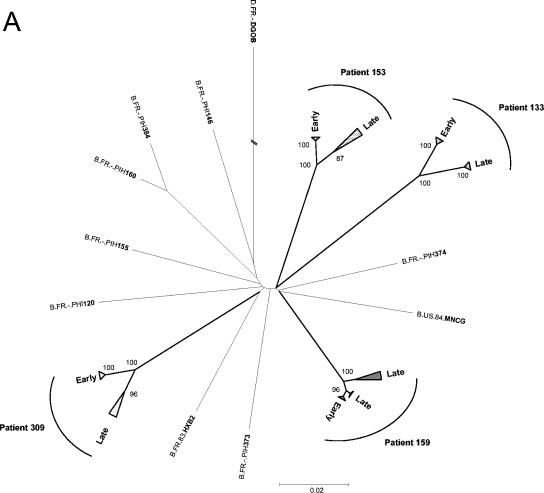
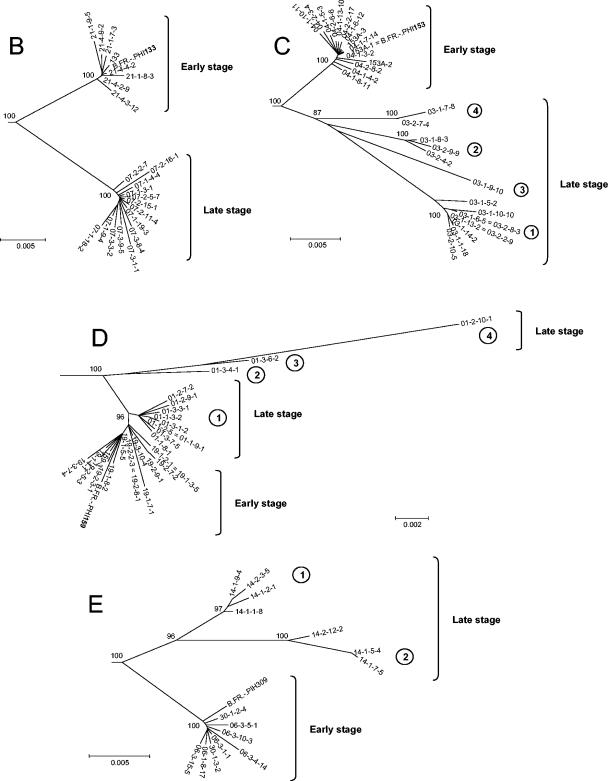
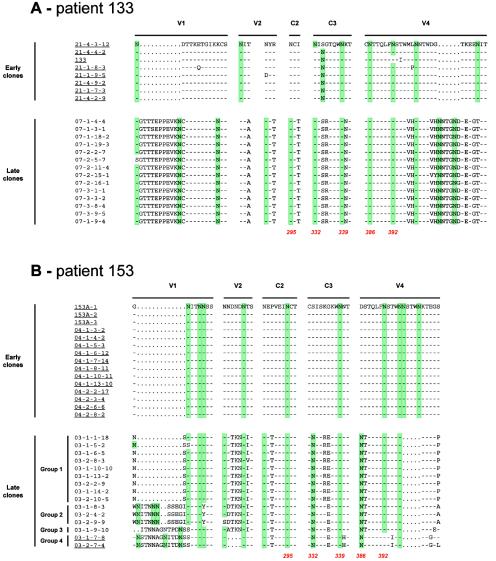
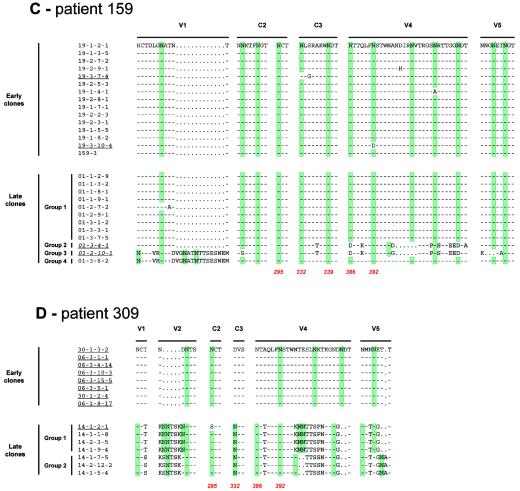
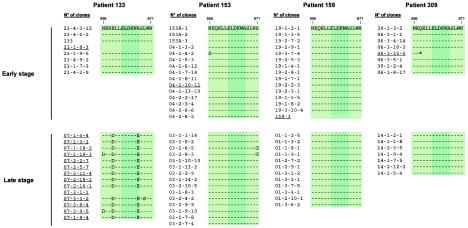
Elucidation of the kinetics of exposure of neutralizing epitopes on the envelope of human immunodeficiency virus type 1 (HIV-1) during the course of infection may provide key information about how HIV escapes the immune system or why its envelope is such a poor immunogen to induce broadly efficient neutralizing antibodies. We analyzed the kinetics of exposure of the epitopes corresponding to the broadly neutralizing human monoclonal antibodies immunoglobulin G1b12 (IgG1b12), 2G12, and 2F5 at the quasispecies level during infection. We studied the antigenicity and sequences of 94 full-length envelope clones present during primary infection and at least 4 years later in four HIV-1 clade B-infected patients. No or only minor exposure differences were observed for the 2F5 and IgG1b12 epitopes between the early and late clones. Conversely, the envelope glycoproteins of the HIV-1 quasispecies present during primary infection did not expose the 2G12 neutralizing epitope, unlike those present after several years in three of the four patients. Sequence analysis revealed major differences at potential N-linked glycosylation sites between early and late clones, particularly at positions known to be important for 2G12 binding. Our study, in natural mutants, confirms that the glycosylation sites N295, N332, and N392 are essential for 2G12 binding. This study demonstrates the relationship between the evolving "glycan shield " of HIV and the kinetics of exposure of the 2G12 epitope during the course of natural infection.
Figures
References
-
- Ataman-Onal, Y., C. Coiffier, A. Giraud, A. Babic-Erceg, F. Biron, and B. Verrier. 1999. Comparison of complete env gene sequences from individuals with symptomatic primary HIV type 1 infection. AIDS Res. Hum. Retrovir. 15:1035-1039. - PubMed
-
- Baba, T. W., V. Liska, R. Hofmann-Lehmann, J. Vlasak, W. Xu, S. Ayehunie, L. A. Cavacini, M. R. Posner, H. Katinger, G. Stiegler, B. J. Bernacky, T. A. Rizvi, R. Schmidt, L. R. Hill, M. E. Keeling, Y. Lu, J. E. Wright, T. C. Chou, and R. M. Ruprecht. 2000. Human neutralizing monoclonal antibodies of the IgG1 subtype protect against mucosal simian-human immunodeficiency virus infection. Nat. Med. 6:200-206. - PubMed
-
- Barin, F., S. Brunet, D. Brand, C. Moog, R. Peyre, F. Damond, P. Charneau, and F. Barré-Sinoussi. 2004. Interclade neutralization and enhancement of human immunodeficiency virus type 1 identified by an assay using HeLa cells expressing both CD4 receptor and CXCR4/CCR5 coreceptors. J. Infect. Dis. 189:322-327. - PubMed
-
- Binley, J. M., R. Wyatt, E. Desjardins, P. D. Kwong, W. Hendrickson, J. P. Moore, and J. Sodroski. 1998. Analysis of the interaction of antibodies with a conserved enzymatically deglycosylated core of the HIV type 1 envelope glycoprotein 120. AIDS Res. Hum. Retrovir. 14:191-198. - PubMed
-
- Brand, D., F. Lemiale, G. Thibault, B. Verrier, S. Lebigot, P. Roingeard, L. Buzelay, S. Brunet, and F. Barin. 2000. Antigenic properties of recombinant envelope glycoproteins derived from T-cell-line-adapted isolates or primary human immunodeficiency virus isolates and their relationship to immunogenicity. Virology 271:350-362. - PubMed
Publication types
MeSH terms
Substances
Associated data
- Actions
- Actions
- Actions
- Actions
- Actions
- Actions
- Actions
- Actions
- Actions
- Actions
- Actions
- Actions
- Actions
- Actions
- Actions
- Actions
- Actions
- Actions
- Actions
- Actions
- Actions
- Actions
- Actions
- Actions
- Actions
- Actions
- Actions
- Actions
- Actions
- Actions
- Actions
- Actions
- Actions
- Actions
- Actions
- Actions
- Actions
- Actions
- Actions
- Actions
- Actions
- Actions
- Actions
- Actions
- Actions
- Actions
- Actions
- Actions
- Actions
- Actions
- Actions
- Actions
- Actions
- Actions
- Actions
- Actions
- Actions
- Actions
- Actions
- Actions
- Actions
- Actions
- Actions
- Actions
- Actions
- Actions
- Actions
- Actions
- Actions
- Actions
- Actions
- Actions
- Actions
- Actions
- Actions
- Actions
- Actions
- Actions
- Actions
- Actions
- Actions
- Actions
- Actions
- Actions
- Actions
- Actions
- Actions
- Actions
- Actions
- Actions
- Actions
- Actions
- Actions
- Actions
LinkOut - more resources
Full Text Sources
Other Literature Sources
Molecular Biology Databases
