Review
. 2004 Nov 10;23(22):4365-70.
doi: 10.1038/sj.emboj.7600450. Epub 2004 Oct 28.

Genomic specification and epigenetic regulation of eukaryotic DNA replication origins

Affiliations
Review

Genomic specification and epigenetic regulation of eukaryotic DNA replication origins

Francisco Antequera. EMBO J. .

Abstract

Identification of DNA replication origins (ORIs) at a genome-wide level in eukaryotes has proved to be difficult due to the high degree of degeneracy of their sequences. Recent structural and functional approaches, however, have circumvented this limitation and have provided reliable predictions of their genomic distribution in the yeasts Saccharomyces cerevisiae and Schizosaccharomyces pombe, and they have also significantly increased the number of characterized ORIs in animals. This article reviews recent evidence on how ORIs are specified and maintained in these systems and on their regulation and sensitivity to epigenetic signals. It also discusses the possible additional involvement of ORIs in processes other than DNA replication.


Figures

Figure 1
Figure 1
A+T-rich and C+G-rich islands at DNA replication origins. (A) A+T content across the 50 kb regions including the 1041 and 1098 A+T-rich islands in S. pombe. Red and blue rectangles represent genes transcribed towards the left and the right, respectively. Black bars labelled 2D represent restriction fragments containing an active ORI as assayed by 2D gel electrophoresis. Broken lines indicate the average intergenic A+T content (70%). Scale bar, 10 kb. (B) G+C content across the 50 kb regions spanning the first two exons of the human TOP1 gene and the bidirectionally transcribed PRKDC and MCM4 genes. Arrows indicate the direction of transcription. Red and blue bars represent exons. Black bars labelled IP represent DNA fragments preferentially immunoprecipitated by ChIP analysis with anti-hOrc2p antibodies. Broken lines indicate the human average genomic G+C content (41%). Scale as in (A).
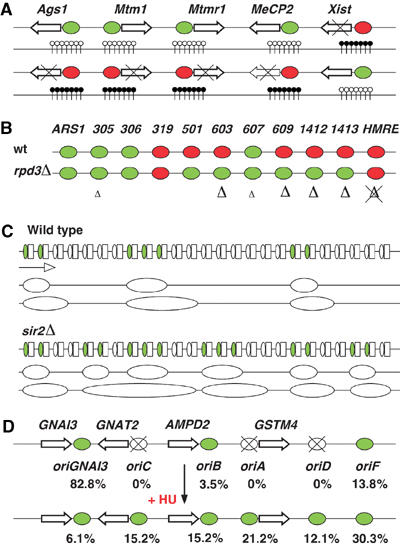
Figure 2
Figure 2
Epigenetic regulation of replication origins. (A) Arrows represent the same five genes in the active (top) and inactive (bottom) mouse X chromosomes. CpG islands surrounding their promoters are indicated by vertical lines with nonmethylated (white circles) or methylated (black circles) CpG dinucleotides. Genes are not transcribed when their associated CpG islands are methylated (crossed arrows). Xist is expressed in the inactive X chromosome only. Replication origins at nonmethylated CpG islands are replicated early during S phase (green ovals) and late when methylated (red) (Gómez and Brockdorff, 2004). Genes and intergenic distances are not drawn to scale. (B) Green and red ovals represent 11 replication origins that are activated early or late, respectively, during S phase in S. cerevisiae. Late ORIs in wild type (wt) cells are activated in early S phase in rpd3Δ mutants and in many cases this is accompanied by an increase in histone acetylation (large Δ). This increase is comparatively smaller in the early origins ARS305 and ARS607 (small Δ). Activation time of ARS319 and HMR-E is not affected in rpd3Δ cells and no increase in histone acetylation was detected in HMR-E (Vogelauer et al, 2002; Aparicio et al, 2004). (C) Replication origins (ovals) localize at the nontranscribed spacer between 35S transcription units (white boxes) in the rDNA locus in S. cerevisiae. Only 20–25% of all ORIs are activated in small clusters (green) in wild-type cells, while additional ORIs fire in sir2Δ mutants in every S phase (Pasero et al, 2002). Large ovals represent replication bubbles at two consecutive stages of replication, which is mainly unidirectional in this region. The direction of transcription and replication is indicated by an arrow. (D) Arrows represent four genes in the hamster AMPD2 locus. Six ORIs have been identified in this region and their relative percentage of activation in cell line GMA32/422 is indicated (top) (Anglana et al, 2003). Active and inactive ORIs are indicated by green and crossed white ovals, respectively. Treatment with hydroxyurea (HU) modifies dramatically the pattern of activity and efficiency of the six ORIs (bottom). Genes and intergenic distances are not drawn to scale.

References

    1. Aggarwal BD, Calvi BR (2004) Chromatin regulates origin activity in Drosophila follicle cells. Nature 430: 372–376 - PubMed
    1. Aladjem MI, Fanning E (2004) The replicon revisited: an old model learns new tricks in metazoan chromosomes. EMBO Rep 5: 686–691 - PMC - PubMed
    1. Altman AL, Fanning E (2004) Defined sequence modules and an architectural element cooperate to promote initiation at an ectopic mammalian chromosomal replication origin. Mol Cell Biol 24: 4138–4150 - PMC - PubMed
    1. Anglana M, Apiou F, Bensimon A, Debatisse M (2003) Dynamics of DNA replication in mammalian somatic cells: nucleotide pool modulates origin choice and interorigin spacing. Cell 114: 385–394 - PubMed
    1. Antequera F (2003) Structure, function and evolution of CpG island promoters. Cell Mol Life Sci 60: 1647–1658 - PMC - PubMed

LinkOut - more resources