. 2004 Oct;168(2):585-93.
doi: 10.1534/genetics.104.034777.

Development of an expressed sequence tag (EST) resource for wheat (Triticum aestivum L.): EST generation, unigene analysis, probe selection and bioinformatics for a 16,000-locus bin-delineated map

Affiliations

Development of an expressed sequence tag (EST) resource for wheat (Triticum aestivum L.): EST generation, unigene analysis, probe selection and bioinformatics for a 16,000-locus bin-delineated map

G R Lazo et al. Genetics. 2004 Oct.

Abstract

This report describes the rationale, approaches, organization, and resource development leading to a large-scale deletion bin map of the hexaploid (2n = 6x = 42) wheat genome (Triticum aestivum L.). Accompanying reports in this issue detail results from chromosome bin-mapping of expressed sequence tags (ESTs) representing genes onto the seven homoeologous chromosome groups and a global analysis of the entire mapped wheat EST data set. Among the resources developed were the first extensive public wheat EST collection (113,220 ESTs). Described are protocols for sequencing, sequence processing, EST nomenclature, and the assembly of ESTs into contigs. These contigs plus singletons (unassembled ESTs) were used for selection of distinct sequence motif unigenes. Selected ESTs were rearrayed, validated by 5' and 3' sequencing, and amplified for probing a series of wheat aneuploid and deletion stocks. Images and data for all Southern hybridizations were deposited in databases and were used by the coordinators for each of the seven homoeologous chromosome groups to validate the mapping results. Results from this project have established the foundation for future developments in wheat genomics.


Figures
F<sc>igure</sc> 1.—
Figure 1.—
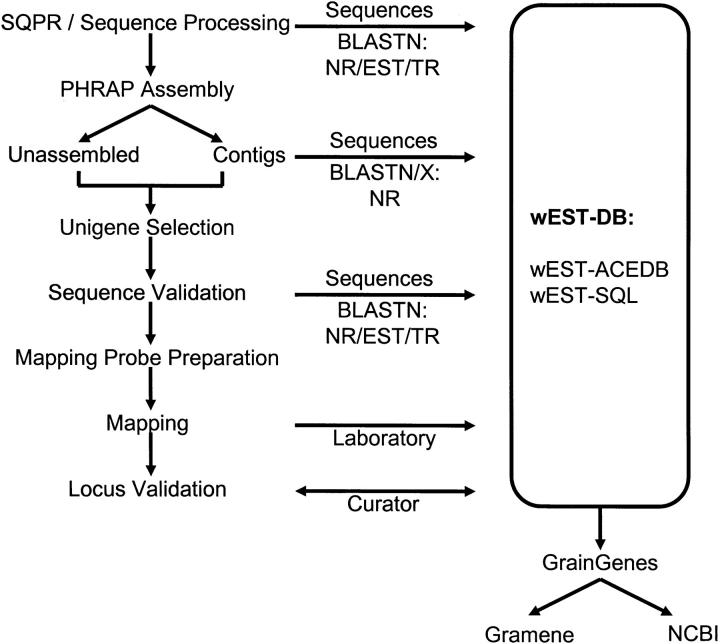
Overview of sequence processing and database entry. The column on the left shows, from top to bottom, the data processing pipeline for EST sequencing and preparation of the unigene set for genome mapping. At all steps of the process, data were entered into wheat EST databases (wEST-DB), accessible from http://wheat.pw.usda.gov/wEST. Archives used for blast comparisons included nonredundant (NR), dbEST (EST), and local Triticeae (TR) databases. Sequences deposited into databases were derived from initial 5′ sequencing, formed assembly contigs, and 5′/3′ validation sequencing.
F<sc>igure</sc> 2.—
Figure 2.—
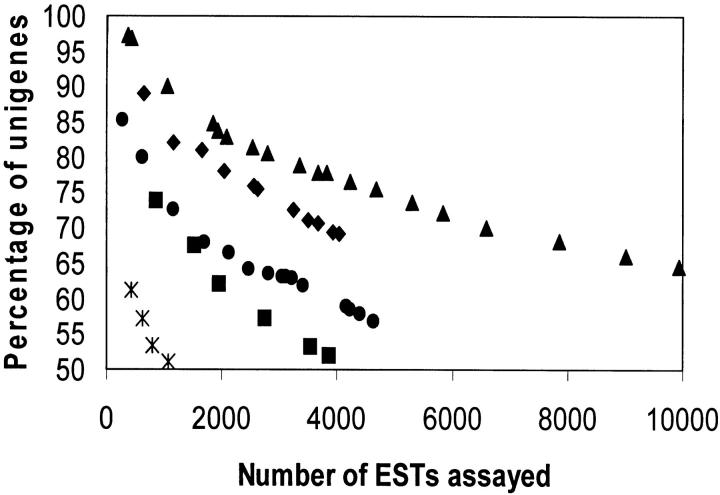
Diminishing number of unigene ESTs with increasing number of ESTs generated. As libraries were sequenced, the total from each library was assessed for the number of new sequences generated. Shown are plots for five libraries as percentages of unigenes vs. total number of ESTs generated at each increment of EST generation and analysis: ♦, root (TA008E1X); •, anther (SC024E1X); ▴, preanthesis spike (TA019E1X); ▪, endosperm (TA001E1X); and *, 20–45 DPA spike (TA017E1X).
F<sc>igure</sc> 3.—
Figure 3.—
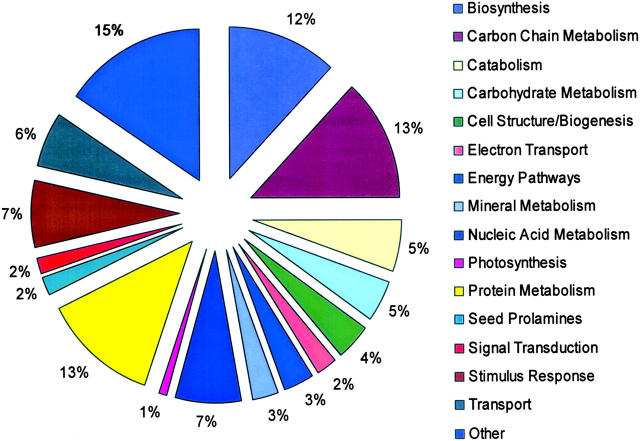
EST annotation by GO and manual assignments. ESTs with GO assignments are collated and plotted as a percentage of GO-annotated ESTs plus ESTs manually assigned to the gliadin and glutenin (prolamine) classes of wheat seed storage proteins. Some classifications were pooled to reduce the number of classes.
F<sc>igure</sc> 4.—
Figure 4.—
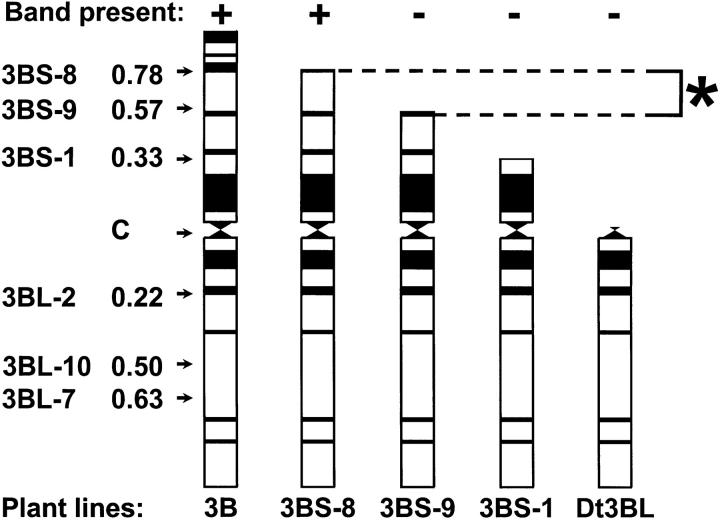
Mapping loci to chromosome bins using aneuploid stocks. Shown is the mapping of a locus on chromosome 3BS from the data for probe BE406607, band 3 (Figure 1a in Qi et al. 2004). The five diagrams represent the chromosome 3B configurations in five stocks represented as C-banded chromosomes. Heterochromatic regions are shown as solid and C indicates the centromere. Breakpoint names and positions on the respective chromosome arms are shown on the left. The complete 3B chromosome is on the left. The next three are deletion lines named for the deletion breakpoint involved. The last (Dt3BL) is the ditelocentric 3BL line (containing a pair of 3B chromosomes missing the short arm). The presence or absence of a hybridizing band from the sample as detected by autoradiography is indicated by + or − in the “Band present” row. The presence of the band in the first two stocks, but not in the latter three, indicates that it maps to the bin marked by the asterisk (bin 3BS9-0.57-0.78).

References

    1. Adams, M. D., J. M. Kelley, J. D. Gocayne, M. Dubnick, M. H. Polymeropoulos et al., 1991. Complementary DNA sequencing: expressed sequence tags and human genome project. Science 252: 1651–1656. - PubMed

    1. Akhunov, E. D., A. W. Goodyear, S. Geng, L. L. Qi, B. Echalier et al., 2003. a The organization and rate of evolution of wheat genomes are correlated with recombination rates along chromosome arms. Genome Res. 13: 753–763. - PMC - PubMed
    1. Akhunov, E. D., A. R. Akhunova, A. M. Linkiewicz, J. Dubcovsky, D. Hummel et al., 2003. b Synteny perturbations between wheat homoeologous chromosomes caused by locus duplications and deletions correlate with recombination rates. Proc. Natl. Acad. Sci. USA 100: 10836–10841. - PMC - PubMed
    1. Altschul, S. F., T. L. Madden, A. A. Schaffer, J. Zhang, Z. Zhang et al., 1997. Gapped BLAST and PSI-BLAST: a new generation of protein database search programs. Nucleic Acids Res. 25: 3389–3402. - PMC - PubMed
    1. Apweiler, R., A. Bairoch, C. H. Wu, W. C. Barker, B. Boeckmann et al., 2004. UniProt: the universal protein knowledge base. Nucleic Acids Res. 32: D115–D119. - PMC - PubMed

Publication types