


Natural genetic variation caused by transposable elements in humans
- PMID: 15514065
- PMCID: PMC1448813
- DOI: 10.1534/genetics.104.031757
Natural genetic variation caused by transposable elements in humans
Abstract
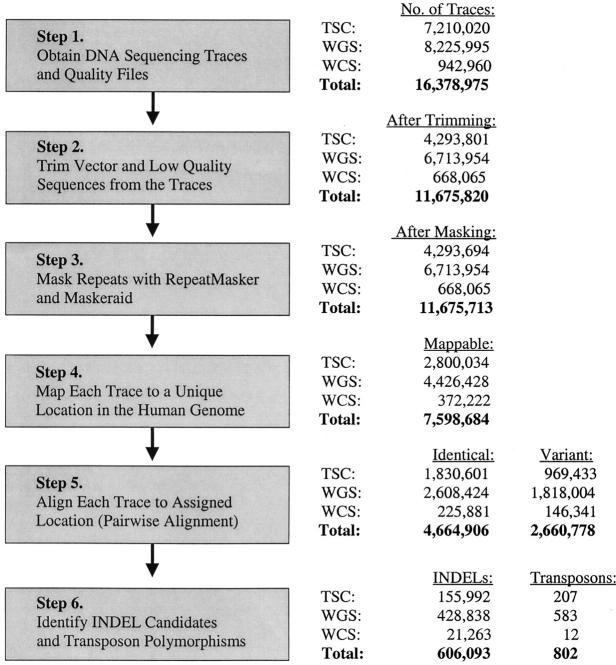
Transposons and transposon-like repetitive elements collectively occupy 44% of the human genome sequence. In an effort to measure the levels of genetic variation that are caused by human transposons, we have developed a new method to broadly detect transposon insertion polymorphisms of all kinds in humans. We began by identifying 606,093 insertion and deletion (indel) polymorphisms in the genomes of diverse humans. We then screened these polymorphisms to detect indels that were caused by de novo transposon insertions. Our method was highly efficient and led to the identification of 605 nonredundant transposon insertion polymorphisms in 36 diverse humans. We estimate that this represents 25-35% of approximately 2075 common transposon polymorphisms in human populations. Because we identified all transposon insertion polymorphisms with a single method, we could evaluate the relative levels of variation that were caused by each transposon class. The average human in our study was estimated to harbor 1283 Alu insertion polymorphisms, 180 L1 polymorphisms, 56 SVA polymorphisms, and 17 polymorphisms related to other forms of mobilized DNA. Overall, our study provides significant steps toward (i) measuring the genetic variation that is caused by transposon insertions in humans and (ii) identifying the transposon copies that produce this variation.
Figures
References
-
- Abdel-Halim, S., G. E. Kilroy, W. S. Watkins, L. B. Jorde and M. A. Batzer, 2003. Recently integrated Alu elements and human genomic diversity. Mol. Biol. Evol. 20: 1349–1361. - PubMed
-
- Bailey, J. A., Z. Gu, R. A. Clark, K. Reinert, R. V. Samonte et al., 2002. Recent segmental duplications in the human genome. Science 297: 1003–1007. - PubMed
-
- Batzer, M. A., and P. L. Deininger, 2002. Alu repeats and human genomic diversity. Nat. Rev. Genet. 3: 370–379. - PubMed
-
- Bedell, J. A., I. Korf and W. Gish, 2000. MaskerAid: a performance enhancement to RepeatMasker. Bioinformatics 16: 1040–1041. - PubMed
Publication types
MeSH terms
Substances
Grants and funding
LinkOut - more resources
Full Text Sources
Research Materials
