Evidence based guidelines or collectively constructed "mindlines?" Ethnographic study of knowledge management in primary care
- PMID: 15514347
- PMCID: PMC524553
- DOI: 10.1136/bmj.329.7473.1013
Evidence based guidelines or collectively constructed "mindlines?" Ethnographic study of knowledge management in primary care
Abstract
Objective: To explore in depth how primary care clinicians (general practitioners and practice nurses) derive their individual and collective healthcare decisions.
Design: Ethnographic study using standard methods (non-participant observation, semistructured interviews, and documentary review) over two years to collect data, which were analysed thematically.
Setting: Two general practices, one in the south of England and the other in the north of England.
Participants: Nine doctors, three nurses, one phlebotomist, and associated medical staff in one practice provided the initial data; the emerging model was checked for transferability with general practitioners in the second practice.
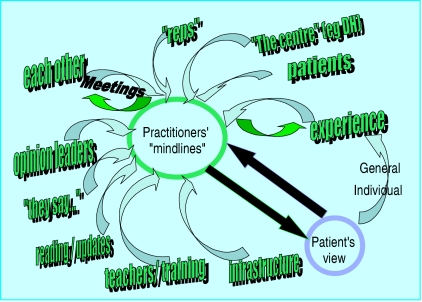
Results: Clinicians rarely accessed and used explicit evidence from research or other sources directly, but relied on "mindlines"--collectively reinforced, internalised, tacit guidelines. These were informed by brief reading but mainly by their own and their colleagues' experience, their interactions with each other and with opinion leaders, patients, and pharmaceutical representatives, and other sources of largely tacit knowledge. Mediated by organisational demands and constraints, mindlines were iteratively negotiated with a variety of key actors, often through a range of informal interactions in fluid "communities of practice," resulting in socially constructed "knowledge in practice."
Conclusions: These findings highlight the potential advantage of exploiting existing formal and informal networking as a key to conveying evidence to clinicians.
Figures
Comment in
-
Evidence based medicine: does it make a difference? Management of complex systems needs new approaches.BMJ. 2005 Jan 8;330(7482):92-3; discussion 94. doi: 10.1136/bmj.330.7482.92-b. BMJ. 2005. PMID: 15637374 Free PMC article. No abstract available.
-
Evidence based medicine: does it make a difference? Make it evidence informed practice with a little wisdom.BMJ. 2005 Jan 8;330(7482):92; discussion 94. doi: 10.1136/bmj.330.7482.92-a. BMJ. 2005. PMID: 15637375 Free PMC article. No abstract available.
-
Evidence based medicine: does it make a difference? In Germany disease is treated via patients' clinical pictures rather than by following mindlines.BMJ. 2005 Jan 8;330(7482):93; discussion 94. doi: 10.1136/bmj.330.7482.93. BMJ. 2005. PMID: 15637380 Free PMC article. No abstract available.
-
Primary care practitioners based everyday practice on internalised tacit guidelines derived through social interactions with trusted colleagues.Evid Based Nurs. 2005 Jul;8(3):94. doi: 10.1136/ebn.8.3.94. Evid Based Nurs. 2005. PMID: 16021726 No abstract available.
References
-
- Muir Gray J. Evidence-based healthcare: how to make health policy and management decisions. Edinburgh: Churchill Livingstone, 1998.
-
- Haines A, Donald A, eds. Getting research into practice. London: BMJ Books, 1998.
-
- Trinder L, Reynolds S, eds. Evidence-based practice: a critical appraisal. Oxford: Blackwell Science, 2000.
-
- Davenport TK, Prusak L Working knowledge: how organisations manage what they know. Boston: Harvard Business School Press, 1998.
-
- Polanyi M. Personal knowledge: towards a post-critical philosophy. London: Routledge and Kegan Paul, 1958.
Publication types
MeSH terms
LinkOut - more resources
Full Text Sources