. 2004 Nov;186(22):7490-8.
doi: 10.1128/JB.186.22.7490-7498.2004.

Calcium inhibits bap-dependent multicellular behavior in Staphylococcus aureus

Affiliations

Calcium inhibits bap-dependent multicellular behavior in Staphylococcus aureus

María Jesús Arrizubieta et al. J Bacteriol. 2004 Nov.

Abstract

Bap (biofilm-associated protein) is a 254-kDa staphylococcal surface protein implicated in formation of biofilms by staphylococci isolated from chronic mastitis infections. The presence of potential EF-hand motifs in the amino acid sequence of Bap prompted us to investigate the effect of calcium on the multicellular behavior of Bap-expressing staphylococci. We found that addition of millimolar amounts of calcium to the growth media inhibited intercellular adhesion of and biofilm formation by Bap-positive strain V329. Addition of manganese, but not addition of magnesium, also inhibited biofilm formation, whereas bacterial aggregation in liquid media was greatly enhanced by metal-chelating agents. In contrast, calcium or chelating agents had virtually no effect on the aggregation of Bap-deficient strain M556. The biofilm elicited by insertion of bap into the chromosome of a biofilm-negative strain exhibited a similar dependence on the calcium concentration, indicating that the observed calcium inhibition was an inherent property of the Bap-mediated biofilms. Site-directed mutagenesis of two of the putative EF-hand domains resulted in a mutant strain that was capable of forming a biofilm but whose biofilm was not inhibited by calcium. Our results indicate that Bap binds Ca2+ with low affinity and that Ca2+ binding renders the protein noncompetent for biofilm formation and for intercellular adhesion. The fact that calcium inhibition of Bap-mediated multicellular behavior takes place in vitro at concentrations similar to those found in milk serum supports the possibility that this inhibition is relevant to the pathogenesis and/or epidemiology of the bacteria in the mastitis process.


Figures
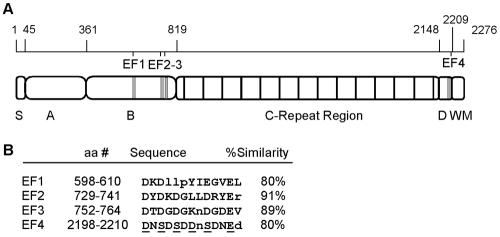
FIG. 1.
FIG. 1.
EF-hand-like domains in the Bap sequence. (A) Positions of the potential EF hands, shown in a diagram representing the structural organization of Bap. S, signal peptide; A, region A; B, region B; C, C-repeat region; D, region rich in serine-aspartate (SD) repeats; WM, cell wall anchor, membrane-spanning region, and positively charged tail. The positions of the potential EF-hand-like motifs, designated EF1 to EF4, are indicated by vertical grey lines. (B) Sequences of the four potential EF-hand motifs in Bap and degrees of similarity to the consensus sequence. Residues that do not conform to the EF-hand loop consensus sequence are in lowercase letters. The positions that participate in coordinating Ca2+ are underlined. aa, amino acid.
FIG. 2.
FIG. 2.
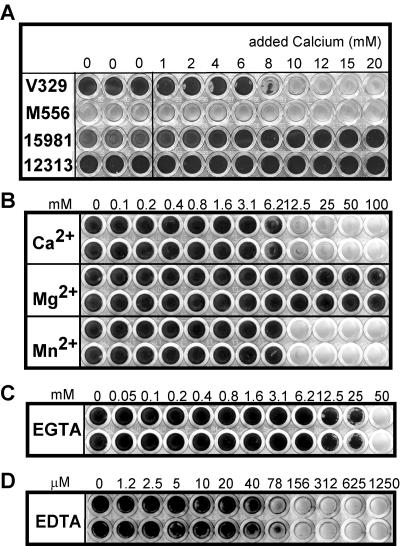
Effects of divalent cations and chelating agents on V329 biofilm formation. Bacteria were inoculated onto microtiter plates containing TSB-glucose supplemented with Ca2+, Mg2+, Mn2+, EGTA, or EDTA at the final concentrations indicated. After 24 h of incubation the microplates were washed and stained with crystal violet. (A) Effect of Ca2+ addition on the ability of S. aureus strains V329, M556, 15981, and 12313 to form biofilms. (B) Effect of Ca2+, Mg2+, and Mn2+ on the ability of V329 to form a biofilm. (C) Effect of EGTA addition on the biofilm formed by V329 in TSB-glucose. (D) Effect of EDTA addition on the biofilm formed by V329 in TSB-glucose. The results of a representative experiment are shown.
FIG. 3.
FIG. 3.
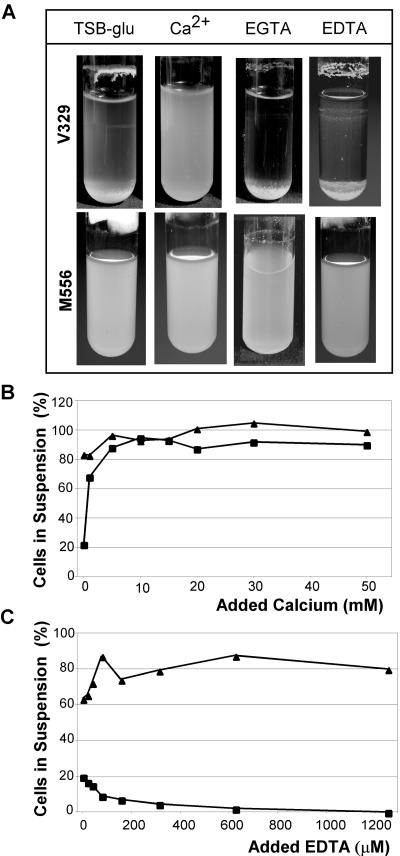
Ca2+ inhibits V329 bacterial clumping in liquid culture tubes. (A) Culture tubes containing TSB-glucose were inoculated with V329 or M556, and Ca2+, EGTA, and EDTA were added as indicated to final concentrations of 10, 1.25, and 1.25 mM, respectively. After 16 h of incubation at 37°C, the tubes were photographed. (B) Percentages of suspended cells in V329 and M556 liquid cultures grown in TSB-glucose supplemented with different amounts of Ca2+. The results of a representative experiment are shown. (C) Same as panel B, except that EDTA was added to the culture tubes. Symbols: ▪, V329; ▴, M556.
FIG. 4.
FIG. 4.
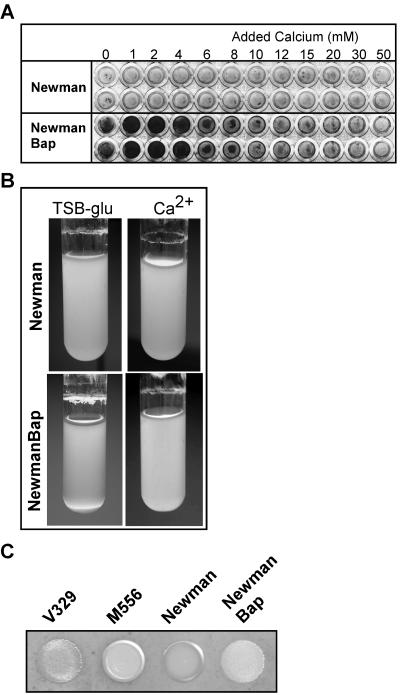
Expression of Bap changes the multicellular behavior of the Newman strain. (A) Biofilm formation by strains Newman and Newman_Bap on microtiter plates containing TSB-glucose supplemented with different amounts of Ca2+. Newman cells did not form a biofilm after 24 h of incubation, whereas the Newman_Bap mutant that contained a chromosomal copy of bap formed a biofilm and this biofilm was inhibited by millimolar amounts of added Ca2+. (B) Liquid culture tubes containing Newman and Newman_Bap grown overnight in TSB-glucose or TSB-glucose supplemented with 10 mM Ca2+. Liquid cultures of Newman_Bap exhibited a greater degree of bacterial clumping than Newman cultures, and the clumping was inhibited by addition of 10 mM Ca2+ to the growth medium. The results of a representative experiment are shown. (C) Colony morphology on Congo red agar plates incubated at 37°C for 24 h for strains V329, M556, Newman, and Newman_Bap.
FIG. 5.
FIG. 5.
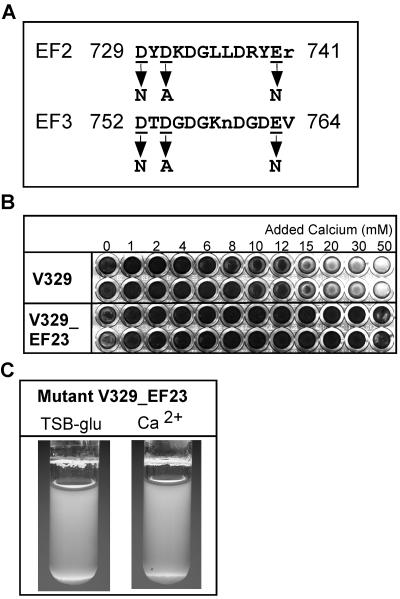
Mutation of the potential EF-hand motifs EF2 and EF3. (A) Amino acid substitutions introduced into the chromosomal copy of bap in V329 to configure mutant V329_EF23. The positions at which residues were replaced are underlined, and the arrows indicate the residues introduced into the mutant. (B) Formation of biofilms on microplates by V329 and mutant V329_EF23 grown overnight in TSB-glucose supplemented with different amounts of Ca2+. (C) Liquid culture tubes containing V329_EF23 grown overnight in TSB-glucose or TSB-glucose supplemented with 10 mM Ca2+. The degree of bacterial clumping of the mutant was not affected by Ca2+ addition. The results of a representative experiment are shown.
FIG. 6.
FIG. 6.
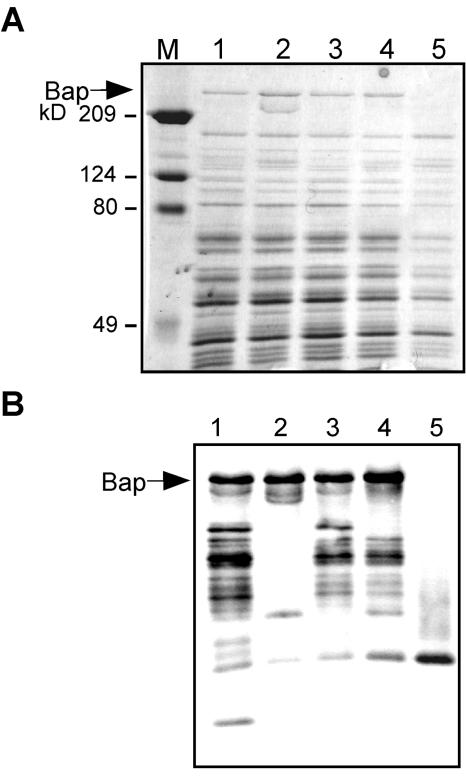
Analysis of surface protein preparations. (A) SDS-PAGE of surface protein preparations obtained under isosmotic conditions. Lane M, Bio-Rad prestained broad-range Mr standards; lane 1, V329 grown in TSB-glucose; lane 2, V329 grown in TSB-glucose supplemented with 10 mM Ca2+; lane 3, mutant V329_EF23 grown in TSB-glucose; lane 4, mutant V329_EF23 grown in TSB-glucose supplemented with 10 mM Ca2+; lane 5, negative control preparation obtained from Bap-negative S. aureus strain CH142 grown in TSB-glucose. (B) Western blot analysis with anti-Bap serum. For lane contents see above. The amounts of each preparation loaded for SDS-PAGE and Western analysis were 10 and 0.2 μl, respectively. The arrow indicates the position of full-size Bap.
FIG. 7.
FIG. 7.
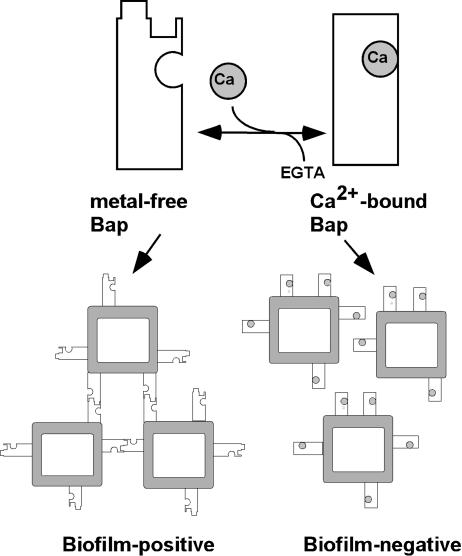
Model illustrating the effect of Ca2+ on Bap conformation and biofilm formation. Metal-free Bap participates in the series of interactions that lead to cell-to-cell adhesion and biofilm formation. Occupation of the inhibitory site(s) by Ca2+ induces a conformational change in Bap and renders the protein noncompetent for biofilm formation. The ligand for Bap on neighboring cells is illustrated as other Bap molecules, but it could be a different type of molecule. Only at high Ca2+ concentrations would Bap be saturated with the metal, whereas chelating agents would favor the metal-free form.

References

    1. Alais, C. 1984. Science du lait: principes des techniques laitières, 4th ed. SEPAIC, Paris, France.
    1. Blood, D. C., J. H. Arundel, C. C. Gay, J. A. Henderson, and O. M. Radostits. 1979. Veterinary medicine: a textbook of the diseases of cattle, sheep, pigs and horses. Elsevier, Amsterdam, The Netherlands.
    1. Bootman, M. D., and M. J. Berridge. 1995. The elemental principles of calcium signaling. Cell 83:675-678. - PubMed
    1. Brown, E. M., P. M. Vassilev, and S. C. Hebert. 1995. Calcium ions as extracellular messengers. Cell 83:679-682. - PubMed
    1. Callebaut, I., D. Gilges, I. Vigon, and J. P. Mornon. 2000. HYR, an extracellular module involved in cellular adhesion and related to the immunoglobulin-like fold. Protein Sci. 9:1382-1390. - PMC - PubMed

Publication types

MeSH terms

LinkOut - more resources