. 2004 Nov;186(22):7499-507.
doi: 10.1128/JB.186.22.7499-7507.2004.

Characteristics of zinc transport by two bacterial cation diffusion facilitators from Ralstonia metallidurans CH34 and Escherichia coli

Affiliations

Characteristics of zinc transport by two bacterial cation diffusion facilitators from Ralstonia metallidurans CH34 and Escherichia coli

Andreas Anton et al. J Bacteriol. 2004 Nov.

Abstract

CzcD from Ralstonia metallidurans and ZitB from Escherichia coli are prototypes of bacterial members of the cation diffusion facilitator (CDF) protein family. Expression of the czcD gene in an E. coli mutant strain devoid of zitB and the gene for the zinc-transporting P-type ATPase zntA rendered this strain more zinc resistant and caused decreased accumulation of zinc. CzcD, purified as an amino-terminal streptavidin-tagged protein, bound Zn2+, Co2+, Cu2+, and Ni2+ but not Mg2+, Mn2+, or Cd2+, as shown by metal affinity chromatography. Histidine residues were involved in the binding of 2 to 3 mol of Zn2+ per mol of CzcD. ZitB transported 65Zn2+ in the presence of NADH into everted membrane vesicles with an apparent Km of 1.4 microM and a Vmax of 0.57 nmol of Zn2+ min(-1) mg of protein(-1). Conserved amino acyl residues that might be involved in binding and transport of zinc were mutated in CzcD and/or ZitB, and the influence on Zn2+ resistance was studied. Charged or polar amino acyl residues that were located within or adjacent to membrane-spanning regions of the proteins were essential for the full function of the proteins. Probably, these amino acyl residues constituted a pathway required for export of the heavy metal cations or for import of counter-flowing protons.


Figures
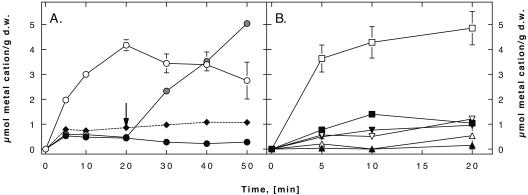
FIG. 1.
FIG. 1.
CzcD functionally complements a ΔzitB::Cm zntA::Km E. coli strain. (A) Accumulation of 65Zn2+ by E. coli GG48 (ΔzitB::Cm zntA::Km) (○) and strain GG48 containing the czcD gene (•) was determined by the filtration method with 15 μM zinc chloride. The arrow indicates when 10 μM FCCP was added to cells containing the czcD gene (gray circles). ♦, zinc uptake by W3110 wild-type cells. (B) Accumulation of 109Cd2+ (□ and ▪), 57Co2+ (▵ and ▴), or 63Ni2+ (▿ and ▾) by E. coli GG48 (ΔzitB::Cm zntA::Km) (open symbols) and strain GG48 containing the czcD gene (solid symbols), as determined at a metal cation concentration of 15 μM as described above. Mean values of duplicate determinations are shown; the error bars indicate standard deviations. d.w., cellular dry weight.
FIG. 2.
FIG. 2.
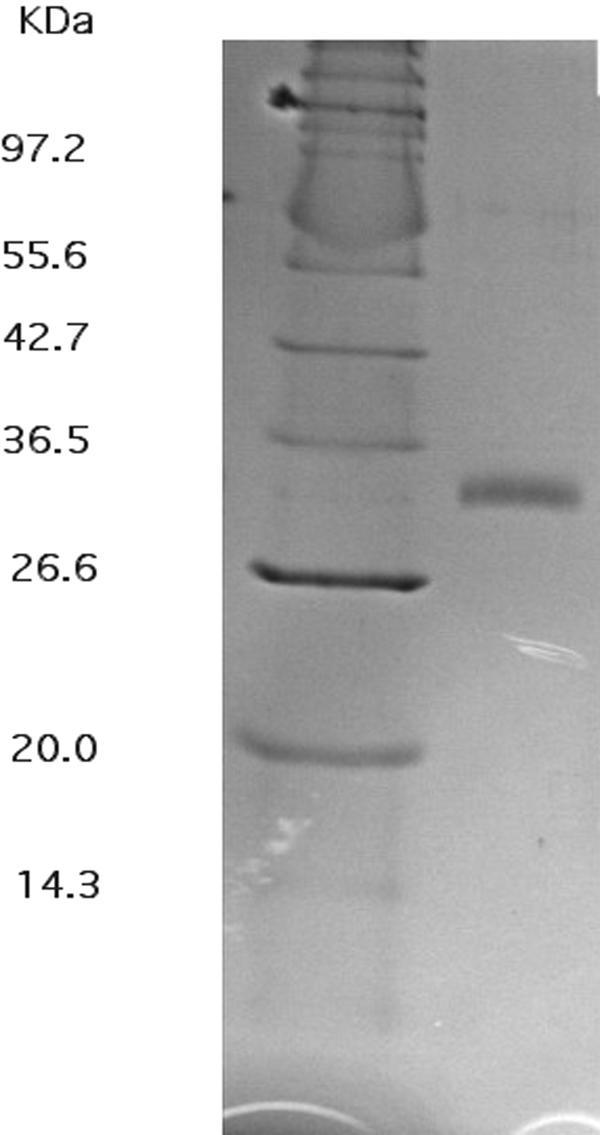
Coomassie blue-stained polyacrylamide gel containing purified CzcD. The gel contained purified CzcD in the right lane and a size marker in the left lane. The faint band corresponding to the twofold size of CzcD is indeed a dimer that starts to form during storage of the purified protein (data not shown).
FIG. 3.
FIG. 3.
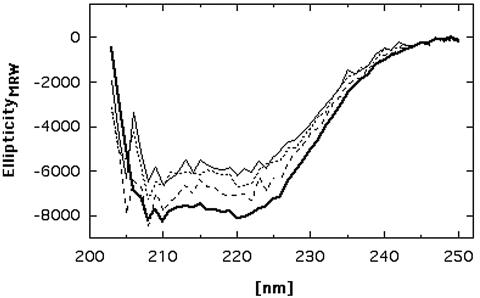
CD spectrum of CzcD. The spectrum was generated with 0.24 g of CzcD per liter (thick solid line). Additionally, the CD spectrum of CzcD at a concentration of 0.1 g/liter was obtained in the presence of 100 μM Zn2+ (dotted line), in the presence of 500 μM Zn2+ (dashed line), or without added zinc (thin solid line). Due to strong light scattering at wavelengths below 203 nm, data points could not be collected at these wavelengths. EllipticityMRW, mean residue molar ellipticity.
FIG. 4.
FIG. 4.
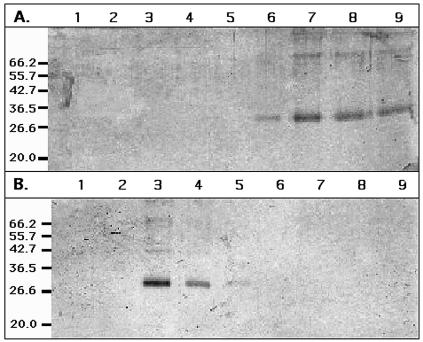
CzcD retention by metal affinity chromatography. Chelating Sepharose fast-flow columns were prepared with Zn2+ (A) or Mg2+ (as a negative control) (B). Sixty micrograms of CzcD protein was applied to each column, and the columns were washed with 10 bed volumes of 10 mM sodium phosphate buffer (pH 7.2). Fractions (300 μl) were collected and applied to an SDS—15% polyacrylamide gel, which was silver stained. Lanes 1 to 5 contained the protein from the first five wash fractions, and lanes 6 to 9 contained the first four elution fractions. The positions of size markers are indicated on the left.
FIG. 5.
FIG. 5.
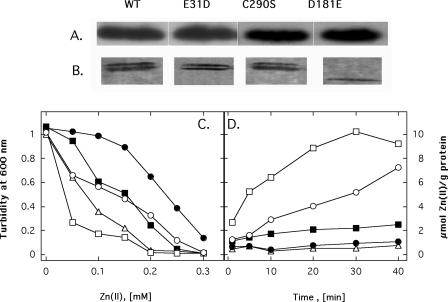
Effects of some amino acid changes on the function of CzcD. (A) Signals of wild-type CzcD (WT) and mutant proteins CzcDC290S, CzcDD181E, and CzcE31D in a Western blot with anti-CzcD antibodies. (B) Same protein signals in isolated cytoplasmic membranes. The bands were visualized by using the Strep-TagII detection system (IBA GmbH). The double band for the wild type and two mutant proteins is probably a gel migration artifact. (C and D) Effects of mutant proteins CzcDC290S (▵), CzcDD181E (□), and CzcE31D (▪) investigated by using dose-response curves (C) and by performing zinc accumulation experiments (D). (C) E. coli GG48 (ΔzitB::Cm zntA::Km) containing the pASK5 vector plasmid without an insert (○) and strain GG48 containing the wild-type czcD gene (•) or the mutated czcD genes, all cloned on plasmid pASK-IBA5 under control of the tetAp promoter, were cultivated in LB containing various concentrations of Zn2+ and 200 μg of the inducer anhydrotetracycline liter−1. The cells were cultivated with shaking for 14 h at 37°C, and the optical density at 600 nm was determined. The mean values for double determinations are shown. (D) Accumulation of 65Zn2+ by E. coli strain GG48 cells as determined by the filtration method with 15 μM 65Zn2+.
FIG. 6.
FIG. 6.
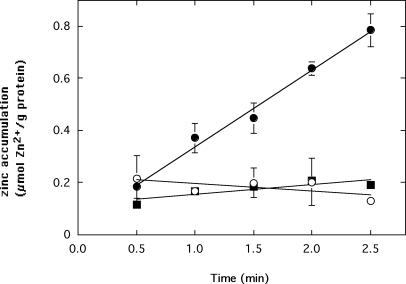
Zinc uptake into everted membrane vesicles is dependent upon ZitB: accumulation of 65Zn2+ with 5 μM ZnCl2 in everted membrane vesicles of E. coli strain GR362 carrying the pASK-IBA3 expression vector with zitB inserted (•), with zitB inserted in the presence of 10 μM FCCP (▪), or without zitB (○). Uptake was initiated at zero time by addition of 5 mM NADH, and vesicles were captured by filtration through a 0.2-μm-pore-size filter every 30 s for 2.5 min. 65Zn accumulation was determined by liquid scintillation analysis. Identical measurements obtained in the absence of NADH were subtracted from the values obtained at the corresponding time points as background.
FIG. 7.
FIG. 7.
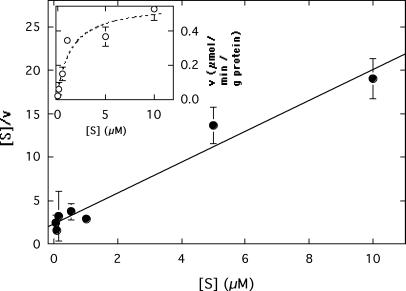
Effect of substrate concentration ([S]) on the rate of NADH-dependent 65Zn accumulation (v). Zinc uptake was assayed as described in the legend to Fig. 6 at six different substrate concentrations. The initial uptake rate was plotted against the zinc concentration (inset). Km and Vmax were calculated from a Wolf-Hanes linear transformation of the data; Vmax was the reciprocal of the slope (0.56 ± 0.17 μmol/min/g of protein), and Km was the x intercept multiplied by Vmax (1.4 ± 0.4 μM). The regression coefficient of the linear Wolf-Hanes function was 96.4%, meaning that the error was 3.6%, and the mean deviation of the single data points was 27%, which resulted in a total error of 31%.

References

    1. Anton, A., C. Große, J. Reißman, T. Pribyl, and D. H. Nies. 1999. CzcD is a heavy metal ion transporter involved in regulation of heavy metal resistance in Ralstonia sp. strain CH34. J. Bacteriol. 181:6876-6881. - PMC - PubMed
    1. Chao, Y., and D. Fu. 2004. Kinetic study of the antiport mechanism of an Escherichia coli zinc transporter, ZitB. J. Biol. Chem. 279:12043-12050. - PubMed
    1. Gaither, L. A., and D. J. Eide. 2001. Eukaryotic zinc transporters and their regulation. Biometals 14:251-270. - PubMed
    1. Goldberg, M., T. Pribyl, S. Juhnke, and D. H. Nies. 1999. Energetics and topology of CzcA, a cation/proton antiporter of the RND protein family. J. Biol. Chem. 274:26065-26070. - PubMed
    1. Goris, J., P. De Vos, T. Coenye, B. Hoste, D. Janssens, H. Brim, L. Diels, M. Mergeay, K. Kersters, and P. Vandamme. 2001. Classification of metal-resistant bacteria from industrial biotopes as Ralstonia campinensis sp. nov., Ralstonia metallidurans sp. nov. and Ralstonia basilensis Steinle et al. 1998 emend. Int. J. Syst. Evol. Microbiol. 51:1773-1782. - PubMed

Publication types

MeSH terms

LinkOut - more resources