. 2004 Nov;186(22):7690-6.
doi: 10.1128/JB.186.22.7690-7696.2004.

GntP is the Escherichia coli Fructuronic acid transporter and belongs to the UxuR regulon

Affiliations

GntP is the Escherichia coli Fructuronic acid transporter and belongs to the UxuR regulon

Cristina Bates Utz et al. J Bacteriol. 2004 Nov.

Abstract

Escherichia coli has four gluconate transporters, GntP, GntU, GntT, and IdnT, which are members of the major facilitator superfamily. The physiological function of GntP was previously unknown and is the subject of this study. GntP is not induced by gluconate, and despite being located adjacent to genes involved in glucuronate catabolism, gntP does not encode a glucuronate transporter. Here we identify gntP as the gene which encodes the fructuronate transporter. We show that gntP is induced by fructuronate and is a new member of the UxuR regulon: gntP is derepressed in an uxuR strain, UxuR binds in vitro specifically to an operator site that overlaps the gntP promoter, and UxuR binding is eliminated by fructuronate. Transcription of gntP requires activation by cyclic AMP (cAMP)-cAMP receptor protein. A gntP mutant cannot grow on fructuronate but grows normally on glucuronate and gluconate. Thus, the UxuR regulon is a module of sugar acid catabolism whose physiological role is for growth on fructuronate. Glucuronate, because it proceeds through a fructuronate intermediate, must induce the UxuR regulon and must also induce the ExuR regulon, which encodes the glucuronate transporter, ExuT, and the first step in its catabolism, UxaC. Thus, hexuronate catabolism in E. coli requires both the ExuR and UxuR regulons, while fructuronate catabolism requires only the UxuR regulon.


Figures
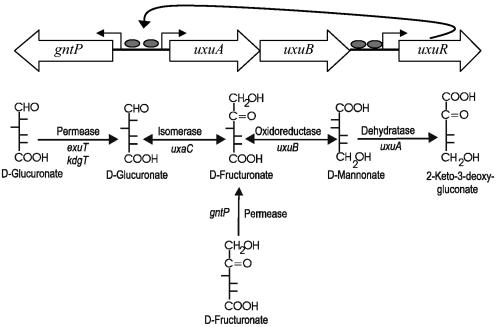
FIG. 1.
FIG. 1.
Gene map of gntP region (top). Grey ovals indicate putative UxuR binding sites (27). Bottom, proposed pathway for fructuronate metabolism in E. coli.
FIG. 2.
FIG. 2.
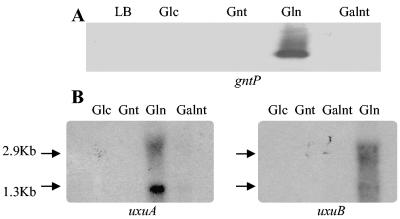
A. Northern blot analysis of gntP transcription with a gntP-specific probe. RNA samples from E. coli W1485 grown in LB medium with indicated carbon sources (0.2%): LB, none; Glc, glucose; Gnt, gluconate; Gln, glucuronate; Galnt, galacturonate. B. Northern blot of the E. coli uxuA and uxuB transcripts with gene-specific probes. RNA samples were isolated from E. coli W1485 cells grown in LB medium with the indicated carbon sources (0.2%).
FIG. 3.
FIG. 3.
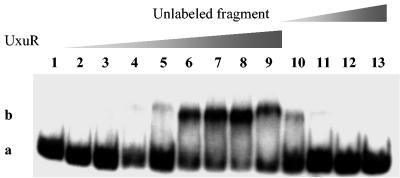
Gel retardation of a 32P-labeled gntP promoter probe by purified UxuR. All lanes contained 8 nmol of a radioactively labeled DNA fragment containing the UxuR operator. Lane 1, no protein. Lanes 2 to 9 contain increasing amounts of UxuR: 0.9, 1.8, 3.6, 7.2, 14.4, 28.8, 57.6, and 115.2 nmol, respectively. Lanes 10 to 13 represent competition experiments using unlabeled gntP fragments: lane 10, 25×; lane 11, 100×; lane 12, 200×; and lane 13, 300× unlabeled fragment (by weight). The shifted band (b) and free DNA (a) are indicated on the left.
FIG. 4.
FIG. 4.
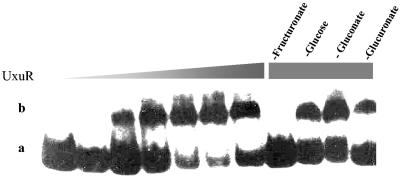
Binding of UxuR to the gntP operator in the presence of various sugars. All lanes contained 8 nmol of radioactively labeled DNA probe. Lane 1 contains no protein and lanes 2 to 7 contain increasing amounts of UxuR protein: 0.9, 1.8, 3.6, 7.2, 14.4, and 28.8 nmol, respectively. Lanes 8 to 11 contain 28.8 nmol of UxuR protein together with 100 mM d-fructuronate (lane 8), d-glucose (lane 9), d-gluconate (lane 10), or d-glucuronate (lane 11). The shifted band (b) and free DNA (a) are indicated on the left.
FIG. 5.
FIG. 5.
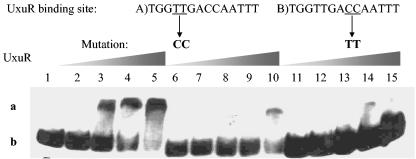
Effect of UxuR binding site mutations on formation of the repressor-operator complex. The wild-type UxuR binding site is shown at the top with the mutated base pairs within the binding sites underlined and the alterations shown in boldface below the wild-type binding site. Lane 1 contains the wild-type DNA probe and no protein. Lanes 2 to 5 contain the wild-type binding site and increasing amounts of UxuR: 0.9, 1.8, 3.6, and 7.2 nmol, respectively. Lanes 6 to 10 contain the DNA probe with a mutation in the left-half site (A) and increasing amounts of UxuR (same concentrations as lanes 2 to 5). Lanes 11 to 15 contain the DNA probe with a mutation in the right-half site (B) with increasing amounts of UxuR (same concentrations as lanes 2 to 5). The shifted band (b) and free DNA (a) are indicated on the left.

References

    1. Ashwell, G. 1962. Enzymes of glucuronic and galacturonic acid metabolism in bacteria. Methods Enzymol. 5:190-208.
    1. Blanco, C., P. Ritzenthaler, and A. Kolb. 1986. The regulatory region of the uxuAB operon in Escherichia coli K12. Mol. Gen. Genet. 202:112-119. - PubMed
    1. Busby, S., and R. H. Ebright. 1999. Transcription activation by catabolite activator protein (CAP). J. Mol. Biol. 293:199-213. - PubMed
    1. Chang, D. E., D. J. Smalley, D. L. Tucker, M. P. Leatham, W. E. Norris, S. J. Stevenson, A. B. Anderson, J. E. Grissom, D. C. Laux, P. S. Cohen, and T. Conway. 2004. Carbon nutrition of Escherichia coli in the mouse intestine. Proc. Natl. Acad. Sci. USA 101:7427-7432. - PMC - PubMed
    1. Conway, T. 1992. The Entner-Doudoroff pathway: history, physiology and molecular biology. FEMS Microbiol. Rev. 9:1-27. - PubMed

Publication types

MeSH terms

LinkOut - more resources