


doi: 10.1017/s0952523804213451.
Protanopic observers show nearly normal color constancy with natural reflectance spectra
Affiliations
- PMID: 15518212
- PMCID: PMC1863826
- DOI: 10.1017/s0952523804213451
Item in Clipboard
Protanopic observers show nearly normal color constancy with natural reflectance spectra
Vis Neurosci.
2004 May-Jun.
Abstract
The ability of color-deficient observers to discriminate between illuminant changes and surface-reflectance changes in a scene was tested with natural and Munsell reflectance spectra. To avoid the confounding effects of spatial structure, stimuli were simulations of Mondrian-like colored patterns, presented on a computer-controlled color monitor. Protanopes performed less well than normal trichromats, regardless of the type of reflectance spectra, but they were least disadvantaged with patterns comprising reflectance spectra drawn from urban and rural scenes, more characteristic of the natural environment.
Figures
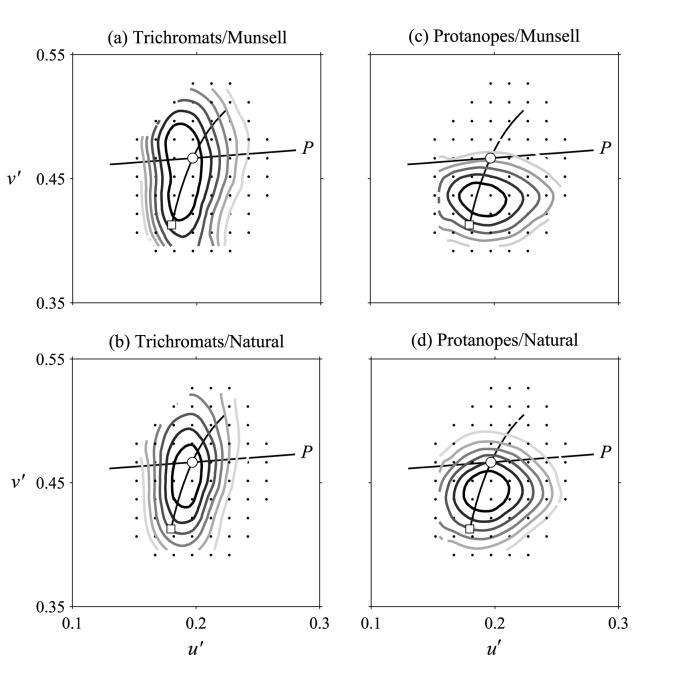
Detectability of changes in surface color during daylight illuminant changes of correlated color temperature 25000 to 6700 K for observers with normal trichromatic and protanopic color vision. Each contour represents a constant frequency of “illuminant-change” responses in the CIE 1976 (u′, v′) chromaticity diagram. Data are shown for Mondrian-like patterns of Munsell and natural reflectance spectra. The open squares and circles indicate, respectively, the chromaticity coordinates of the first and the second global illuminants on the pattern. The daylight locus and the protanopic confusion lines (P) are also shown.
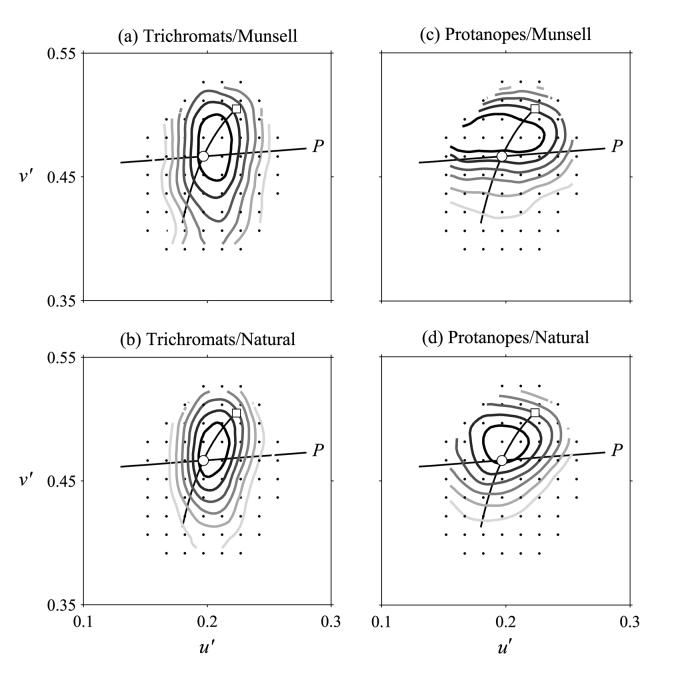
Detectability of changes in surface color during daylight illuminant changes of correlated color temperature 4000 to 6700 K for observers with normal trichromatic and protanopic color vision. Other details as for Fig. 1.
References
-
- Amano K, Foster DH, Nascimento SMC. Red-green colour deficiency and colour constancy under orthogonal-daylight changes. In: Mollon JD, Pokorny J, Knoblauch K, editors. Normal and defective colour vision. Oxford: Oxford University Press; 2003a. pp. 225–230.
-
- Amano K, Foster DH, Nascimento SMC. Relational color constancy in natural scenes and in mondrian patterns of natural and artificial surfaces. Investigative Ophthalmology & Visual Science. 2003b;44:3194.
-
- Arend LE, Jr., Reeves A, Schirillo J, Goldstein R. Simultaneous color constancy: papers with diverse Munsell values. Journal of the Optical Society of America A-Optics Image Science and Vision. 1991;8:661–672. - PubMed
-
- Bramwell DI, Hurlbert AC. Measurements of colour constancy by using a forced-choice matching technique. Perception. 1996;25:229–241. - PubMed
-
- Cleveland WS. Visualizing Data. Summit, New Jersey: Hobart Press; 1993.
Publication types
MeSH terms
Grants and funding
LinkOut - more resources
Full Text Sources
Medical
