


Antitumor polyketide biosynthesis by an uncultivated bacterial symbiont of the marine sponge Theonella swinhoei
- PMID: 15520376
- PMCID: PMC528957
- DOI: 10.1073/pnas.0405976101
Antitumor polyketide biosynthesis by an uncultivated bacterial symbiont of the marine sponge Theonella swinhoei
Abstract
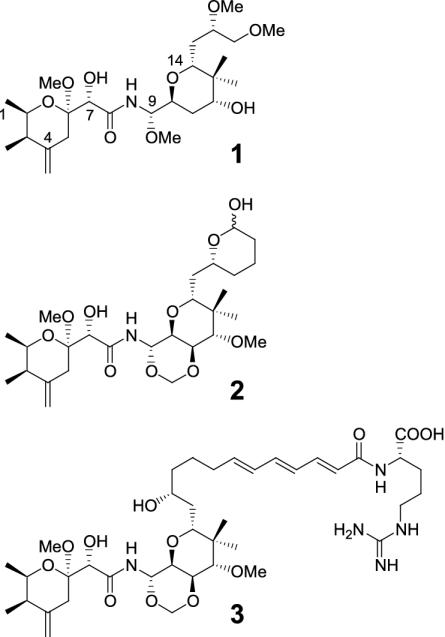
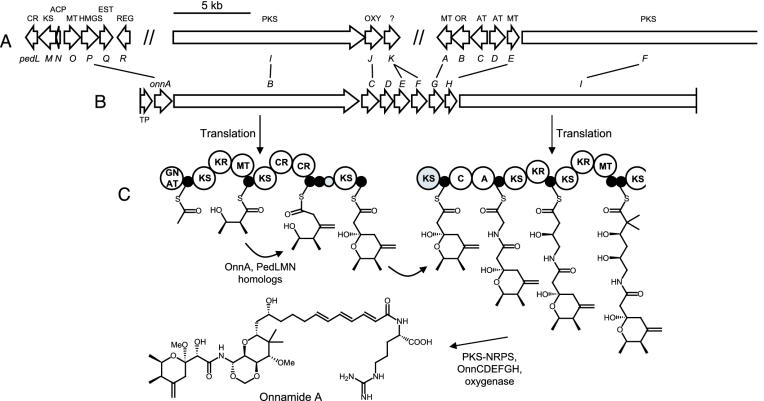
Bacterial symbionts have long been suspected to be the true producers of many drug candidates isolated from marine invertebrates. Sponges, the most important marine source of biologically active natural products, have been frequently hypothesized to contain compounds of bacterial origin. This symbiont hypothesis, however, remained unproven because of a general inability to cultivate the suspected producers. However, we have recently identified an uncultured Pseudomonas sp. symbiont as the most likely producer of the defensive antitumor polyketide pederin in Paederus fuscipes beetles by cloning the putative biosynthesis genes. Here we report closely related genes isolated from the highly complex metagenome of the marine sponge Theonella swinhoei, which is the source of the onnamides and theopederins, a group of polyketides that structurally resemble pederin. Sequence features of the isolated genes clearly indicate that it belongs to a prokaryotic genome and should be responsible for the biosynthesis of almost the entire portion of the polyketide structure that is correlated with antitumor activity. Besides providing further proof for the role of the related beetle symbiont-derived genes, these findings raise intriguing ecological and evolutionary questions and have important general implications for the sustainable production of otherwise inaccessible marine drugs by using biotechnological strategies.
Figures
References
-
- Piel, J. (2004) Nat. Prod. Rep. 21, 519-538. - PubMed
-
- Faulkner, D. J. (2000) Nat. Prod. Rep. 17, 1-6. - PubMed
-
- Schwarzer, D. & Marahiel, M. A. (2001) Naturwissenschaften 88, 93-101. - PubMed
-
- Schwartsmann, G., da Rocha, A. B., Mattei, J. & Lopes, R. M. (2003) Expert Opin. Investig. Drugs 12, 1367-1383. - PubMed
-
- Schmidt, E. W., Obraztsova, A. Y., Davidson, S. K., Faulkner, D. J. & Haygood, M. G. (2000) Mar. Biol. (Berlin) 136, 969-977.
Publication types
MeSH terms
Substances
Associated data
- Actions
LinkOut - more resources
Full Text Sources
Other Literature Sources
Molecular Biology Databases
