Genetics of colorectal cancer
- PMID: 15520636
- PMCID: PMC1435595
Genetics of colorectal cancer
Abstract
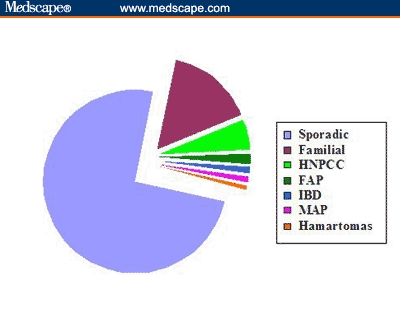
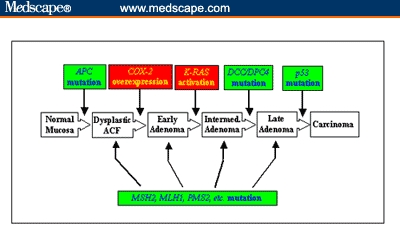
Colorectal cancer (CRC) is the second leading cause of cancer-related mortality in the United States. As such, it assumes a significant role in both health policy decision-making and scientific research. CRC has been a model for investigating the molecular genetics of cancer development and progression; this is in part due to the easily detectable, sequential transition of cells from normal colonic epithelium to adenoma and then to adenocarcinoma. In addition, familial syndromes that predispose to CRC, such as familial adenomatous polyposis (FAP) and hereditary nonpolyposis colorectal cancer (HNPCC), have significantly contributed to our understanding of the genetic mechanisms underlying CRC formation. It is now well recognized that hereditary CRC syndromes are due to germline mutations of genes that function as tumor suppressors or, less frequently, oncogenes. Accumulation of subsequent mutations in other genes with related functions results in the stepwise progression to carcinoma. It is important to note that somatic changes in similar genes are involved in the formation of sporadic CRC. The identification of these important CRC-related genes may help facilitate the early diagnosis, prevention, and treatment of CRC. This article reviews the various familial CRC syndromes along with their genetic etiology, as well as discusses the principle of genetic testing for these conditions.
Figures
References
-
- American Cancer Society. Cancer Facts & Figures 2004. Available at: http://www.cancer.org/downloads/STT/CAFF_finalPWSecured.pdf. Accessed August 4, 2004.
-
- Fearon ER, Vogelstein B. A genetic model for colorectal tumorigenesis. Cell. 1990;61:759-767. - PubMed
-
- Herrera L, Kakati S, Gibas L, Pietrzak E, Sandberg AA. Gardner syndrome in a man with an interstitial deletion of 5q. Am J Med Genet. 1986;25:473-476. - PubMed
-
- Bodmer WF, Bailey CJ, Bodmer J, et al. Localization of the gene for familial adenomatous polyposis on chromosome 5. Nature. 1987;328:614-616. - PubMed
-
- Leppert M, Dobbs M, Scambler P, et al. The gene for familial polyposis coli maps to the long arm of chromosome 5. Science. 1987;238:1411-1413. - PubMed
Publication types
MeSH terms
Grants and funding
LinkOut - more resources
Full Text Sources
Medical
Miscellaneous