


Surgery for hemorrhagic choroidal neovascular lesions of age-related macular degeneration: ophthalmic findings: SST report no. 13
- PMID: 15522364
- PMCID: PMC1256022
- DOI: 10.1016/j.ophtha.2004.07.023
Surgery for hemorrhagic choroidal neovascular lesions of age-related macular degeneration: ophthalmic findings: SST report no. 13
Abstract
Purpose: To present best-corrected visual acuity (BCVA) findings and other clinical outcomes from eyes of patients enrolled in one of the Submacular Surgery Trials (SST) evaluating surgical removal versus observation of predominantly hemorrhagic subfoveal choroidal neovascularization (CNV) associated with age-related macular degeneration.
Design: Randomized clinical trial (SST Group B Trial).
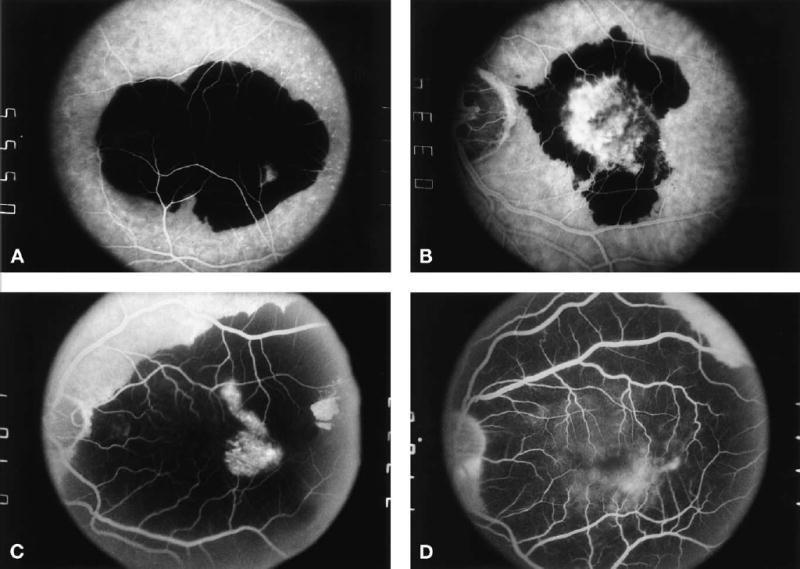
Participants: Eligible patients had subfoveal choroidal neovascular lesions greater than 3.5 disk areas (8.9 mm2) composed of at least 50% blood (either blood or CNV underlying the center of the foveal avascular zone) and BCVA of 20/100 to light perception in the study eye.
Intervention: Patients were assigned randomly at time of enrollment to observation or surgical removal of blood and any associated CNV.
Main outcome measure: A successful outcome was defined a priori as either improvement in visual acuity (VA), no change in VA, or a decline in VA of no more than 1 line (7 letters) from baseline to the 24-month examination based on an intent-to-treat analysis.
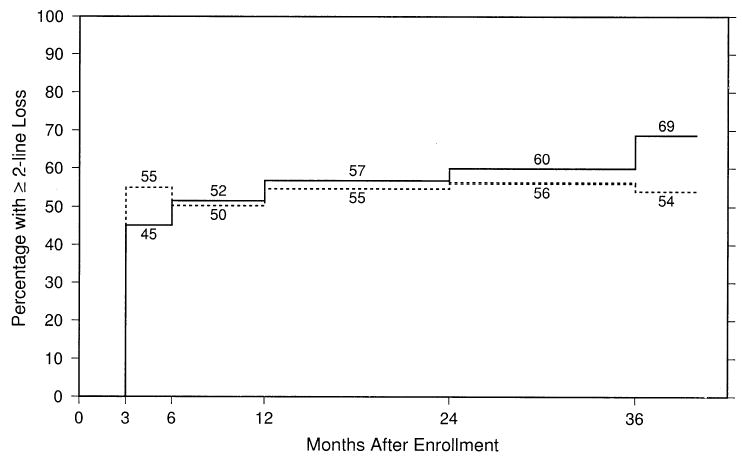
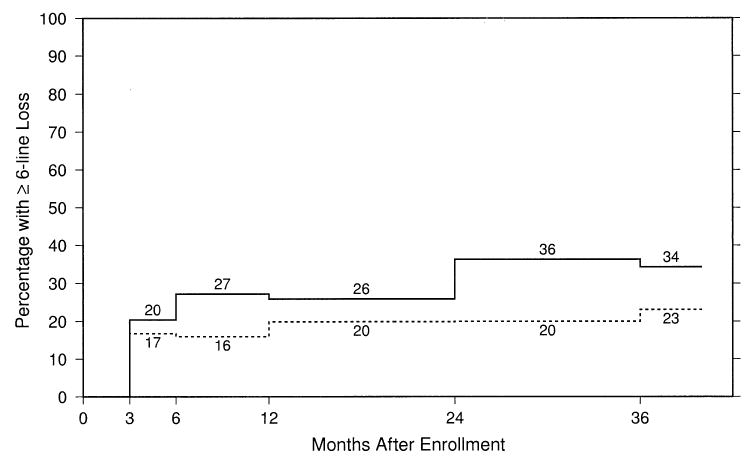
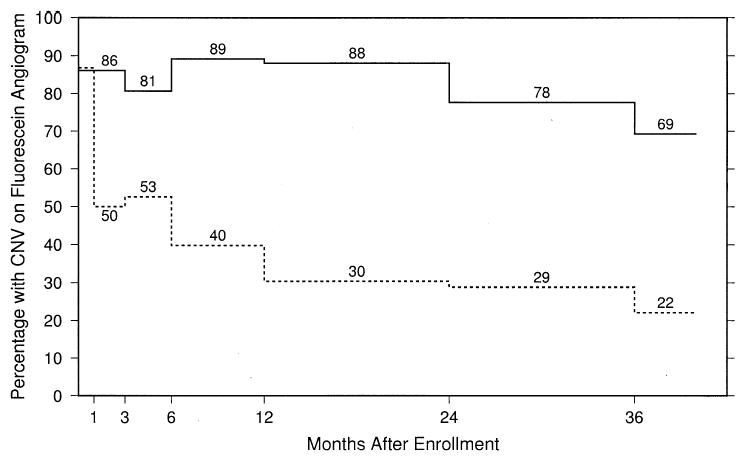
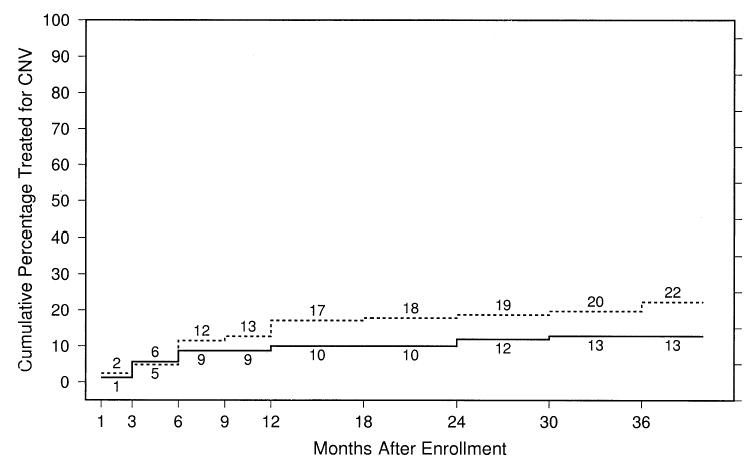
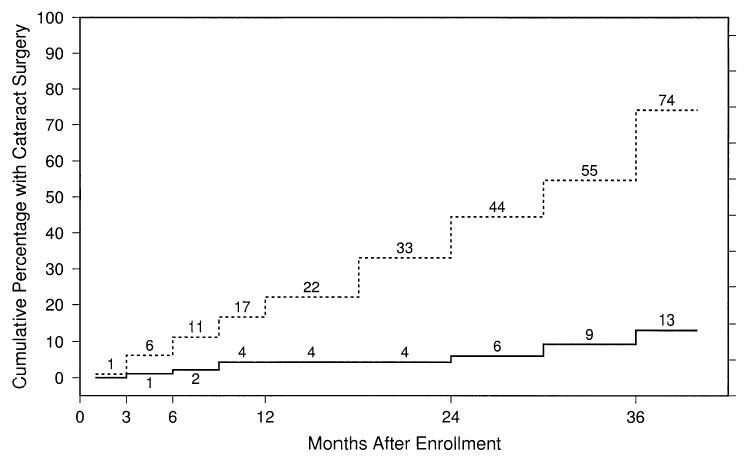
Results: Of 336 patients enrolled, 168 were assigned to each treatment arm; treatment arms were balanced by baseline characteristics. Of 1501 expected examinations 3 months through 36 months after baseline, 1370 (91%) were performed. Loss of > or =2 lines (> or =8 letters) of VA occurred in 56% of surgery eyes, versus 59% of observation eyes examined at 24 months. Although severe loss of VA was not the primary outcome of interest, surgery more often prevented such loss: 36% in the observation arm versus 21% in the surgery arm at the 24-month examination (chi2 P = 0.004). Of initially phakic eyes, the cumulative percentage that had undergone cataract surgery by 24 months was 44% in the surgery arm, compared with 6% in the observation arm. Twenty-seven eyes (16%) in the surgical arm, compared with 3 eyes (2%) in the observation arm, had a rhegmatogenous retinal detachment (RD).
Conclusions: Submacular surgery as performed in the SST Group B Trial did not increase the chance of stable or improved VA (the primary outcome of interest) and was associated with a high risk of rhegmatogenous RD, but did reduce the risk of severe VA loss in comparison with observation. This article contains additional online-only material available at http://www.ophsource.com/periodicals/ophtha.
Figures
Comment in
-
Submacular Surgery Trials.Ophthalmology. 2005 Nov;112(11):2055. doi: 10.1016/j.ophtha.2005.08.006. Ophthalmology. 2005. PMID: 16271325 No abstract available.
References
-
- Macular Photocoagulation Study Group. Subfoveal neovascular lesions in age-related macular degeneration. Guidelines for evaluation and treatment in the Macular Photocoagulation Study. Arch Ophthalmol. 1991;109:1242–57. - PubMed
-
- Treatment of Age-Related Macular Degeneration with Photodynamic Therapy (TAP) and Verteporfin in Photodynamic Therapy (VIP) Study Groups. Photodynamic therapy of subfoveal choroidal neovascularization with verteporfin: fluorescein angiographic guidelines for evaluation and treatment—TAP and VIP report no. 2. Arch Ophthalmol. 2003;121:1253–68. - PubMed
-
- Avery RL, Fekrat S, Hawkins BS, Bressler NM. Natural history of subfoveal subretinal hemorrhage in age-related macular degeneration. Retina. 1996;16:183–9. - PubMed
-
- Berrocal MH, Lewis ML, Flynn HW., Jr Variations in the clinical course of submacular hemorrhage. Am J Ophthalmol. 1996;122:486–93. - PubMed
Publication types
MeSH terms
Grants and funding
LinkOut - more resources
Full Text Sources
Medical
Miscellaneous
